2 Corinthians 11:14 “And no marvel; for Satan himself is transformed into an angel of light.”
In 2 Nephi chapter 2, Lehi tells Jacob there’s a punishment affixed that is opposite to the happiness prepared for the righteous. If you’re LDS and you think the punishment is Outer Darkness, you might want to reconsider.
For the rest of the chapter, Lehi teaches a dogma that points to Outer Darkness being the place of happiness.
In verse 11 he says, “For it must needs be, that there is an opposition in all things. If not so, my first born in the wilderness, righteousness could not be brought to pass, neither wickedness, neither holiness nor misery, neither good nor bad. Wherefore, all things must needs be a compound in one…”
In verse 13 he goes on to say that if there is no sin, there is no righteousness. For this reason, the Celestial Kingdom cannot be heaven. Where is the opposition and sin in the Celestial realm? It is absent. The people who go there get to spend eternity with their families in peace.
Outer Darkness on the other hand, is described as a place of weeping, wailing, and gnashing of teeth. What agony, what misery, what joy!
Still skeptical? What if I told you there’s no agency in the Celestial Kingdom? That’s right, the thing you fought so hard for in the pre-existence, will be gone.
Lehi explains this in verse 16, “Wherefore, the Lord gave unto man that he should act for himself. Wherefore, man could not act for himself save it should be that he was enticed by the one or the other.”
In context, Lehi is talking about the fruit of the Tree of Life vs the Tree of Knowledge of Good and Evil, but in LDS teaching this is an eternal principle. Agency requires that we be compelled by opposing forces.
Because there’s no sin or evil in the Celestial Kingdom, there’s no tension. Without opposition, it’s impossible to gain righteousness and continue on the path to eternal progression.
The people who go to the Celestial Kingdom are damned for eternity, because they cannot progress. They revert to an infantile state of innocence, having no joy because they know no misery, and doing no good because they know no sin (2 Nephi 2:23).
The fall of man is directly associated with joy in The Book of Mormon. 2 Nephi 2:25 says, Adam fell that men might be, and men are, that they might have joy.
In the next verse, we learn that God’s goal is to redeem us from the fall. Therefore, his plan is to eradicate our happiness.
Mormon theology ultimately portrays Outer Darkness as heaven, and Satan as the God of that realm. By taking 2 Nephi 2:25 to its logical conclusion, we learn that Satan also fell that men might be, and that they might have joy!
The opposition gospel twists the title of Adversary into a positive thing. It honors and glorifies Satan. If it’s true, then it is only in him, and through him that we become holy. We must follow Satan to harvest true joy.
If you’re LDS and you find this ridiculous, that’s because it is. Yet it’s what 2 Nephi teaches. If I may offer a solution, I implore you to embrace Biblical teaching instead.
Simply stated, righteousness does not need wickedness to exist. You do not have to be evil and miserable in order to be happy. The Bible draws a clear distinction between sin and holiness.
Romans 6:23 (KJV) says: For the wages of sin is death; but the gift of God is eternal life through Jesus Christ our Lord.
“A good sign of how secure you are is what it takes to offend you. The more secure we are, the less we take offense.” -Dr. Henry Cloud
Ghosting is something that happens in the dating world. It occurs when one person ends the relationship by disappearing off the face of the planet. The victim is left wondering where their partner went, why their calls aren’t being answered, and whether they did something to scare the person off. This practice is cheap, dirty, and unholy. Ironically, no one has mastered this better than the LDS version of the Holy Ghost.
After baptism, a new Latter-day Saint receives the gift of the Holy Ghost by the laying on of hands. The Holy Ghost becomes his lifelong companion. However, there’s a caveat to this companionship. Mormon Holy Ghost (henceforth referred to as MHG) is easily offended. And when MHG gets offended, he packs his bags and leaves.
Mormons claim that the Father, Son, and Holy Ghost are one in purpose. Yet in their pursuit to emulate God, you never see them wishing they were more easily offended. The reason is simple. Being easily offended is a negative trait. Everyone knows this. Yet the MHG is given a pass in the name of tough love.
What’s puzzling about the members of the Godhead being one in purpose, is how radically different Jesus and MHG are in their approaches. Jesus ate with sinners, and the Pharisees berated him for it. According to LDS doctrine, we should have expected the Holy Ghost to side with the Pharisees, if he wasn’t storming off in a rage.
The fact is MHG can’t stand the presence of sinners. Mormon apostle Dallin H. Oaks said, “The blessings available through the gift of the Holy Ghost are conditioned upon worthiness. ‘The Spirit of the Lord doth not dwell in unholy temples’. Even though we have a right to his constant companionship, the Spirit of the Lord will dwell only with us when we keep the commandments. He will withdraw when we offend him by profanity, uncleanliness, disobedience, rebellion, or other serious sins.”
In April of 2006 apostle David Bednar said, “The standard is clear. If something we think, see, hear, or do distances us from the Holy Ghost, we should stop thinking, seeing, or doing that thing. If that which is intended to entertain, for example, alienates us from the Holy Spirit, then certainly that type of entertainment is not for us. Because the Spirit cannot abide that which is vulgar, crude, or immodest, then clearly such things are not for us. Because we estrange the Spirit of the Lord when we engage in activities we know we should shun, then such things definitely are not for us.”
Rumors abound in the church about an extensive list of pet peeves that will set him off. These include contention of any kind, staying out too late, not wearing temple garments, swimming on Sundays, and a slew of other vague things.
It was explained to me as a young man, that if I walked into a bar I would forfeit the companionship of the Holy Ghost. Even if I had no intention of drinking, apparently. The problem is, if MHG can’t handle sinful places, then logically he can’t operate on earth. I suppose there’s always the temples, but even they have locks on their lockers.
God should be the bigger man, but the ball is always in our court with MHG. He gets offended by our actions and we have to make things right. We must repent to repair the relationship. He never stoops to our level to make things right.
My friends, it is not love that drives MHG to abandon us to the very teeth of sin when we need him the most.
The Bible describes love like this:
Love is patient, love is kind. It does not envy, it does not boast, it is not proud. It does not dishonor others, it is not self seeking. It is not easily angered, it keeps no record of wrongs. Love does not delight in evil but rejoices with the truth. It always protects, always trusts, always hopes, always perseveres (1 Corinthians 13:4, NIV).
Romans 5:8 says: But God demonstrates his own love for us in this: While we were still sinners, Christ died for us.
Praise God that although He had every right to ghost us, He did not leave us to our deserved fate. Instead of wrath, He gave love, not through abandonment, but by dying in our place.
Disclaimer: I have changed some of the wording in Romans 4 to fit with LDS concepts. Most notably, I changed circumcision to baptism. Obviously, Paul wasn’t talking about baptism in this chapter, but it is a suitable comparison because like circumcision, Mormons consider it an essential ordinance for receiving eternal life.
Despite some phrases being in Mormonese, the overall message of this chapter remains the same: we are not justified by anything we do. In fact, we are justified in our disobedience, while we are ungodly, and grace is a gift we do not deserve.
* * * *
What shall we say was gained by Abraham, our forefather?
2 For if Abraham was justified by obedience, he has something to boast about, but not before God.
3 For what does the Scripture say? “Abraham believed God, and it was counted to him as righteousness.”
4 Now to the one who keeps temple covenants, his blessings are not counted as a gift but as binding the Lord.
5 And to the one who does not keep temple covenants but believes in him who justifies the ungodly, his faith is counted as righteousness,
6 just as David also speaks of the blessing of the one to whom God counts righteousness apart from saving ordinances.
7 “Blessed are those whose lawless deeds are forgiven,
and whose sins are covered;
8 blessed is the man against whom the Lord will not count his sin.”
9 Is this blessing then only for the baptized, or also for the unbaptized? For we say that faith was counted to Abraham as righteousness.
10 How then was it counted to him? Was it before or after he had been baptized? It was not after, but before he was baptized.
11 He received the sign of baptism as a seal of the righteousness that he had by faith while he was still unbaptized. The purpose was to make him the father of all who believe without saving ordinances, so that righteousness would be counted to them as well,
12 and to make him the father of the baptized who are not merely baptized but who also walk in the footsteps of the faith that our father Abraham had before he was baptized.
13 For the promise to Abraham and his offspring that he would be heir of the world did not come through temple covenants but through the righteousness of faith.
14 For if it is the adherents of temple covenants who are heirs, faith is null and the promise is void.
15 For these covenants bring wrath, but where there is no law there is no transgression.
16 That is why it depends on faith, in order that the promise may rest on grace and be guaranteed to all his offspring—not only to the adherents of baptism but also to the ones who share the faith of Abraham, who is the father of us all,
17 as it is written, “I have made you the father of many nations”—in the presence of the God in whom he believed, who gives life to the dead and calls into existence the things that do not exist.
18 In hope he believed against hope, that he should become the father of many nations, as he had been told, “So shall your offspring be.”
19 He did not weaken in faith when he considered his own body, which was as good as dead (since he was about a hundred years old), or when he considered the barrenness of Sarah’s womb.
20 No unbelief made him waver concerning the promise of God, but he grew strong in his faith as he gave glory to God,
21 fully convinced that God was able to do what he had promised.
22 That is why his faith was “counted to him as righteousness.”
23 But the words “it was counted to him” were not written for his sake alone,
24 but for ours also. It will be counted to us who believe in Him who raised from the dead Jesus our Lord,
25 who was delivered up as a proxy for our trespasses and raised for our justification.
Ask a Latter-day Saint about their faith, and they’ll proudly proclaim that God has given them new scripture. In addition to the Bible, they have The Book of Mormon, the Doctrine and Covenants, and the Pearl of Great Price. Their modern-day prophets and apostles also speak scripture over the pulpit twice a year at General Conference.
In a recent article entitled, “Why the Bible Needed to be Rescued” LDS blogger Greg Trimble argues that the Bible is not complete. He says, “So, when someone says the Bible is complete, my question is, where did they get that from? Who said that God was going to stop talking to us through prophets? Why would He? He’s been doing it since the day he dropped a garden in Eden… so why would He stop now when we need it the most?”
When I was a Latter-day Saint this was my trope as well. Why would a loving God stop talking to us? It didn’t make sense. However, if we turn the tables, we will see that an open canon is more problematic than a closed one.
Imagine that a book came out called, “Everything You Need to Know about Marriage.” Then, a year later volume 2 came out. A year later volume 3 made the New York Best Sellers list. What would this do to the original title? Would it save it, like The Book of Mormon supposedly saves the Bible? No. These new volumes would undermine the original book, because clearly, it does not teach us everything we need to know about marriage.
This is exactly what The Book of Mormon does to the Bible: it weakens it. By adding new revelation to the equation, the LDS church says the Bible is insufficient. The Book of Mormon is subsequently weakened by the Doctrine and Covenants, and it by the Pearl of Great Price. All these religious texts are weakened by modern Mormon prophets.
According to Wilford Woodruff, Brigham Young once took the stand, laid out the LDS scriptures, and said, “There is the written word of God to us, concerning the work of God from the beginning of the world, almost to our day. And now, when compared with the living oracles those books are nothing to me; those books do not convey the word of God direct to us now, as do the words of a Prophet or a man bearing the Holy Priesthood in our day and generation. I would rather have the living oracles than all the writing in the books (Conference Report, October 1897, p.22).”
In Mormonism, the dead prophets are weakened by the living prophet. In October of 1990, President Hinkley gave a talk entitled, “Mormon Should Mean ‘More Good’” in which he quoted a missionary saying, “While I’m thankful for the privilege of being a follower of Jesus Christ and a member of the Church that bears His name, I am not ashamed of the nickname Mormon.”
Hinkley and his successor President Monson both pushed for the famous “I’m a Mormon” campaign. But when Russell M. Nelson became the prophet, all that was hewn down. In October of 2018 he gave a talk entitled, “The Correct Name of the Church” wherein he said that using the nickname Mormon is “a major victory for Satan”.
As long as new scripture is able, not only to add to old scripture, but to contradict it, an open canon is worthless because we never know what’s coming that might obliterate something we believe in now. With an open canon, there’s no guarantee that even gospel basics won’t be changed somewhere down the road.
The Book of Mormon’s subtitle is “Another Testament of Jesus Christ.” It is championed as being a second witness to support the stories of the Old and New Testaments. The reality, though, is far different. It claims that many plain and precious things were taken out of the Bible, and because of that, “an exceeding great many do stumble, yea, insomuch that Satan hath great power over them.” (1 Nephi 13:29)
This statement only serves to weaken the Bible, to say that it has the story wrong, and that it’s insufficient. To say The Book of Mormon came to its rescue, is like saying a lifeguard jumped into the pool and rescued someone by drowning them.
Another verse I used to cite as a Latter-day Saint was John 21:25 which says: And there are also many other things which Jesus did, the which, if they should be written every one, I suppose that even the world itself could not contain the books that should be written. Amen.
I was convinced that John 21:25 supported the need for more scripture, but here’s the dilemma. If so many books were written that the world was filled, all those books could not be read. So, while it’s emotionally satisfying to think we deserve modern scripture, it isn’t very practical.
With a closed canon, God’s word is succinct. It is powerful. It can’t be altered by the whims of a false prophet. To say we need an endless quantity of God’s word, is to say there’s no quality in God’s word, and that simply isn’t true. So no, The Book of Mormon did not rescue the Bible. On the contrary, the Bible rescues us from The Book of Mormon and everything else that corrupts the gospel of Christ.
“And he said unto me: Behold, there are save two churches only; the one is the church of the Lamb of God, and the other is the church of the devil; wherefore, whoso belongeth not to the church of the Lamb of God belongeth to that great church, which is the mother of abominations; and she is the whore of all the earth.“1 Nephi 14:10
This is perhaps the truest statement in The Book of Mormon. There are only two churches: the church of God, and the church of the devil. But how do we differentiate between the two?
Doctrine and Covenants 18:5 sheds some light on this. It says: Wherefore, if you shall build up my church, upon the foundation of my gospel and my rock, the gates of hell shall not prevail against you.
In other words, the gospel and the church are fundamentally connected. Thus, a true church cannot have a false gospel, and vice versa. By honing in on the gospel itself, we can determine whether a church is from God, or of the devil. It should come as no surprise that there are only two gospels: amputation and imputation.
The gospel of amputation says we cannot be saved in sin, so we must eradicate it from our lives to be worthy. Imputation is the opposite. Instead of taking something off, it’s about putting something on, namely the righteousness of Christ. This gospel teaches that we can be saved despite our sins, because Christ’s worthiness is accredited to us vicariously.
At their most basic definitions, one gospel says man participates in his salvation, the other says we do not. Thus, the truth cannot exist outside these dimensions, and it cannot be a combination of the two as that would be a contradiction.
The Amputation Heresy
A Latter-day Saint might argue that their covenants and ordinances place them outside the bounds of amputation theology. However, there are two types of sin. There are sins of omission and commission, so in order to amputate sin from our lives, not only must we stop doing bad things, we must stop not doing good things. Since LDS covenants are considered good things that are required to gain the presence of Heavenly Father, they fall directly in line with amputation.
Some Latter-day Saints have adopted the idea that imputation occurs at some point on their journey to exaltation, like at baptism. The problem with this is Jesus is an infinite being of infinite righteousness, and infinity can’t be divided. The moment Jesus gives us any percentage of His righteousness, He gives it all. So, if imputation occurs at baptism it negates the need for any ordinances afterward. To say otherwise is to deny the total worthiness of Christ.
Even if Latter-day Saints embrace imputation, they still fall under the dominion of amputation theology because imputation cannot occur until man does something first.
With amputation theology, your worthiness hinges on your obedience. So as long as you have sin in your life, you’re in trouble. With imputation, sin doesn’t harm salvation, because worthiness hinges on faith.
This puts a damper on LDS efforts to say we believe the same thing. In fact, the divide between these gospels is so great that Mormons have more in common with every religion on earth than with Biblical Christianity.
This is a major problem, because in Galatians 1:8 Paul says, “But even if we or an angel from heaven should preach to you a gospel contrary to the one we preached to you, let him be accursed.” In Galatians 5:4 he says, “You are severed from Christ, you who would be justified by the law; you have fallen away from grace.”
When Paul spoke about the law and grace, he was talking about amputation vs imputation. Even though Latter-day Saints don’t follow the law of Moses, Paul’s statements still condemn them on principle.
Romans 3:19-20 says: Now we know that whatever the law says it speaks to those who are under the law, so that every mouth may be stopped, and the whole world may be held accountable to God. For by works of the law no human being will be justified in his sight, since through the law comes knowledge of sin.
The law reveals God’s standards, and is meant to stop our mouths and make us guilty before Him. Ironically, the covenants of the restored gospel do exactly the same thing. And assuming God doesn’t change, whether He reveals His standards through the law or LDS covenants, it still condemns us.
The gospel of amputation is an impossible gospel, because no matter how hard we try we can never eradicate the sin from our lives. 1 John 1:8 says: If we say we have no sin, we deceive ourselves, and the truth is not in us.
Thus, a gospel that can’t save us despite our sins cannot save us at all.
The Gospel of Imputation
In Romans 3:23-25 Paul writes, “For all have sinned and fall short of the glory of God, and are justified by his grace as a gift, through the redemption that is in Christ Jesus, whom God put forward as a propitiation by his blood, to be received by faith.”
There are a number of doctrines being stated here. None of us are up to achieving God’s perfect standard, and as a result we are pronounced guilty. God’s grace is given as a gift to us, even though we don’t deserve it. And grace is received through faith. There is no mention of baptism, endowment, or temple sealings.
In Romans 4:4-5 Paul says, “Now to the one who works, his wages are not counted as a gift but as his due. And to the one who does not work but believes in him who justifies the ungodly, his faith is counted as righteousness.”
The message is simple. Faith is not an action word that includes LDS covenants or obedience. It is completely separate from anything we do. If we will just believe, we will be counted righteous.
Of course, the Joseph Smith translation of the Bible corrupts Romans 4:5, changing it to say that God does not justify the ungodly. Not only does this go against the context of Romans 4, it doesn’t make sense. Why would God need to justify the godly anyway?
During his ministry, Jesus said, “Those who are well have no need of a physician, but those who are sick. Go and learn what this means: ‘I desire mercy and not sacrifice.’ For I came not to call the righteous, but sinners (Matthew 9:12-13).”
The restored gospel is a doctrine of sacrifice. Latter-day Saints must abstain from tea, coffee, and alcohol. They must sacrifice 10% of their incomes to the church. They must sacrifice Sunday as a holy day to the Lord. In the temple, Latter-day Saints covenant to consecrate their time, talents, and anything else the Lord has blessed them with, to the Church of Jesus Christ of Latter-day Saints.
Joseph Smith said, “A religion that does not require the sacrifice of all things, never has power sufficient to produce the faith necessary unto life and salvation (Lectures on Faith 6:7).” This is not the gospel taught in the Bible. Jesus doesn’t require a gospel of sacrifice. He gave us a gospel of mercy.
Here’s the million-dollar question for Latter-day Saints. If there are only two churches, and only two gospels for these churches to be founded on, then where does that leave you? Either Christianity is true, and you believe in a false gospel, or you are right and so is every other religious group on earth that teaches man must do something. Either way, it’s a lose-lose proposition, because the gospel you claim was restored already existed long before Mormonism came on the scene.
I am going to start by repeated my opening statement that I made in my article pertaining to the 3 Witnesses:
“When talking about the reliability of Joseph Smith’s testimony of the gold plates and the Book of Mormon, a big pillar of truth for LDS members is what is written in the first couple pages of the Book of Mormon: the testimony of the 3 witnesses and the testimony of the 8 witnesses. Bible based Christians will often claim that one of the best reasons to believe in the resurrection is the fact that we have eyewitnesses who saw the risen Christ and then wrote about it. These written testimonies are in our Bible today. Latter Day Saints like to draw the same comparison in regard to the witnesses of the gold plates. Let’s compare these two groups and see where the evidence leads. Let’s start by listing the witnesses of the gold plates and their relation to Joseph Smith:
Martin Harris – JS’s business associate (sold his farm to publish BOM. Would have lost everything if the BOM plan failed. Very financially motivated for it to succeed)
Oliver Cowdry – JS’s cousin
Jospeh Smith Sr – JS’s father
Samuel Smith – JS’s brother
Hyrum Smith – JS’s brother
John Whitmer – Brother of David Whitmer.
Jacob Whitmer – Brother of David Whitmer.
Christian Whitmer – Brother of David Whitmer.
Peter Whitmer – Brother of David Whitmer.
David Whitmer – Close friend with Cowdry.
Hiram Page – David Whitmer’s brother in-law
First thing right off the bat that we have to recognize is that all of these people are related to Joseph Smith either by blood or by business. Because of these tight connections, a skeptic might call out the obvious possibility of collusion.”
In a nutshell, there are a number of statements given by the 8 witnesses that indicate they only saw the angel and the plates in a visionary experience. But this begs the question: If the gold plates were real, why would these witnesses need to see them in a vision when the gold plates were physically here on earth in Joseph Smith’s possession?
There are also several statements of the witnesses saying that they only saw the plates when they were covered with a cloth. It is also important to note that by 1847, not a single one of the surviving eleven witnesses was part of the LDS Church. Of the 8 witnesses, we only have clear quotations from 2 of them that we can glean from. Let’s begin examining their statements:
John Whitmer. “I now say, I handled those plates; there were fine engravings on both sides. …they were shown to me by a supernatural power.” (History of the Church, Vol. 3, p. 307) Again, why would a supernatural power be necessary if the plates physically existed in Joseph Smith’s house? Why wouldn’t Smith simply invite them inside to take a look at the gold plates?
Marvin Hill (faithful LDS historian) commented on a letter written by Hiram Page to the Ensign of Liberty in 1848. In it, Page defended his belief that the Book of Mormon was a work of the Lord. However, Hill conceded that Page did not actually say he saw the plates:
“With only a veiled reference to ‘what I saw,’ Page does not say he saw the plates but that angels confirmed him in his faith. Neither does he say that any coercion was placed upon him to secure his testimony. Despite Page’s inconsistencies, it is difficult to know what to make of Harris’ affirmation that the eight saw no plates in the face of John Whitmer’s testimony.”
This last one is related to Martin Harris. I know Harris isn’t in the category of the 8 witnesses, but the importance of this detail makes it worth mentioning. Stephen Burnett was ordained an elder by John Whitmer and ordained a high priest by Oliver Cowdry. Burnett wrote a letter to Lyman E. Johnson in 1838 and makes mention of Martin Harris. In this letter, Burnett reported that Harris once told him that,
“he had hefted the plates repeatedly in a box with only a tablecloth or a handkerchief over them, but he never saw them only as he saw a city through a mountain. And said that he never should have told that the testimony of the eight was false.”
Burnett went on to say,
“I am well satisfied for myself that if the witnesses whose names are attached to the Book of Mormon never saw the plates as Martin admits that there can be nothing brought to prove that any such thing ever existed.”
Needless to say, Burnett apostatized and was excommunicated from the Church. But I think I think it is super important to note why he left. It was because of the very topic we are discussing. Being very close to Martin Harris, listening to the things he said, and realizing that the 11 witnesses are nothing more than a group of people who claim to have had a spiritual visionary experience of seeing gold plates. He realized how shady that is and it understandably broke his faith.
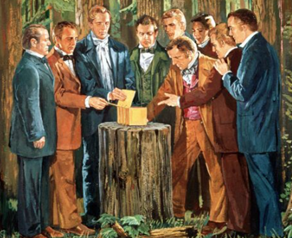
When latter day saints today grow up with the visualization that the witnesses physically handled the plates as the Book of Mormon testimonies state, and that the 8 witnesses saw the gold plates on a tree stump and each turn turns flipping the gold pages, it can be a very brutal wake up call when they realize that this is not at all how it happened. Yet there are pictures on the LDS Church website depicting that this is how it happened.
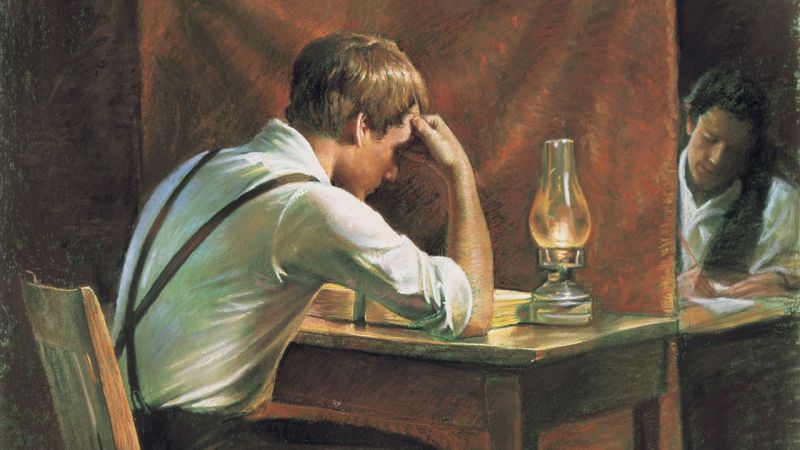
This similar situation is applicable to Joseph Smith translating the gold plates. Many Latter Day Saints grew up believing what is portrayed on the Church website today: a picture of Smith sitting down at a desk and diligently examining the gold plates. We know that this isn’t how it happened. Emma Smith attests that the gold plates weren’t even in the room while other close testimonies say that they were occasionally in the room but were covered with a cloth. Either way, the portrayal that this picture gives us never happened.
These examples can be viewed as the LDS Church leaders being intentionally misleading and dishonest by allowing these pictures to be portrayed on their website, when they know full well that it is not the case.
Did the eyewitnesses of the risen Christ ever change their testimony?
They did not and that is one primary difference between the eyewitnesses of the risen Christ and the eyewitnesses of the gold plates. I encourage you to study and dig deeper the New Testament gospels of Jesus. I assure you that we can trust the words of Jesus and his apostles.
Please let me know your thoughts, things you appreciated or things that you disagreed with in the comment section below. Thank you for reading and God bless!
In one of my other posts, called “How Did We Get The Book Of Mormon?” (https://jllds.org/2023/12/21/how-did-we-get-the-book-of-mormon-pt-1/), I mentioned a discussion that I had with one of my missionary friends. After I gave him my answer, he responded and said, “How then do you go about explaining the geographic specifications that are mentioned in the BOM? Did Joseph Smith just happen to get super lucky in getting all of those things correct when he was on the other side of the world and talking about things that happened 2000+ years ago?”
In any case, both the BOM and Bible can’t be proven to be 100% true by evidence, especially in regard to the miracles and specific details of the stories within. But in regard to the people and tribes mentioned, and also in regard to the cities that are mentioned, those things can be legitimately proven! To give us a baseline, let’s start with a few of the archeological discoveries related to the Bible:
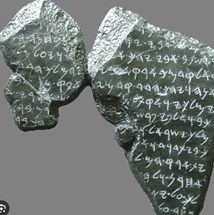
The Tel Dan Stele: This ancient tablet dates back to roughly 800 BC. The phrase “house of David” is mentioned on it. This just goes to show that the Biblical writers weren’t fabricated this dynasty. The house of David that is referenced in the Old Testament is something that actually existed in history.
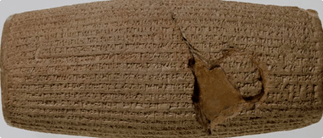
2. The Cyrus cylinder: King Cyrus of Persia wrote on this horizontal clay jar about how he allowed his slaves to return to home and rebuilt their sanctuaries for their gods. In Ezra chapter 1, we read about the same guy (king Cyrus) and it says that Cyrus allowed the Israelites to return to Jerusalem and rebuild their temple for Yahweh, the one true God. That’s external and secular archeology that directly supports a person, a place, a tribe and an event that is referenced in the Bible.
3. The Moabite Stone: This was written by the king of Moab. He writes about how the king of Israel oppressed them (the Moabites) for a long time. Then they eventually rebelled and conquered Israel. The Bible talks about this same event in 2 Kings 3:4-7. This is also important because here we have clear external evidence from an enemy of Israel which verifies that the nation of Israel and Moab were actual historical people groups in history and not just tribes that the Biblical writers fabricated.
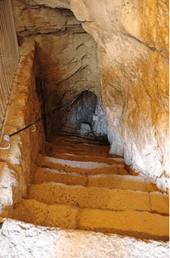
4. In 2 Kings 20:20, we read about King Hezekiah and how he built a tunnel for a better water source when he was king of Israel. That tunnel has been discovered, confirmed and excavated.
5. The pool of Siloam is mentioned in John 9:7 when Jesus healed the blind man. That has been discovered as well!
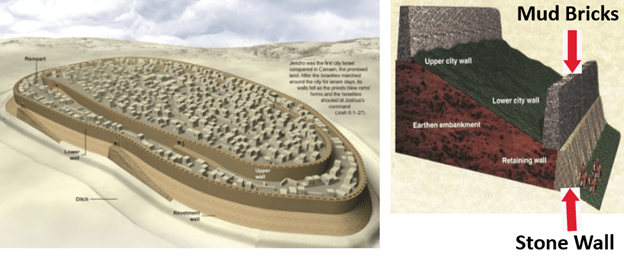
6. The picture above (left side) is what Jericho used to look like: a heavily fortified city that was surrounded by an impenetrable wall. In the right picture, you’ll notice that the wall is divided into two sections: bricks on top and stones on the bottom.
This is what Jericho looks like today. Both secular and Christian scholars agree that this is the geographic location of Jericho. As you can see in the pictures above, the bottom section of the wall is still standing thousands of years later! When archeologists first discovered this location, they dug at the base of the stone wall only to find the crumbled remains of the bricks that were once standing on top of the stones. Again, both secular and Christian scholars agree that there was an outside tribe that laid siege against Jericho which is undoubtably what caused those mighty walls to come tumbling down…just as the Bible describes.
7. Many of the cities that are mentioned in the Bible are still on maps today.
8. Rivers and seas mentioned in the Bible are still on maps today: Sea of Galilee, the Dead sea, Jordan river, Red Sea, .
9. We read in Genesis that the Garden of Eden was near the Tigris and Euphrates Rivers. Those rivers still exist to this day in Africa.
10. All scholars agree that the disciples of Jesus were real people and that Paul was a historical person. Most, if not all the places that Paul visited on his missionary journeys have been confirmed by all historians to be real places as well.
Now that we have some examples of what constitutes as legitimate geographic and archeological evidence, let’s pivot to the Book of Mormon and the archeological evidence that it has to offer. Dee Green and Thomas Ferguson were two of the earliest archeologists who worked for the department of archeology at BYU as faithful members of the LDS Church. After years of research, here is what Dee Green had to say on the matter:
“The first myth we need to eliminate is that Book of Mormon archaeology exists… If one is to study Book of Mormon archaeology, then one must have a corpus of data with which to deal. We do not… Biblical archaeology can be studied because we do know where Jerusalem and Jericho were and are, but we do not know where Zarahemla and Bountiful, nor any other location for that matter, were or are.” (A Journal of Mormon Thought, 1969. Pg 76-78)
Thomas Ferguson was also very dedicated to finding archeological evidence for the Book of Mormon. In the end, here is what he said:
“With all of these great efforts, it cannot be established factually that anyone has put his finger on a single point of terrain that was a Book-of-Mormon geographical place. And the hemisphere has been pretty well checked out by competent people. Thousands of sites have been excavated…Evidence of the foregoing animals has not appeared in any form — ceramic representations, bones or skeletal remains, mural art, sculptured art or any other form. The zero score presents a problem that will not go away with the ignoring of it. The absence of such evidence…is distressing and significant…I’m afraid that up to this point, I must agree with Dee Green, who has told us that to date there is no Book of Mormon geography. I, for one, would be happy if Dee were wrong.” (Written Symposium on Book-of-Mormon Geography, 1975, pg 4)
A year later, Fergeson proceeded with further details: “The real implication of the paper is that you can’t set Book of Mormon geography down anywhere–because it is fictional and will never meet the requirements of the dirt-archeology. I should say –what is in the ground will never conform to what is in the book.” (Letter to Mr. & Mrs. Lawrence, 1976)
A professor at BYU named Ray Matheny also stated:
“While some people choose to make claims for the Book of Mormon through archaeological evidences, to me they are made prematurely, and without sufficient knowledge…I would feel terribly embarrassed if anyone sent a copy of any book written on the subject (supporting archeology for the BOM) to the National Museum of Natural History – Smithsonian Institution, or other authority, making claims that cannot as yet be substantiated.…there are very severe problems in this field in trying to make correlations with the scriptures. Speculation, such as practiced so far by Mormon authors has not given church members credibility.” (Letter by Ray T. Matheny, dated Dec. 17, 1987)
Here are three faithful LDS members who have dedicated much of their live to discovering legitimate archeology for the Book of Mormon. But in their painful and honest admission, they both state that there is absolutely no archeological evidence that supports the existence of the people, cities, tribes and events listed therein. And these two men aren’t alone. This has happened to a number of Latter-Day Saints who set out on a sincere mission to prove the geography for the Book of Mormon. But then they end up realizing…there’s nothing. For many, it breaks their faith. Even current apologetic sources like Fair Latter Day Saint made this statement:
The Book of Mormon talks about the big battle between the Lamanites and the Nephites on the Hill Cumorah. The LDS Church has a visiting center today for the Hill Cumorah, which is located in Manchester, New York. (screenshot below)
There were allegedly millions of people who fought against each other during this last battle, yet no artifact, shield, sword, tablet, or verification of any kind has ever been discovered. But here is the kicker: we apparently “know” the general vicinity of where the battle of Hill Cumorah took place, right? The LDS Church confirmed this in the following letter:
“The Church has long maintained as attested to by references in the writings of general authorities, that the Hill Cumorah in western New York state is the same as referenced in the Book of Mormon (Ether 15:2).” (General Authority Michael Watson, 1990, Letter to Bishop Brooks)
If I was a Church leader, I would be searching every nook and cranny on that hill to prove to the world that the Book of Mormon is true. And guess what? This is exactly what the LDS Church did. After their search, they quietly released their findings:
“In accord with these general observations about New York and Pennsylvania, we come to our principal object—the Hill Cumorah. Archaeologically speaking, it is a clean hill. No artifacts, no walls, no trenches, no arrowheads. The area immediately surrounding the hill is similarly clean. Pre-Columbian people did not settle or build here. This is not the place of Mormon’s last stand. We must look elsewhere for that hill.” (BYU Publication – John E. Clark, “Archaeology and Cumorah Questions”, Journal of Book of Mormon Studies, Volume 13, Number 1, p.151 (July 31, 2004);
Much of this can be boiled down to this one critical thought:
Am I really supposed to believe that the same God inspired both of these books?
Is it wise for me to believe that God would really be that inconsistent and say, “My first book is going to have so much archeological evidence even atheists will be convinced of its validity and come to Christ (which there are many testimonies of)…while my 2nd book is going to have so little evidence that it’s going to cause many strong believers to lose their faith and walk away from my Church?”
I know that God isn’t asking us to know the answers to every single question in life, but he has given us a mind and he expects us to use it. One of the things I love most about Christianity is that it is the farthest thing from a blind faith. There are so many good reasons to trust the Bible to be a compilation of legitimate and historical documents with events that actually took place and people who actually lived! For evidence supporting that the Bible we have today is trustworthy and reliable, feel free to check my article: “Has The Bible Been Accurately Preserved Over Time.” https://jllds.org/2023/12/15/has-the-bible-been-accurately-preserved-over-time/
When it comes to these the Bible and the Book of Mormon, there is no competition for which one has more external and archeological support for his historicity and validity. Yet we see the Book of Mormon (1 Nephi 13:28) stating that many plain and precious truths have been removed from the book of the Lamb/Bible, implying that we can’t fully trust what it says because it has basically been tampered with and corrupted to an extent. Doesn’t it seem very much backwards that the book with little to no evidence is criticizing the book with overwhelming evidence?
I know it might sound ridiculous if you have been raised in the LDS Church your whole life…but if you are an LDS member, I want to invite you to entertain the idea and ponder this question:
If God was leading you out of the LDS Church, would you honestly be willing to follow him?
Please let me know your thoughts, things you appreciated or things that you disagreed with in the comment section below. Thank you for reading and God bless!
An LDS missionary friend of mine once asked me, “Paul, I got a question for you: Where do you believe the Book of Mormon came from?” To start, we know that Joseph Smith was the seer/translator while Oliver Cowdry, John Whitner and Emma Smith were the scribes. However, I believe that a fair and unbiased position for us to start at would be admitting that no one 100% knows where Joseph Smith got most of the Book of Mormon from. This is largely because no supporting manuscript or plate has ever been discovered, unlike the Bible which has over 26,000 manuscripts for the New Testament alone.
In any case, we can start by examining the source of the Book of Mormon. What do we know about Joseph Smith and his background? To start, we know that he was a poor farm boy and that his family was destitute. This is one factor that led both Joseph and his father into the business of treasure digging. Church history also tells us that Smith and his family were also into folk magic and occultic like practices. There are accounts of Smith and his dad killing dogs and sprinkling its’ blood to appease the spirits that were “guarding the buried treasure” in hopes that the spirit would allow them to take the treasure. Below are a few quotes from LDS history on the matter:
“The facts are that the sacrifice of white dogs, black sluts, black cats, and such like was an indispensable part or appendage of the art which Smith, the embryo prophet, was then practicing.” (Early Mormon Documents, Dan Vogel, 4:308-309)
“For in the time of their digging for money and not finding it attainable, Joe Smith told them there was a charm on the pots of money, and if some animal was killed and the blood sprinkled around the place, then they could get it. So they killed a dog and tried this method of obtaining the precious metal; Still, they dug and dug, but never came to the precious treasure.” (Life Among the Mormons, Emily M Austin, 1882).
When Smith found a seer stone, it was right up his ally. He would then convince others that he was a seer and charge them money in exchange for him using his seer stone to help them find the buried treasure.
He would tell his customers where to dig, and after digging all around that area for a very long time, Smith would then look into his hat again to verify where the treasure was located. But there was a problem: As he lifted his head from the hat, he would say something along the lines of, “Sorry guys. The spirit caused the treasure to sink deeper into the earth…but we were so close!” Smith was never able to come through and find any treasure for any of his paying customers. Below are a few quotes on this:
“On accounting of an enchantment, the trunk (treasure) kept settling away from under them while digging.” (Docket Entry from a court hearing, 1826)
“He (Isaiah Stowell) positively knew that the prisoner (Joseph Smith) could tell, and professed the art of seeing those valuable treasures through the medium of said stone…that said Stowell and prisoner thereupon commenced digging, found a tail-feather, but money was gone; that he supposed that money moved down (sank into the earth);” (Miss Pearsall’s account of Josiah Stowell’s statement)
This question must be considered:
If Smith was poor and if he had a magic seer stone that truly could guide him to find the buried treasure…why wouldn’t he just go and dig up the treasure for him and his family?
Moving on, Smith eventually met Emma. Smith asked Emma’s dad for his daughter’s hand in marriage. Emma’s dad believed that Smith was a con man. He did not approve of Smith’s treasure digging business and believed that he was intentionally fooling people into giving him their money. But Joseph and Emma eloped and got married anyways. After this happens, Smith returns and is in the process of moving Emma’s things from her parent’s house. Joseph Smith hired a young man named, Peter Ingersoll to help him move the furniture and records a conversation that took place between Joseph and Emma’s father.
READ THIS VERY CLOSELY!
“In the month of August, 1827, I was hired by Joseph Smith, Jr. to go to Pennsylvania, to move his wife’s household furniture up to Manchester, where his wife then was. When we arrived at Mr. Hale’s, in Harmony, Pa. from which place he had taken his wife, a scene presented itself, truly affecting. His father-in-law [Emma’s dad] addressed Joseph, in a flood of tears: “You have stolen my daughter and married her. I had much rather have followed her to her grave. You spend your time in digging for money – pretend to see in a stone, and thus try to deceive people.” Joseph wept, and acknowledged he could not see in a stone now, nor never could; and that his former pretensions in that respect, were all false. He then promised to give up his old habits of digging for money and looking into stones.” (Peter Ingersoll, 1833)
To summarize: Emma’s dad calls Smith out for scamming people and pretending to be able to use the seer stone, and then Smith admits to it. That he had been deceiving people and pretending to use a seer stone but was never actually able to use it.
With this background in mind, we can now pivot and move on to the translation of the Book of Mormon. Smith claims that an angel Moroni appeared to him. Moroni told him where the gold plates are buried. Smith goes to the hill Cumorah to get the gold plates but Moroni would not allow Smith to take the gold plates yet. Think of the parallel here:
Instead of treasure being guarded by spirits, Smith is now telling us that there are gold plates that are being guarded by an angel. A skeptic might connect the dots and say, “Well, it looks like Smith just took the scenario from treasure digging and repackaged it in a religious wrapping.”
After Smith received the gold plates, he translated the Book of Mormon then Moroni took the gold plates up to heaven without a trace. Yet another parallel with treasure digging: First, we have guardian spirits that could move the treasure so that it can’t be found, and now we have an angel taking the gold plates so that they can’t be found.
When translating the Book of Mormon, Smith didn’t even look at the gold plates. Once again, he used the same seer stone in the hat. The biggest concern here is this: if Smith previously admitted to being a fraud, is it wise for us to trust that now all of the sudden, Smith can accurately and divinely use this same seer stone when it failed to find him any treasure before? If he deceived people and pretended to have the ability to use the seer before, what reason do we have to trust him now?
In connection to Smith being poor and destitute: his business associate, Martin Harris, sold his farm to publish the Book of Mormon. Here we have two primary people who are highly motivated by finances for this religious book to succeed. Just after writing the BOM in 1830, Smith even tried to sell the copy wright in Canada but was unsuccessful. On this matter, former BYU professor Marvin Hill writes:
“The economic situation of the Smith families was so desperate at this time that Joseph tried to sell the copyright of the Book of Mormon…Page indicated that they hoped to get $8,000 (equivalent to $272,500 today) for the copyright and that they traveled to Canada covertly to prevent Martin Harris from sharing in the dividend. Smith evidently believed that Harris was well enough off while his own family was destitute.”
Then the last thing I have to touch on is how this story of how Smith translating the BOM was portrayed to LDS members before the internet and also how it is still being portrayed to investigators today. LDS missionaries have a set of pamphlets that they hand out to people. One of them is called “The Restoration of the gospel of Jesus Christ.” It briefly talks about Smith translating the BOM and says, “By the power of God, Joseph Smith translated this book from an ancient record written on gold plates.” In people’s minds, this naturally leads them to picture Smith sitting at a desk while diligently studying and translating the gold plates.
This picture above is currently on the Church website today. The name of the article is: “Joseph Smith Translates the Gold Plates.” However, Emma Smith specifically stated that the gold plates weren’t even in the same room when Smith was translating the BOM. This picture never happened. The LDS Church leaders never publicly came clean to their members by stating that Smith used a seer stone in a hat until after 2010. The seer stone and the hat are very often omitted by missionaries unless the investigator brings it up.
I once asked a missionary, “How did Smith translate the Book of Mormon?” He responded by asking, “What do you know about it?” The thought entered my mind, “Does the way you answer my question depend on what I am aware of?” I was honest with him and said that I know about the seer stone and the hat, but if I was someone who hadn’t done any research on the topic, would he have mentioned the seer stone at all? I don’t know the answer to that question, but I do know that if investigators were aware of how this translation process accurately took place, then that would significantly decrease the number of converts to the LDS Church…and the LDS Church leaders obviously don’t want that to happen.
This brings us back to my beginning point: we can’t say for sure where Smith might have gotten his ideas from. He might not have been super intellectual or formally educated, but he could have been very street savvy. The evidence for this lies in the fact that he was able to fool people into believing that he was a real seer who could find treasure. It takes people skills and charisma to have the ability to convince people that you are the real deal when you are truly a fraud.
While we can’t say for sure where Smith got most of the BOM from, we do know for sure where he got some of it from: the King James Bible. Specifically, chapters from Isaiah that are recorded in 2 Nephi. In the King James Bible, there are a couple verses in these chapters where the translators mistranslated a word.
Example: Isaiah 2:16 “And upon all the ships of Tarshish, and upon all pleasant pictures.”
The misinterpreted word at the end is “pictures,” but it should be “ships.” There are some other unique errors like this that are only found in the King James Bible. We know that Joseph Smith took these passages right out of the King James Bible and pasted them into the Book of Mormon because the 1830 version of the Book of Mormon had these exact same errors. The Book of Mormon has had over 3,000 changes since it was published in 1830. In the current 2013 edition, those errors have been fixed. But if God truly gave Smith those gold plates, and if Smith truly had the gift of translating them, it would seem to make sense that those identical errors wouldn’t be there in the BOM.
Instead of asking, “Where did the Book of Mormon come from?” I think a better question we should ask is this:
Is it wise for me to trust that what Joseph Smith has presented was truly from God? Or was it another scam?
I encourage you to put for trust in the Word of God, and not in the words of men claiming to speak on behalf of God. Thank you for reading, God bless and remember to never stop chasing after Jesus!
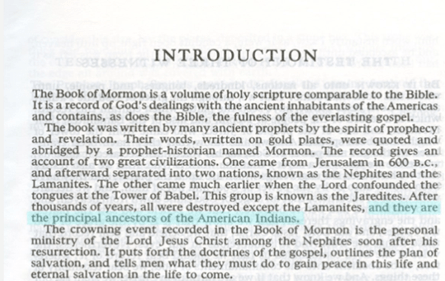
In 2005 and all years prior, the BOM Introduction page read, “all were destroyed except the Lamanites, and they are the principal ancestors of the American Indians.” But if you look in your Book of Mormon starting in 2006 and onward, it now reads: “all were destroyed except the Lamanites, and they are among the ancestors of the American Indians.”
So let that just sink in for a minute. That introduction page originally read that “the Lamanites are the principal ancestors of the American Indians” and then for some reason in 2006, the LDS Church decided to slightly change the wording to, “The Lamanites are AMONG the ancestors of the American Indians.” If I was a Latter Day Saint shoes, I would be curious enough to ask the questions:
Why did they make that change?
And why did they choose to make this change in 2006?
I think the timing of this change is important because if we understand the recent events that led up to this change, I think it can help shed light on why the change may have occurred.
Leading up to this change, people tested the DNA of the Indians and Mayans. The LDS Church was eager about this as they were seeking for evidence to demonstrate that the Book of Mormon was legitimate history. If they could prove that Native Americans genetically originated from the middle east, that would be a tremendous help to their cause.
However, the DNA test results showed that the vast majority, if not all of the Native Americans migrated from Southeast Asia. To say this more clearly, it’s been proven virtually by all DNA analysis experts that the Indians did not come from the Middle East as the Book of Mormon and LDS Church leaders have taught over the years.
The LDS Church acknowledged this and that is what led to that slight change on this introduction page. They know that their previous wording of the Lamanites being “the principal ancestors of the American Indians” is false. So they had to change it so that it now it reads that the Lamanites are “AMONG the ancestors of the American Indian.”
Does the truth matter to you personally? If so, are you willing to follow the evidence wherever it leads? For more information on evidence, check out my article called, “Geographic Evidence: The BOM vs The Bible.”
Please let me know your thoughts, things you appreciated or things that you disagreed with in the comment section below. Thank you for reading and God bless!
There are 3 primary goals for this ministry website.
#1 – Whenever I engage people of different faiths, it is always for 3 reasons: A. Love for God B. Love for others C. Love for the truth Galatians 1:6-7 “I am astonished that you are so quickly deserting the one who called you to live in the grace of Christ and are turning to a different gospel—which is really no gospel at all. Evidently some people are throwing you into confusion and are trying to pervert the gospel of Christ.” - Jesus has given us his amazing gospel of grace. There are sadly many people who are under a false gospel of works and a false gospel cannot save anyone. My desire is to equip the saints and build them up so that they can clearly proclaim the true gospel of grace to their LDS friends, family members and missionaries and to contend for the faith that was once and for all delivered to the church of Christ (Jude 1:3).
#2 – I have discovered that there are a number of Bible based Christians who are interested in having theological discussions with Latter-Day Saints but are either unsure how to go about starting this kind of conversation or all they want to do is argue with and “bash” them. I used to be one of those people who just wanted to prove that the LDS Church is false. God has worked on my heart a lot over the years. He has replaced my heart of contention with a heart of love and compassion for my LDS friends and missionaries who come to my door. I hope to inspire other Bible-based Christians to approach missionaries with this same kind of love and respect that I have found to be so much more fruitful and enjoyable.
#3 – In the Fall of 2023, I had 3 missionaries over who helped me rake leaves as a service project. Afterwards, I bought them lunch and we ate in my downstairs living room while talking about some essential topics. We focused primarily on what it means to have a personal relationship with Jesus and also how we can become declared 100% righteous before God. As I was taking them through a number of Bible different passages, one of the elders said, “Thank you for creating this kind of atmosphere where we can study the Bible together.” And that is my sincere hope: to teach both Bible-based Christians and Latter-Day Saints how to contextually and honestly interpret the Word of God. If you are someone who is desiring to gain a better understanding of the teachings of Jesus and his apostles, this is the place for you. Just click on one of the “related” links below or go to the ” Resources” menu above, click on “Bible Lessons,” then select a lesson that is of interest to you and get started!









 JLLDS Ministries