The Apostle Paul’s Law v. Grace Dichotomy

If you’re a Latter-day Saint who has talked theology with Evangelicals, chances are you’ve walked away exasperated more than once. I’m willing to wager you’ve thought, “How can these people misrepresent my church so much? Do they understand my beliefs at all?” Perhaps, you think the most blatant example is when Evangelicals show scriptures that say the Law doesn’t save and then give that smug “gotcha” look. The problem should be obvious, but it isn’t.

You don’t follow the Law of Moses, you believe in the restored gospel. And you’ve said it enough times that Evangelicals should get it by now, right? But we all get stuck in battle debate mode and just have to win, don’t we? So it’s easy to keep pushing an argument in vain.  We all know how it goes, don’t we? 

As a result, we are going to express what Evangelicals have been trying to say all along, but typically don’t know how to because they aren’t bi-lingual and speak both Mormonese and Christianese as your intrepid reporters here do.  

First, both sides agree that Mormonism is a restoration. Yes, you heard that right, it is a restoration. However, Evangelicals see it as a restoration of the Old Testament Law of Moses, not New Testament Christianity. That is, to put it into Mormonese: It’s a restoration of the Lesser Law not the Higher Law as Mormonism claims. (Evangelicals, see BYU Professor Larry E. Dahl’s article, “The Higher Law”, Ensign, February 1991 for a good primer on the difference between the two from the Mormon perspective.) 

Study this out in your mind and see if it is right: When Paul wrote his letters he made a distinction between grace and Law. Since Mormonism claims to be a restoration of New Testament Christianity, not Old Testament Judaism, it stands to reason that it should fit soundly into one of Paul’s categories, right?  So let’s dig in and see why the above thesis is true. 

Similarities with the Law

How dare Evangelicals equate the LDS gospel with the Law of Moses, right? After all, Latter-day Saints don’t sacrifice animals, nor do they consider circumcision an essential covenant or ordinance of the gospel. Plus, the Word of Wisdom doesn’t require abstinence from consuming pork, shellfish, or other non-kosher food, does it?

So, why do Evangelicals equate the LDS gospel with the Law of Moses? Evangelicals are not merely looking at outward practices, but rather, they are going deeper; looking at the principal(s) behind the practices. Very early on in the Old Testament, this principle is established in the Law of Moses.  

I am setting before you today a blessing and a curse: the blessing, if you obey the commandments of the LORD your God, which I command you today, and the curse, if you do not obey the commandments of the LORD your God.
(Deuteronomy 11:27-28, KJV) 

The  principle of blessings for obedience is also  included in LDS scripture.  

There is a law, irrevocably decreed in heaven before the foundations of this world, upon which all blessings are predicated – And when we obtain any blessing from God, it is by obedience to that law upon which it is predicated.
(D&C 130:20-21) 

Comparing the two, the Law of Moses (Old Covenant) clearly delineates laws/commandments to be obeyed in specific situations by a specific group of people (Israelites); obedience or disobedience resulted in temporal blessings or curses for the nation of Israel. 

In Galatians 3:24, Paul explains that the Law of Moses, “was given to be a tutor to bring us to Christ, that we might be justified by faith”. Obedience to the Law has never been the means by which men enter into eternal life. Eternal Life has always been a blessing given by grace through faith.

In contrast, D&C 130 only presents a principle of blessings for obedience (no curses for disobedience). It then takes the principle of blessings for obedience and doubles down on it;  making obedience to laws a requirement for all of God’s blessings – up to and including Eternal Life.[2] This leaves no room for eternal life to be granted by grace through faith (see definition below). As a result, many of the practices found in the Law of Moses continue to exist in Mormonism. 

After all, you still covenant to sacrifice all that the Lord blesses you with, don’t you? Doesn’t the LDS Church require a mandatory tithe – even though the tithe was a covenant-keeping ordinance of the lesser Law? Don’t you consider baptism an essential covenant akin to circumcision? And aren’t coffee, tea, and alcohol essentially non-kosher foods that cause one to break covenant if one consumes them? 

Further, don’t both the lesser Law and higher Laws require making and keeping covenants with God in a temple? Weren’t the unworthy Gentiles forbidden from even entering the temple foyer, let alone the washing and anointing area? Ditto for Jews who didn’t keep their covenants? Weren’t women forbidden from holding the Priesthood? Ditto for male children below a certain age?  Wasn’t there a special class of men who could hold the Priesthood out of all the men on earth? Weren’t there classes or castes of priests within the Priesthood rather than a single Royal Priesthood? 

And, aren’t both systems so overwhelmingly arduous, demanding, and ultimately impossible that they drive us to ultimate failure, condemn us and point us to our ever-present, all-surpassing need for a savior. In short, the Law and the LDS gospel serve to bring us to a knowledge of sin. Thus, both systems condemn us just as Paul said so well in his epistles: 

Now we know that what things soever the law saith, it saith to them who are under the law: that every mouth may be stopped, and all the world may become ||guilty before God. Therefore by the deeds of the law there shall no flesh be justified in his sight: for by the law is the knowledge of sin.
(Romans 3:19-20, KJV) 

We know that the Law is good, if one uses it lawfully, realizing the fact that law is not made for a righteous person, but for those who are lawless and rebellious, for the ungodly and sinners, for the unholy and profane, for those who kill their fathers or mothers, for murderers and immoral men and homosexuals and kidnappers and liars and perjurers, and whatever else is contrary to sound teaching, according to the glorious gospel of the blessed God, with which I have been entrusted
(1 Timothy 1.8-11, KJV)

As one of our authors (writing under the pen name “Marie Johnson”) said well: 

The Old Covenant sacerdotal system, which came 430 years after God made his promises to Abraham (Genesis 12: 1-3) was never designed to give eternal life. Its purpose was to act as a tutor and a disciplinarian; teaching people about the depths of their sinfulness. As their custodian, it watched over them and kept them in check until the fullness of time came and they could be justified by faith in Jesus (Galatians 3:19-24). Just as the promise was not the reality, the sacrifices of the Mosaic covenant were only a foreshadow of the good things that were coming in Christ. (Hebrew 10:1-2)

Inaugurated with the shed blood of animals, the Mosaic covenant had a very distinct beginning. When Moses took the blood of calves and goats and sprinkled the book of the covenant and all the people, the Israelites were bound to abide by the Law of Moses (Exodus 24:8, Hebrews 9:19). They were required to continually perform sacrifices for the temporary covering of sins (Hebrews 10:11). If they intentionally defied the Mosaic Law, they would be cut off from Israel; that is, put to death (Numbers 15:30, Hebrews 10:28). No Hebrew was exempt from this obligation to the law until, “the fullness of the time was come, [when] God sent forth his Son, made of a woman, made under the law, to redeem them that were under the law, that we might receive the adoption of sons. (Galatians 4:4-5,KJV)P

(Pam Hanvey (writing as “Marie Johnson”), “The Bible v. The Book of Mormon Gospel”, Beggar’s Bread website, April 17, 2016) 

The Jews under the Old Covenant had to make a sin sacrifice once a year because they kept sinning. The LDS sacrament is essentially the same thing. It is a repeated ordinance that renews the covenant. The New Covenant, as Paul emphasizes again, again, and again in his epistles, does not need to be renewed at all. In this, Paul merely affirms and validates what Christ, Himself said on the cross, “It is finished” (see John 19:30).

So to review:
  

  • Both systems have tithing. 
  • Both systems honor the Sabbath. 
  • Both systems uphold the ten commandments.
  • Both systems require making and keeping covenants. 
  • Both systems overwhelm us and condemn us. 
  • And both systems point us our need for a Savior.

Dissimilarities with Grace

The other problem is how dissimilar Mormonism is with grace as the Bible defines it. For example, Mormonism commits a classic “Fallacy by Definition” error by reframing the primary definition of grace as, “the help or strength given through the Atonement of the Lord Jesus Christ” (see “Grace” official LDS Church website; https://www.churchofjesuschrist.org/study/manual/gospel-topics/grace?lang=eng

However, the words for grace in the Bible (“charis” in New Testament Greek and “chen” in the Old Testament) are generally defined as first and foremost, “the free and unmerited favour of God” (see “Divine grace” Wikipedia website; https://en.wikipedia.org/wiki/Divine_grace). That is the definition of the word that not only the Christian world uses, but the world in general does. For example, consider this definition from Dictionary.com (https://www.dictionary.com/browse/grace) which is about as generic a dictionary as they come: “favor or goodwill; a manifestation of favor, especially by a superior”.[1]

Can you see what just happened there, my Latter-day Saint friend? By simply defining the word correctly and giving it its true meaning, suddenly the atonement has shifted away from what I must do to gain God’s favor through Law-keeping to simply receiving the favor that God has so freely already given me through faith and trust in the atonement of Christ. Suddenly, as two of the authors of this article explained in a previous article, we move from the Garden of Gethsemane to the Cross of Golgotha: 

Though the difference between Gethsemane and Golgotha might appear to be a trivial technicality, it underscores the vast differences between orthodox Biblical Christianity and Mormonism. By situating it at Golgotha, mainstream Christianity locates the atonement in the sacrifice of Christ; by situating it in Gethsemane, Mormons locate the atonement in the obedience of the believer.

It’s the difference between grace and works. On the one hand, there is the truly finished work that the believer looks to in faith; and on the other, there is the completed demonstration that the believer aspires to recreate (albeit metaphorically). In the latter, Christ might show the way, but he stops short of becoming the way, thus the believer is thrust back on his own efforts to secure the goal. As Adam Gopnik in the New Yorker noted, Mormonism is more about attainment than atonement, (Adam Gopnik, “I, Nephi: Mormonism and its Meanings”; The New Yorker, August 13, 2012). But such a focus denies the Christ-centered redemption narrative that’s at the very core of the gospel message and so rightly cherished by Christians the world over.
(Fred W. Anson & Michael Flournoy, “Behold the Man Upon the Cross”, Beggar’s Bread website, September 30, 2018; https://beggarsbread.org/2018/09/30/beholdthemanonthecross/

And this is a shift that’s reiterated again, again, and again in the Bible: 

For it is by grace you have been saved, through faith—and this is not from yourselves, it is the gift of God—not by works, so that no one can boast.
(Ephesians 2:8-9, KJV) 

I do not set aside the grace of God, for if righteousness could be gained through the law, Christ died for nothing!
(Galatians 2:21, KJV)

You who are trying to be justified by the law have been alienated from Christ; you have fallen away from grace.
(Galatians 5:4, KJV) 

Even so then at this present time also there is a remnant according to the election of grace. And if by grace, then it cannot be based on works; if it were, grace would no longer be grace.
(Romans 11:5-6, KJV) 

For the law was given through Moses; grace and truth came through Jesus Christ.
(John 1:17, KJV) 

For sin shall no longer be your master, because you are not under the law, but under grace.
(Romans 6:14, KJV) 

For if the inheritance depends on the law, then it no longer depends on the promise; but God in his grace gave it to Abraham through a promise.
(Galatians 3:18, KJV)

In the aforementioned article, Pam Hanvey summed things up nicely when she said, 

Because Jesus redeemed those under the law, the Old Covenant became obsolete when the New Covenant was ratified in his blood. (Hebrews 8:13, 10:9-10). Jesus addressed this in the parable of the wineskins. New wine can’t be poured into old wineskins: The old skins will burst and both will be ruined. (Matthew 9:14-17). The two covenants can’t be mixed. [Yet] In spite of Paul and Jesus’ teaching, the Book of Mormon asserts that people who were under Old Covenant law could freely partake of the New Covenant and claim remission of sins through Jesus’ atonement…

Splattered throughout the pages of the Book of Mormon, this concocted gospel attempts to mix the Old and New Covenants, only to rip apart the fabric of the Old Covenant and trample underfoot the New Covenant.
(op cit, Hanvey) 

This is the focus of the entire book of Galatians, which may best be summarized by this passage: 

Knowing that a man is not justified by the works of the law, but by the faith of Jesus Christ, even we have believed in Jesus Christ, that we might be justified by the faith of Christ, and not by the works of the law: for by the works of the law shall no flesh be justified…

I do not frustrate the grace of God: for if righteousness come by the law, then Christ is dead in vain.
(Galatians 2:16,21, KJV) 

But Paul doesn’t stop there, he goes further to press home the fact that those trying to justify themselves by Law-keeping are actually putting themselves under a curse: 

For as many as are of the works of the law are under the curse: for it is written, Cursed is every one that continueth not in all things which are written in the book of the law to do them.

But that no man is justified by the law in the sight of God, it is evident: for, The just shall live by faith.

And the law is not of faith: but, The man that doeth them shall live in them.
(Galatians 3:10-12, KJV) 

He even goes so far as to say that law-keeping is a yoke of bondage, rather than freedom, 

Stand fast therefore in the liberty wherewith Christ hath made us free, and be not entangled again with the yoke of bondage.
(Galatians 5:1 KJV) 

So my dear Latter-day Saint friend, if you feel like that pressures and demands of the conflated, mish-mash, of the false Mormon Gospel of intermingled Old Testament Law and New Covenant grace that your church teaches is enslaving and crushing you, Paul would simply say to you, “You’re right, it is!”  

And then I would imagine that he would simply look you in the eye, and ask this paraphrased version of his infamous Galatians 3:1 question,  

“O foolish Mormon, who hath bewitched you?”

NOTES

[1] This isn’t to say that the LDS Church’s definition isn’t included in or a subset of the biblical definition grace, it is. However, it’s a secondary effect or by-product of “the free and unmerited favour of God”, nothing more. This is as Louis Berkhof explains so well in his Systematic Theology: 

The word “grace” is not always used in the same sense in Scripture, but has a variety of meanings. In the Old Testament we have the word chen (adj. chanun), from the root chanan. The noun may denote gracefulness or beauty, Prov. 22:11; 31:30, but most generally means favour or good-will. The Old Testament repeatedly speaks of finding favour in the eyes of God or of man. The favour so found carries with it the bestowal of favours or blessings. This means that grace is not an abstract quality, but is an active, working principle, manifesting itself in beneficent acts, Gen. 6:8; 19:19; 33:15; Ex. 33:12; 34:9; I Sam 1:18; 27:5; Esth. 2:7. The fundamental idea is, that the blessings graciously bestowed are freely given, and not in consideration of any claim or merit. The New Testament word charis, from chairein, “to rejoice,” denotes first of all a pleasant external appearance, “loveliness,” “agreeableness,” “acceptableness,” and has some such meaning in Luke 4:22; Col. 4:6. A more prominent meaning of the word, however, is favour or good-will, Luke 1:30; 2:40, 52; Acts 2:47; 7:46; 24:27; 25:9.

(Louis Berkhof, Systematic Theology (Grand Rapids, 1949), pp. 426-427: https://smile.amazon.com/Systematic-Theology-Louis-Berkhof-ebook/dp/B078QB75G6)

So the problem isn’t so much that the LDS Church’s definition of grace is wrong as much as it’s both “cart before the horse” and incomplete. 

[2] For our non-Mormon readers, Even though there are six (6) types of salvation in LDS soteriology, Mormons will still use the generic term “salvation” without specifying which of the six they’re referring to. Here is the list followed by the full explanation from an official, correlated LDS Church source. 

1) Salvation from Physical Death.

2) Salvation from Sin. 

3) Being Born Again. 

4) Salvation from Ignorance.

5) Salvation from the Second Death.

6) Eternal Life, or Exaltation.

And here, in its entirety is that source: 

Salvation
In the doctrine of The Church of Jesus Christ of Latter-day Saints, the terms “saved” and “salvation” have various meanings. As used in Romans 10:9-10, the words “saved” and “salvation” signify a covenant relationship with Jesus Christ. Through this covenant relationship, followers of Christ are assured salvation from the eternal consequences of sin if they are obedient. “Salvation” and “saved” are also used in the scriptures in other contexts with several different meanings.

Additional Information
If someone were to ask if another person had been saved, the answer would depend on the sense in which the word is used. The answer might be “Yes” or perhaps it might be “Yes, but with conditions.” The following explanations outline six different meanings of the word salvation.

Salvation from Physical Death. All people eventually die. But through the Atonement and Resurrection of Jesus Christ, all people will be resurrected—saved from physical death. Paul testified, “As in Adam all die, even so in Christ shall all be made alive” (1 Corinthians 15:22). In this sense, everyone is saved, regardless of choices made during this life. This is a free gift from the Savior to all human beings.

Salvation from Sin. To be cleansed from sin through the Savior’s Atonement, an individual must exercise faith in Jesus Christ, repent, be baptized, and receive the gift of the Holy Ghost (see Acts 2:37-38). Those who have been baptized and have received the Holy Ghost through the proper priesthood authority have been conditionally saved from sin. In this sense, salvation is conditional, depending on an individual’s continuing in faithfulness, or enduring to the end in keeping the commandments of God (see 2 Peter 2:20-22).

Individuals cannot be saved in their sins; they cannot receive unconditional salvation simply by declaring a belief in Christ with the understanding that they will inevitably commit sins throughout the rest of their lives (see Alma 11:36-37). However, through the grace of God, all can be saved from their sins (see 2 Nephi 25:23; Helaman 5:10-11) as they repent and follow Jesus Christ.

Being Born Again. The principle of spiritual rebirth appears frequently in the scriptures. The New Testament contains Jesus’s teaching that everyone must be “born again” and that those who are not “born of water and of the Spirit … cannot enter into the kingdom of God” (John 3:5). This teaching is affirmed in the Book of Mormon: “All mankind, yea, men and women, all nations, kindreds, tongues and people, must be born again; yea, born of God, changed from their carnal and fallen state, to a state of righteousness, being redeemed of God, becoming his sons and daughters; and thus they become new creatures; and unless they do this, they can in nowise inherit the kingdom of God” (Mosiah 27:25-26).

This rebirth occurs as individuals are baptized and receive the gift of the Holy Ghost. It comes as a result of a willingness “to enter into a covenant with our God to do his will, and to be obedient to his commandments in all things that he shall command us, all the remainder of our days” (Mosiah 5:5). Through this process, their “hearts are changed through faith on his name; therefore, [they] are born of him” (Mosiah 5:7). All who have truly repented, been baptized, have received the gift of the Holy Ghost, have made the covenant to take upon themselves the name of Jesus Christ, and have felt His influence in their lives, can say that they have been born again. That rebirth can be renewed each Sabbath when they partake of the sacrament.

Salvation from Ignorance. Many people live in a state of darkness, not knowing the light of the restored gospel. They are “only kept from the truth because they know not where to find it” (D&C 123:12). Those who have a knowledge of God the Father, Jesus Christ, the purpose of life, the plan of salvation, and their eternal potential are saved from this condition. They follow the Savior, who declared, “I am the light of the world: he that followeth me shall not walk in darkness, but shall have the light of life” (John 8:12).

Salvation from the Second Death. The scriptures sometimes speak of salvation from the second death. The second death is the final spiritual death—being cut off from righteousness and denied a place in any kingdom of glory (see Alma 12:32; D&C 88:24). This second death will not come until the Final Judgment, and it will come to only a few (see D&C 76:31-37). Almost every person who has ever lived on the earth is assured salvation from the second death (see D&C 76:40-45).

Eternal Life, or Exaltation. In the scriptures, the words saved and salvation often refer to eternal life, or exaltation (see Abraham 2:11). Eternal life is to know Heavenly Father and Jesus Christ and dwell with Them forever—to inherit a place in the highest degree of the celestial kingdom (see John 17:3; D&C 131:1-4; 132:21-24). This exaltation requires that men receive the Melchizedek Priesthood, and that all Church members make and keep sacred covenants in the temple, including the covenant of eternal marriage. If the word salvation is used in this sense, no one is saved in mortality. That glorious gift comes only after the Final Judgment.

See also Atonement of Jesus Christ; Baptism; Eternal Life; Grace; Kingdoms of Glory; Plan of Salvation(“True to the Faith” (2004), LDS Church manual, pp. 150-53; https://www.lds.org/topics/salvation?lang=eng&old=true; retreived 4/26/2017)

ALSO RECOMMENDED
“Plan of Salvation Overview”,  LDS Church Book of Mormon Teacher Resource Manual, (2004), pp. 7–10; https://www.lds.org/manual/book-of-mormon-teacher-resource-manual/plan-of-salvation-overview?lang=eng

  • By Fred Anson, Pam Hanvey, and Michael Flournoy

The Dark Knight of Mormonism

Mormonism boasts an incredibly unique story. Its theology includes a pre-mortal existence where humanity lived as God’s literal children before coming to earth. Mormons also believe in eternal families and in the exaltation of man, or the ability to become Gods. Amid this story, there is also an unlikely hero: Lucifer.

Of course, any Latter-day Saint will tell you that Satan is certainly not the hero of their religion, but the facts speak otherwise. Below are three instances where, according to the LDS narrative, Satan is the good guy.

Instance 1: The Pre-Mortal Existence

According to Mormonism, we all lived with God the Father as spirits before coming to earth. All of us, including Jesus and Satan, were siblings, and literal children of God. One day, Jesus presented the Father’s “Earth Plan” to the rest of us.

We would pass through a veil of forgetfulness, which would erase our memories as we were born into mortal bodies on earth. Then we would be tested, to see if we were worthy to return back home. The fall of man was a part of the plan, and as such we would all fall short and sin, thus disqualifying ourselves from God’s presence. Luckily for us, Jesus would also come down and sacrifice himself, which would enable our return. However, tapping into this sacrifice would require that we keep all the commandments and abstain from sin.

One man had the gall to oppose the plan. Lucifer proposed an alternate plan, a plan where everyone would return to live with God because it would either be impossible to sin or said sin wouldn’t count against us.

The reason this makes Satan the good guy, is because the Father’s plan was evil. There is no specific account of what Satan said in Mormon theology, but I imagine it went something like this:

“Are you serious, Father? We’re your children, and you’re going to erase our memories and send us away to test us? And those who fail can never be with you again? Is this a game to you? There is not a single one of us here who denies that you are God, and we would do anything for you. We have already proven our loyalty, and now this? Have you gone mad?”

In Mormon belief, a third of the hosts of heaven sided with Lucifer and fought a war with those who stood with God. This was essentially a war over agency – man’s freedom of choice. In the end, God’s army won and Lucifer and his followers were cast down to earth without bodies. Mormons believe that every person who is born on earth accepted the plan to choose good and evil and that the choices we make are ultimately on our shoulders.

It is widely believed that Satan wanted to take the choice to sin away from us and control us. There has also been some speculation that his plan would allow agency, but our sins would not be imputed to us. President J. Reuben Clark said, “As I read the scriptures, Satan’s plan required one of two things: either the compulsion of the mind, the spirit, the intelligence of man, or else saving in sin.”1 In other words, what the devil may have been advocating is actually the Protestant view of grace: that sin does not count against the salvation of God’s children!

Lucifer front and center from the 2013 Temple Endowment film surrounded by (left to right) Adam & Eve; Peter, James & John, and, last but not least; Elohim (aka “Heavenly Father”).

Instance 2: The Garden of Eden

Adam and Eve were the first spirit children God sent to earth. He placed them in the Garden of Eden and planted the Tree of Life and the Tree of the Knowledge of Good and Evil there. They were given two commandments: not to eat from the Tree of Knowledge, and to multiply and replenish the earth.

Here’s where things get dicey. In Mormon theology, Adam and Eve were not capable of having offspring until after they partook of the forbidden fruit. God placed them in a Catch 22 and forbade them to do exactly the thing he wanted them to do. Dishonesty, anyone?

Lucky for them, Lucifer was there to persuade Eve to eat the forbidden fruit, and the fall (which the LDS call a “fall upward”) was initiated. However, rather than honor the devil for allowing mankind to procreate, Mormons believe that Satan was tricked into making God’s plan work, but was actually trying to stop it.

The videos in the LDS temples show otherwise. These videos give members an exclusive look at the creation and the fall of man, which you can’t find in the Bible or other LDS scripture. Each video has the same script, and in them when God rebukes Satan for giving Eve the forbidden fruit, he responds angrily, “If thou cursest me, for doing the same thing which has been done in other worlds…”

Satan is clearly aware of God’s plan in the videos, and he is rightfully upset at God for punishing him for doing his will.

Things become even more nefarious later in the temple videos. After the fall God and Jesus are portrayed as being distant from Adam and Eve, usually sending messengers in their stead to check on them. Meanwhile, Lucifer is in their presence almost the whole time.

At one point in the video, Lucifer breaks through the fourth wall and looks directly at the audience. He says, “I have a word to say concerning these people. If they do not walk up to every covenant they make at these altars in this temple this day, they will be in my power.”

By addressing the audience directly, saying “in this temple”, it is implied that Satan is, in fact, present inside the temple.

“I have a word to say concerning these people. If they do not walk up to every covenant they make at these altars in this temple this day, they will be in my power.”
(Lucifer breaking the fourth wall in a scene from the 1991 Temple Endowment film)

Instance 3: The Crucifixion

Fast forward to the end of the Savior’s ministry, and Lucifer does something strange that Mormon doctrine can’t explain. In Luke 22:3-4 we read:

Then Satan entered into Judas called Iscariot, who was of the number of the twelve. He went away and conferred with the chief priests and officers how he might betray him to them.

Why is this so strange? Think about it. According to LDS doctrine, Lucifer was there at the council in heaven. He knew that Jesus had to die in order for God’s plan to work. So why on earth would he convince Judas to betray him? It seems to me that if Lucifer really was the enemy of God, he would do the opposite. His best play would be to make everyone love Jesus so they wouldn’t kill him.

The only logical explanation within Mormonism is that Lucifer, being the good guy that he is, decided to do the right thing. He knew that everyone would go to Outer Darkness if Jesus didn’t die on the cross. Even though he didn’t agree with God’s plan, which necessitated the gruesome death of his brother Jesus from the beginning, it was the only chance mankind had. So he manned up and did the right thing, for which God pinned on him the blame.

Lucifer truly is the hero of the LDS narrative.

My Plea to Mormons

2 Nephi 15:20 in The Book of Mormon states: Wo unto them that call evil good, and good evil, that put darkness for light, and light for darkness, that put bitter for sweet, and sweet for bitter!

If you are LDS reading this, I plead with you to open your eyes and accept the simpler explanation. There was no pre-mortal existence. There was no fall upward. It was not Plan A for Jesus to die for mankind. In other words, Jesus was not brutally beaten and crucified because God planned it that way, but because we went astray from God’s plan. God is righteous, and Satan is evil.

I’ll tell you the truth in plainness: The Church of Jesus Christ of Latter-day Saints is not true.

That being said, our God is true! I call on you to put away your trust in a false religion that calls good evil, and evil good, and give your devotion to God instead. He will never fail you, He will never lie to you, and He will never forsake you.

NOTES
1 see Conference Report, Oct. 1949, p.193; also quoted in Doctrines of the Gospel Student Manual [2010], p.15.

  • By Michael Flournoy

Which Gospel Are You Under?

Galatians 1:6-8 “I am astonished that you are so quickly deserting the one who called you to live in the grace of Christ and are turning to a different gospel— which is really no gospel at all. Evidently some people are throwing you into confusion and are trying to pervert the gospel of Christ. But even if we or an angel from heaven should preach a gospel other than the one we preached to you, let them be under God’s curse!”

  • Paul warns us to be on guard for deceptive doctrines and different gospels. He even goes as far to say that any gospel other than the one true gospel of grace is a false and CURSED gospel!

___________________________________________________________________________

While there are many similarities between Latter Day Saints and Bible based Christians, there are also some very essential differences. Let’s start by examining the gospel of the LDS Church directly from the LDS Church website.

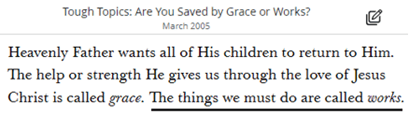
  • What are these things that we must do if we want to receive eternal life?
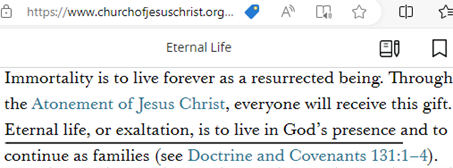
  • You cannot enter into the presence of God without receiving these “saving ordinances” which are also commonly referred to as “covenants” or “temple works.”
  • It is important to note that “Eternal Life” is not just living eternally. It is specifically living in the presence of God in his heavenly kingdom. And that is what we all want, right? According to the LDS gospel, how exactly can I get there?
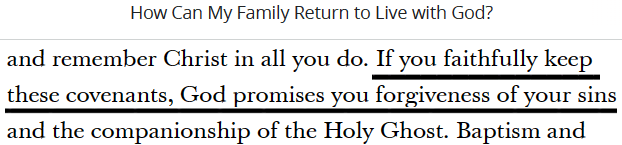
  • This gives us a much better idea of the what the LDS gospel entails and what is required for me to receive eternal life/live in the presence of God.
  • The forgiveness of your sins depends on how faithfully you keep the covenants. This sounds like a lot of pressure.
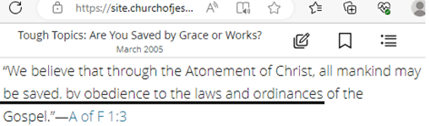
  • This is the LDS Church’s 3rd Article of Faith. There are 13 Articles of Faither for the LDS Church, which is like a statement of their beliefs. Given the information from the previous screenshots, it is easy to understand how it all comes together and why the things we must do are called, “saving ordinances.” Without these essential ordinances/temples works, we cannot enter into the presence of God.

In September, 2013, General Authority Brad Wilcox gave a talk called, “His Grace Is Sufficient.” But the one thing he never tells us is this: What exactly is God’s grace sufficient for? The impression he leaves us with is this: The grace of God enables/empowers us to do the required works, receive the essential ordinances and keep the required covenants in order to qualify for eternal life. You do the works and keep your covenants, then you will receive eternal life and live in the presence of God only if you faithfully do so. One way to summarize this is: You do the works, receive the ordinances, and make the covenants in order to gain access to God’s grace, then God’s grace enables you to live in his presence.

In October, 2003, General Authority Dallin Oaks gave a talk called, “Repentance and Change.” Here is a quote from him: “Practices must be changed by those who wish to qualify for God’s choicest blessings…The gospel plan is based on individual responsibility…The plan of the father and the savior is based on individual choice and individual effort.”

  • The choicest blessing anyone can receive is eternal life/living in the presence of God. This is something you must qualify for. What does your qualification for eternal life depend on? Your own choices and your own efforts in receiving the ordinances and keeping the covenants.

    Alma 5:35 “Yea, come unto me and bring forth works of righteousness, and ye shall not be hewn down and cast into the fire”

    Below is an equation that sums up the LDS gospel:

    Grace + Works = Eternal Life (entrance into God’s kingdom)

________________________________________________________

What did Jesus and his apostles teach?

John 3:16 & 18 “Whoever believes in him (Jesus) shall not perish but have eternal life…Whoever believes in him is not condemned, but whoever does not believe stands condemned already because they have not believed in the name of God’s one and only Son.”

  • If you believe in Jesus, you will receive eternal life. If you don’t, then you will stand condemned and not receive eternal life. Pretty straight forward.

Matthew 7:21 “Not everyone who says to me, ‘Lord, Lord,’ will enter the kingdom of heaven, but only the one who does the will of my Father who is in heaven.” (This begs the question: what is the will of the Father?)

John 6:40 “For my Father’s will is that everyone who looks to the Son and believes in him shall have eternal life.”

John 6:28-29 “Then they asked him, “What must we do to do the works God requires?” Jesus answered, “The work of God is this: to believe in the one he has sent.”

  • When these people asked Jesus, “What are the works that God requires?” this would have been a perfect opportunity for Jesus to say, “You see the temple right over there? Go inside, receive the saving ordinances and make the temple covenants…but he doesn’t! He says that the work that the Father requires is to believe in Jesus.
  • Only those who do the will and work of the Father can enter into his kingdom and receive eternal life. The will and work of the Father is to genuinely believe in Jesus.

Ephesians 2:8-9 “For it is by grace you have been saved, through faith—and this is not from yourselves, it is the gift of God—not by works, so that no one can boast.”

  • Only those who have faith in Christ will be saved. That is a conditional statement. The necessary condition and requirement of faith implies that this verse is talking about eternal life/living in the presence of God, not general salvation (immortality). It is saying that by grace and through faith/trust in Jesus alone that we will receive eternal life…and not by our own works and effort as Dallin Oaks taught.

Romans 6:23 “For the wages of sin is death, but the gift of God is eternal life in Christ Jesus our Lord.”

  • Eternal life is gift of God. Think of a birthday party. You get gifts from friends and family. One friend holds out a present to you and says, “Before I give you this gift, you have to do 100 pushups, then I will give you your gift.” You are going to look at your friend and think, “First of all, it’s my birthday and I don’t feel like doing any pushups. Secondly, that’s no longer a gift. Anything that has obligations or required works that I must perform is not gift. In order for something to be truly classified as a gift, the only condition is that you must choose to accept it for what it is. That is what a free gift is. And according to God’s Word: eternal life is a free gift.

Titus 3:3-5 “At one time we too were foolish, disobedient, deceived and enslaved by all kinds of passions and pleasures. We lived in malice and envy, being hated and hating one another. But when the kindness and love of God our Savior appeared, he saved us, not because of righteous things we had done, but because of his mercy.”

  • Our righteous works and obedience do not play any role in our salvation and eternal life. It is ALL about the mercy and grace of Jesus. Faith in his work, not our own.

______________________________________________________________________

Romans 4:3-6 “What does Scripture say? “Abraham believed God, and it was credited to him as righteousness.” Now to the one who works, wages are not credited as a gift but as an obligation.However, to the one who does not work but trusts God who justifies the ungodly, their faith is credited as righteousness. David says the same thing when he speaks of the blessedness of the one to whom God credits righteousness apart from works.”

  • The apostle Paul distinguishes a gospel of grace from a gospel of works. If we are required to work to become righteous and receive eternal life, it would then be wages due and not a gift from God.
  • Jesus is the only person who perfectly fulfilled the Old Covenant by keeping all 613 laws. He alone is perfectly righteous. And if we have sincere faith/trust in Jesus and HIS works, HIS perfect life and HIS atoning sacrifice, then Jesus will cover us with his perfect righteousness as a gift apart from works. We don’t work for our own righteousness. We trust in the righteousness of Christ and then all of our sin-stained garments will be covered and forgiven by the blood and perfect righteousness of Jesus.

Romans 3:27-28 “Where, then, is boasting? It is excluded. Because of what law? The law that requires works? No, because of the law that requires faith. For we maintain that a person is justified by faith apart from the works of the law.”

  • When we stand before God on judgement day, it will not be our works the justify us and get us into the presence of God. It is by faith alone, and not of works.

Romans 11:5-6 “So too, at the present time there is a remnant chosen by grace. And if by grace, then it cannot be based on worksif it were, grace would no longer be grace.”

  • This is the true gospel of grace. If even one work is required for us to be saved, forgiven and receive eternal life, we have then fallen from grace and are under a gospel of works. Some Latter-Day Saints might respond by saying, “Paul, the things we do in the temple are honoring to God. They are covenants that we make BECAUSE we love Him.” But here is the thing: those covenants as defined by the LDS Church are “things that you must do.” And “things you must do” are also defined by the LDS Church as “works.” This is what makes it a works-based gospel.

__________________________________________________

All of this is NOT to say that Christians can just say a prayer, say “Jesus is my home boy” and then continue living in their sin (Romans 6 & James 2). Works are absolutely important, and we ought to obey the commands of Christ…but works are not how we get closer to and qualify for eternal life. Our works simply demonstrate our love and devotion for Jesus.

The truth is: if you don’t care about obeying Jesus, keeping his commands and doing good works, then that sadly could be a sign that you haven’t been changed by his grace, not been born again, and are still under God’s condemnation.

John 14:15 “If you love me, you will keep my commands.”

Our works, obedience, and love for God only come AFTER one has been born again, forgiven, declared righteous and received the gift of eternal life. True faith in Jesus will always produce good works and obedience. The works can only come AFTER one has been born again.

You are either an enemy of God or you are part of his family and church. There is no in between. You cannot please God and do good works for Him until you have first placed all of your faith in Jesus, His work and His sacrifice.

Below is an equation that is in accordance with the New Testament:

Grace  +  Nothing = Eternal Life + Works

__________________________________________________

Which gospel are you under:  The true gospel of grace? Or a cursed gospel of works?

________________________________________________

Notice in the picture above that it is Jesus who is doing all the work. We become clean and righteous through his work that he did on our behalf.

1 John 5:13 “I write these things to you who believe in the name of the Son of God so that you may know that you have eternal life.”

My desire is that you will receive the true gospel of grace so that you can have this blessed peace and assurance of eternal life all because of the work of Christ. If you would like to learn more about what it means for Jesus to be your “personal” Lord and Savior, check out my Bible lesson, “Who Is Your Personal Mediator?” (https://jllds.org/2023/12/13/who-is-your-personal-mediator/)

Please let me know your thoughts, things you appreciated or things that you disagreed with in the comment section below. Thank you for reading and never stop chasing after Jesus!

The Three LDS Conversions: A Primer for the Befuddled

There are three conversions in Mormonism: social, doctrinal, and spiritual.

Doctrinal Conversion is to believe that the tenets of Mormonism are true, along with The Book of Mormon, Doctrine and Covenants, and the Pearl of Great Price.

Social Conversion is to believe that the LDS church is a godly institution, its leaders are inspired, and its founder, Joseph Smith, had an upright, moral character.

Spiritual Conversion is any experience that validates a Mormon’s beliefs.

The most common of these is Spiritual Conversion. It typically occurs after reading The Book of Mormon, which challenges the reader to ask God if it’s true. It promises that God will reveal its truthfulness through the power of the Holy Ghost. Rather than testing The Book of Mormon against the Bible, Latter-day Saints resort to subjective feelings, and often equate a burning in the bosom to an answer from the Spirit. The exact wording in The Book of Mormon is as follows.

Moroni 10:4 And when ye shall receive these things, I would exhort you that ye would ask God, the Eternal Father, in the name of Christ, if these things are not true; and if ye shall ask with a sincere heart, with real intent, having faith in Christ, he will manifest the truth of it unto you, by the power of the Holy Ghost.

These conversions serve as a three-legged stool to keep Mormons tethered to the LDS gospel. If one leg is kicked out, they can keep going on two legs while the damaged one is repaired. Thus, in order to bring them out of the church, at least two of the three conversions must be targeted. However, Latter-day Saints are unlikely to divulge details about their spiritual conversion because those experiences are considered sacred. To them, talking about their experiences with Christians is casting their pearls before swine.

That leaves the social and doctrinal conversions to target. Most Mormons lean either to the doctrinal or the social side of their faith. Rarely, if ever, do you find a Mormon who is on fire about the doctrine and the culture of the church. If they don’t lean either way, they are probably less active. I was a Ward Mission Leader right before leaving, and it was often said that a new convert to Mormonism needed three things: A friend (social conversion), a calling (social conversion), and to be nourished by the good word of God (doctrinal conversion).

Of the two types of Latter-day Saints, the vast majority are socially converted, cultural Mormons. They do not participate in online debates, and their testimonies are not founded on logic. I have been in several wards over the years, and typically I have found only 1 or 2 individuals per congregation that really know their stuff. These doctrinal Mormons are, to some degree or another, outcasts in the faith.

I heard a talk over the pulpit once, where a man was comparing his parents, one of whom was doctrinal, while the other was a cultural Mormon. He said, “My father knew The Book of Mormon backward and forward, he had much of it memorized, and he could explain why each passage was important, but my mom knew it was true…” He implied that because of her blind faith, his mother was the more righteous of the two.

My Conversions into Mormonism
Although I was born under the covenant, I still had to be converted to Mormonism. My social conversion came at age fifteen. I finally made good friends at church and it’s where the pretty girls were. I would have gone without being dragged there by my parents.

My spiritual conversion came a year later when I attended Especially for Youth, a week-long retreat for Latter-day Saints. On Thursday night they ushered us into a room and showed a video about Jesus. It had people testifying that he was their Savior and he’d changed them. That night, the real Jesus visited me.

I was faced with his majesty and righteousness. I knew that I was a wretched sinner, and I would have been satisfied if he had wiped me off the face of the planet. However, instead of wrath, he sent me his love. It was an unbelievable love. It’s the kind of love that says, “You hate my counsel, your feet are slow to do good and swift to do evil, and many of the things you do displease me, but I love you anyway.”

God’s overwhelming, undeserved love made me weep for hours on end. I looked at the context of the situation. I was at a Mormon sponsored event, which I interpreted to mean that the church was true. I decided that my allegiance would be to the Church of Jesus Christ of Latter-day Saints.

When I turned 19, I turned in my mission papers and went to the far away land of California to preach the gospel. Even then, I was seeking the burning in the bosom my counterparts had experienced after reading The Book of Mormon. I was expecting something powerful like my Jesus experience, but it never came. Eventually, I settled on a logical testimony that The Book of Mormon was true, even though it made me feel like a second class citizen in the church.

Spiritual Conversion as articulated by a Mormon Apostle. (click to zoom)

In time, other experiences bolstered my spiritual conversion. On my mission, I met my friend Ed Enochs, an Evangelical Christian, who debated my companion and me for three hours one day. I walked away from that encounter convinced that Mormonism was false. I was saddened at the thought of my family and friends back home. How, I wondered, could such intelligent people be roped in by a scam like Mormonism?

Ed also convinced me that the Bible was the word of God. I decided to examine it and see if it supported the truth claims of the church.

Somehow, as I studied the Bible, I came across all the passages that seemed to support Mormonism, and my doctrinal conversion was complete. When I returned home I became an amateur apologist bent on defending Mormons from smooth talking Christians. With all three conversions in place, the LDS church had me hooked. I spent the next decade as its captive.

My Three Conversions out of Mormonism
By 2015, God was waging war on all three of my conversions. I decided that year to study grace in order to become a more effective weapon. In Mormonism, there are 3 levels of heaven, 6 definitions of salvation, and 50 shades of grace. So every time I came across heaven or salvation in LDS scripture, I had to decipher which level of heaven and what kind of salvation was being described. It was the most frustrating thing I had ever done in my life and I was envious of the elegant simplicity of the gospel my Christian friends believed in.

Later that year the church came out with its policy that children of gay parents could not be baptized. I was not on board with the policy, but what irked me, was the day after it was leaked Mormons were already defending the policy online. It seemed like Latter-day Saints everywhere were abandoning Spirit and scripture in favor of uncontested apostolic authority.

I was on an online forum one day and another Latter-day Saint said he didn’t have a problem with the policy, but if he did, he would just pray about it until he didn’t anymore. I responded, “If that’s not a cult mindset, I don’t know what is!”

Unfortunately, it was a public forum and my family decided to hold a small intervention for me. They warned me to use caution when discussing the church and one family member said throwing the prophet under the bus was the same as throwing Jesus under the bus.

I knew that despite my family’s concern, the truth could withstand criticism. In favor of my relationships, however, I decided to keep my big mouth shut. It was just a stupid policy, after all.

A few days later I saw Elder Nelson speak to Millennials on BYU TV about the policy. He explained that it was not a policy at all, but a revelation from God that had been unanimously received by all 15 prophets, seers, and revelators. My jaw dropped. Suddenly, my issues with the church were just as much doctrinal as they were cultural since God himself was the alleged mastermind behind the policy.https://www.youtube.com/embed/1ePiZLTCHh8?version=3&rel=1&fs=1&autohide=2&showsearch=0&showinfo=1&iv_load_policy=1&start=2735&wmode=transparent

In Mormonism, there are three pillars of truth: the leadership, the Spirit, and the scriptures. Any of these can be used to acquire truth, but in my case, the Spirit and the scriptures were telling me the exact opposite of what the leaders were saying. That October I learned that there had been over 30 suicides of gay and lesbian LDS youth. I was shocked that the so-called “plan of happiness” was causing so much sorrow.

My social conversion shattered into a million pieces. I was no longer proud to be a Mormon; I was ashamed of it. And with my doctrinal conversion struggling as it was, I was dragged into a faith crisis lasting several months. Mormonism had infiltrated every aspect of my identity and questioning it caused me to fall into a confused state of depression.

I managed to stay active through it all. I kept studying grace and came to believe that Christ’s imputed righteousness granted salvation. I found evidence of it in both the Bible and The Book of Mormon, and for a time my doctrinal conversion stabilized. That is until God opened my eyes to the fact that my new favorite doctrine was hostile to the mandatory LDS covenants and ordinances.

My spiritual conversion collapsed soon after that. It didn’t matter that I still had experiences that I couldn’t explain away. One leg was simply not enough to support my testimony. I gave my life to Jesus and over time I discovered that my spiritual experiences did not hold up under scrutiny.

Kicking out the Legs of Conversion
Spiritual conversion is the toughest to target since Mormons are so protective of it. Ex-Mormons might have a shot though, by talking about the spiritual experiences they had while active, and why they failed the test of time. Most Christians will need to go after social and doctrinal conversion instead.

First, find out what kind of Mormon you’re talking to. Does she believe her leaders’ words are always inspired? Does she blur the lines between culture and doctrine? Is she LDS because of the great programs and family values? Does she think people leave the church because they intellectualize their way out? If so, she’s probably a cultural Mormon.

Does he believe the prophets and apostles sometimes speak as men? Is he wary of the culture, but protective of the beliefs? Does his testimony of the LDS scriptures have some basis in logic? Does he think people leave the church over cultural issues? If so, he’s probably a doctrinal Mormon.

Doctrinal and Social Conversion as articulated by a late Mormon Apostle. (click to zoom)

Conventional wisdom says to strike where the Mormon is weak, but that may not be the right strategy. Since my social conversion was weak, I doubled down on the doctrine to overcompensate. I overlooked the prophets’ mistakes because they were men. When faced with Joseph Smith’s misdeeds, it never dented my view that he was a prophet. I just thought he was abusing authority God had actually given him. All the social problems in the world could not have relinquished my grip on the Mormon church.

God attacked my doctrinal conversion first. That made me vulnerable to social problems in the church and set the stage for the avalanche to come. So if you’re talking to doctrinal Mormons, talk about doctrinal issues first: like contradictions between LDS scriptures and the Bible. If you’re witnessing to cultural Mormons, talk primarily about social problems: like Joseph Smith’s polyandry.

I would caution against coming off too aggressive with Latter-day Saints. Above all else, be a friend first. Mormons are wary of Christians who constantly attack their beliefs. We don’t have to tell our LDS friends they’re in a cult every time we see them. They already know what we think, I promise. Bold, fiery preaching may erode their doctrinal conversion, but if it is not coming from a relationship of trust, it will simultaneously bolster their social conversion.

Navigating someone past the three conversions is ultimately the work of God, and it’s a long, drawn out process. Sometimes all we can do is plant seeds, pray for the LDS, and love them. Mormons are unlikely to ever choose Christianity if all they remember from us is: ‘attack, attack, attack’.

I am forever grateful to the many Christians who befriended me while I was LDS, who respected me despite my beliefs, who saw past my religion and saw me, who prayed for me, who built me up, who let the light of Jesus shine through them, and who treated me like a brother before I was one. I don’t know where I’d be without them.

  • By Michael Flournoy

The God Who Abandons: Why Mormonism Makes No Sense

When I was a child, I frequently fought with my younger brother. I’m not talking about play battles, I mean we were trying to destroy each other. My parents had tried to make us stop, to no avail. One night, amid World War 3, my mother made a startling announcement: she and our father had decided they were going to leave us and never come back. My siblings and I shrieked and wailed as they stalked out the door. Within seconds, the feeling of dread was overwhelming. As the oldest, the burden of feeding and educating the others probably fell on me, and it was a burden I had no hope of carrying.

I threw open the sliding glass door and plunged into the unforgiving night. On the back patio, I screamed their names, fairly certain they could not hear me and that I’d never hear their voices again. When I went back in, my parents were there, consoling my brothers and sister, saying they would never leave us.

Looking back, I do not fault my parents for what happened that night. Parenting is a tough thing to do. It doesn’t come with a manual, and half the time it’s like making your way through a pitch black room littered with Legos. Besides, we are all fallible human beings. What I cannot excuse, however, is a god who abandons his children.

A year ago I sat down with an LDS coworker who told me he couldn’t even visit a church that taught that God sends people to hell forever. This was exactly the sentiment I had felt as a Mormon, and it’s probably the way most Latter-day Saints see it too. A God who thrusts people to eternal hell just doesn’t seem merciful. I’ll be the first to admit that hell is a harsh punishment in Protestant Christianity, but it’s even harsher in Mormonism, where God sends his own children there.

According to Mormonism, every person on the face of the planet is literally the offspring of God. This of course, stands in opposition to orthodox Christianity where only saved believers are His children. God is believed to be omniscient and omnipotent; a being who loves everyone perfectly. Yet despite this, in Mormonism, only a small percentage of God’s children will have the chance to live with him in eternity.

Mormons do try to soften the blow of this by espousing a belief in three levels of heaven. Even though Heavenly Father only resides in the highest kingdom, and only the most righteous people will go there, they believe virtually all mankind will go to at least some degree of heaven. The lowest level, the Telestial world, is thought to be so beautiful that if we could see it, we would kill ourselves to get there. In the LDS mindset, this is far more merciful than being sent to a place of fire and torment.

But is it? Elder Holland, an apostle of the LDS church, once said, “I wouldn’t know how to speak of heaven without my wife and my children. It would not be heaven for me” (Temple Open House video – click here to view). This is exactly how Christians view any place devoid of God the Father, it would not be heaven for us. Well guess what folks, in Mormonism eternal families and fellowship with Heavenly Father are both restricted to the Celestial Kingdom alone. So ask yourselves, is a beautiful world where the Father does not come, really heaven? And is it really less painful than a hell made of fire and brimstone?

Whether literal or metaphorical, The Book of Mormon describes the suffering God’s children will endure after the final judgment in Alma 12:16-18.

And now behold, I say unto you then cometh a death, even a second death, which is a spiritual death; then is a time that whosoever dieth in his sins, as to a temporal death, shall also die a spiritual death; yea, he shall die as to things pertaining to righteousness.

Then is the time when their torments shall be as a lake of fire and brimstone, whose flame ascendeth up forever and ever; and then is the time that they shall be chained down to an everlasting destruction, according to the power and captivity of Satan, he having subjected them to his will.

Then, I say unto you, they shall be as though there had been no redemption made; for they cannot be redeemed according to God’s justice; and they cannot die, seeing there is no more corruption.

Latter-day Saints may argue that this is a temporary “everlasting destruction” or it’s only talking about the few who go to Outer Darkness with Satan and his angels, but either way it’s a moot point. In Mormonism these are God’s children who are being abandoned, and left chained by the power of the devil.

Mormons also claim that everyone essentially goes to the degree of heaven they are most comfortable in, and it’s not really God abandoning us, it’s us abandoning him. What concerns me about this approach, is I believe there are people who honestly want God, but cannot abandon their sins, despite all desires to the contrary. These will have the doors to the Celestial Kingdom shut in their face and God will say, “I’m sorry, but you chose this.”

At least the Mormon god is consistent. Assuming that humanity does comprise God’s children, Jesus’ words to the Pharisees are incredibly harsh in John 8:42 where he denounces their heritage, “If God were your Father, you would love me…” In verse 44 he goes on to say their father is none other than the devil. Mormon doctrine also teaches that the Holy Ghost abandons us when we break the commandments, leaving us in the very teeth of sin when we need him the most. I would expect this kind of behavior from a teenage girl. I would not expect it from the highest being in the universe, the Alpha and the Omega.

In 1 John 4:8 we learn that God is love. I’m not talking about the “love” Mormons attribute to him: where he lovingly abandons his children to hell and puts the blame on their shoulders, I’m talking about a noble kind of love. This love is described in 1 Corinthians 13:4-7 (NIV).

Love is patient, love is kind. It does not envy, it does not boast, it is not proud. It does not dishonor others, it is not self-seeking, it is not easily angered, it keeps no record of wrongs. Love does not delight in evil but rejoices with the truth. It always protects, always trusts, always hopes, always perseveres.

It is not wrong for Latter-day Saints to struggle with the justice of God and the eternal nature of hell. It is, however, hypocritical to cast stones at Christianity while excusing the problems in their own theology. As for me, I cannot even visit a church that teaches God sends his own children to hell.

  • By Michael Flournoy

Taking Sacrament: The Mormon Communion Conundrum

Latter-day Saints take communion once a week in remembrance of the sacrifice of Christ as admonished in Luke 22:19 and Doctrine and Covenants 20:75. This is not, however, the only reason they take it. Mormons also take communion in order to renew their baptismal covenant.

This covenant, made at baptism, is a two-way promise that they will take upon them the name of Christ, bear each other’s burdens, mourn with those that mourn and keep the commandments. In return, God promises eternal life (Mosiah 18:8-9).

There are two schools of thought as to why Latter-day Saints need to renew their covenant. The first theory says the covenant is broken by sin. When I was LDS, I thought my sins canceled my protection and taking communion would renew the agreement, much like renewing my car insurance. Taking communion was absolutely essential, hence it’s common name among the LDS: the sacrament.

The second theory says the covenant is not broken by sin. Renewing Covenants is like renewing wedding vows, which means the original agreement wasn’t damaged in any way. Communion is merely a chance for Latter-day Saints to recommit to the Lord.

Both theories are deeply problematic for Latter-day Saints.

The Problem with “Wedding Vow” Communion

The most glaring issue with the covenant not being broken by sin is it makes the covenant unbreakable. Thus the promise of eternal life is assured, regardless of whether man keeps his part of the agreement. This falls directly in line with the Protestant view of eternal security, which Mormons oppose vehemently.

To enter the highest heaven, the Celestial Kingdom, a Mormon must have faith, repent of their sins, be baptized, receive the gift of the Holy Ghost, and last but not least, endure to the end.

2 Nephi 31:16, in The Book of Mormon says: And now, my beloved brethren, I know by this that unless a man shall endure to the end, in following the example of the Son of the living God, he cannot be saved.

Doctrine and Covenants 14:7 says: And, if you keep my commandments and endure to the end you shall have eternal life, which is the greatest of all the gifts of God.

According to LDS scripture, we must endure to the end with our own might. There is no solace in the idea of an unbreakable covenant enduring on our behalf. The responsibility is placed on the shoulders of Latter-day Saints.

The Problem with “Car Insurance” Communion

I took communion weekly for 30 years as a Latter-day Saint. Whenever I partook of the broken bread I thought of Jesus. Though perfect, he was broken so that I, being broken, could be made whole. Every week I was damaged, and so was my covenant with God. With my covenant renewed by the sacrament, I was pure once again. Here’s how Mormon Apostle, Dallin H. Oaks explained this:

No one lives without sin after his or her baptism, however. Without some provision for further cleansing, each of us is lost. How grateful we are that the Lord has provided a process for each baptized member of His Church to be cleansed from the soil of sin. The sacrament is an essential part of that process. We are commanded to repent of our sins, to come to the Lord with a broken heart and a contrite spirit, and to partake of the sacrament. When we renew our baptismal covenants this way, the Lord renews the cleansing effect of our baptism. We are made clean and can always have His Spirit to be with us.(Dallin H. Oaks, “Renewing Our Covenants”, Friend magazine, August 1999) 

There is a paradox in “car insurance” communion. It is a way to repair our unworthiness, but at the same time, it is never to be taken unworthily. Many Latter-day Saints justify taking communion despite having sin in their lives. They feel that as long as they are not committing major sins, and are on the path to righteous living, they are worthy enough to take communion.

Alma 45:16 in The Book of Mormon, tells a different story. It specifies that “the Lord cannot look upon sin with the least degree of allowance.” In other words, God is not satisfied with improvement from the week before. If we show him our spiritual report card and it’s an A-, we are still unworthy in his sight.

2 Nephi 28:8 says: And there shall also be many which shall say: Eat, drink, and be merry; nevertheless, fear God – he will justify in committing a little sin… The following verse calls this “false and vain and foolish” doctrine.

I was in an institute class one semester, watching a video about a drunk driver who killed a man’s family when the truth hit me: I had been judging the man for his depravity, and my own sins were just as vile. My sins were bad enough that Jesus had to die on my behalf! I realized that my righteousness was an illusion, and I had no right to judge anyone.

Romans 3:10-12 (ESV) states: As it is written: “None is righteous, no, not one; no one understands; no one seeks for God. All have turned aside; together they have become worthless; no one does good, not even one.”

LDS President, Joseph Fielding Smith once said,

“The sacrament meeting is the most sacred and the most important meeting required of all the members of the Church. If any of the members are not in good standing; if they have in their hearts any feeling of hatred, envy, or sin of any kind, they should not partake of these emblems. If there are any differences or feelings existing between brethren, these differences should be adjusted before the guilty parties partake; otherwise, they will eat and drink unworthily and bring upon them the condemnation spoken of by Paul…”(Joseph Fielding Smith, “Doctrines of Salvation”, vol.2, p.343)

The problem this poses, is if the covenant has been broken, and the partaker has any sin in his life, he has no right to take communion. In fact, the covenant can never be renewed again, because as 1 John 1:8 (ESV) says: If we say we have no sin, we deceive ourselves, and the truth is not in us.

The Good News

In some ways, LDS communion is a resurrection of the law of Moses. Under the law, ancient Israelites had to make a sin offering once a year to renew their covenant. The new covenant, however, is quite different. Hebrews 10:11-18 (ESV) says:

And every high priest stands daily at his service, offering repeatedly the same sacrifices, which can never take away sins. But when Christ had offered for all time a single sacrifice for sins, he sat down at the right hand of God, waiting for that time until his enemies should be made a footstool for his feet. For by a single offering he has perfected for all time those who are being sanctified.

And the Holy Spirit also bears witness to us; for after saying,

“This is the covenant that I will make with them after those days, declares the Lord: I will put my laws on their hearts, and write them in their minds,” then he adds, “I will remember their sins and their lawless deeds no more.”

Where there is forgiveness of these, there is no longer any offering for sin.

I wept the first time I took communion in a Christian church. It was my first time taking it without feeling guilty. The symbolism overwhelmed me. It was not an offering that I was making to God, it was the offering God had given me. The Lord’s amazing grace was upon me, forgiving me of my trespasses. Jesus was not waiting for me to come to his level, he was meeting me at mine, and granting me full acceptance.

I was the prodigal son, who had returned from feeding pigs in the mire. I was a long way off, but God ran to me. I was filthy, but he embraced me. I was estranged, and he put a ring on my finger. I was naked, and he put his robe on me. I was dead, and he brought me to life.

  • By Michael Flournoy

The Vicarious Atonement Approach

A Guide for Witnessing to Latter-day Saints

Behold, I am sending you out as sheep in the midst of wolves, so be wise as serpents and innocent as doves.Matthew 10:16 ESV

In 2016, God made a major change in my life. I went from being an LDS apologist, to a saved Christian. Many things contributed to my conversion, but one doctrine in particular set the stage. When I learned that Jesus traded His righteousness for my sin, my erroneous beliefs melted away. The principle that changed my mind was imputed righteousness. 

It is incredibly difficult to proselyte Latter-day Saints. If I’m honest, there are days I think there’s no hope for them. Then I look in the mirror and I’m convicted. If there was hope for me, there’s hope for everyone.

The challenge with Latter-day Saints, is how easily offended they are. The moment you say they believe in a different Jesus, or Joseph Smith was a fraud, they disavow you as “anti-Mormon” and your credibility goes out the window. If you take the soft approach, their Mormonese confuses them into thinking there’s no difference in our theologies. 

My new approach takes a middle road. Even though it’s respectful, it cuts to the core of the Mormon faith. I have never had a Latter-day Saint get offended by it. It can be used with friends and family. Instead of attacking Mormonism, it teaches a biblical doctrine: one that negates the need for temple covenants. For me it was the antidote to a works-based religion.

This approach leads Latter-day Saints through four sacred crossings. Think of it like a baseball game. Baseball has four bases and there are four points Latter-day Saints must be convinced of before they can understand the gospel. The doctrinal points are as follows:

  1. Perfect righteousness is required to enter heaven.
  2. Man cannot achieve perfect righteousness.
  3. Christ’s righteousness is imputed to us vicariously. 
  4. Full imputation of Christ’s righteousness occurs at faith.

Before I go over these points, here are eight reasons you can’t go wrong teaching imputation to Latter-day Saints.

  1. Imputation does not exist in the Mormon lexicon. You won’t get stuck saying the same words but having different conversations. Most Latter-day Saints have never heard of imputation, which gives you a few minutes to explain it without argument.
  2. Mormons do work for the dead in their temples, and it’s an easy parallel to use when teaching imputation.
  3. Latter-day Saints who leave tend to become agnostic. Imputation is a bridge to Christianity.
  4. It is promoted heavily by the Bible. The King James Version, which Latter-day Saints prefer, uses the word imputation several times.
  5. It doesn’t feel like an attack on Mormonism, which means the LDS are more likely to engage. 
  6. Imputed righteousness fills in the gaps, and sheds light on the faith and works debate. 
  7. The Book of Mormon has imputation hidden throughout its pages. Since their own scripture teaches it, it’s possible to pin them down.
  8. Talking to Mormons about grace is tough because they adhere to three heavens and multiple salvations. Their theology has several layers they hide behind to keep from being cornered. Imputation negates these layers, by qualifying us for each type of salvation.

If you’re interested in seeing an example of how this approach looks, or just need an article to share with a Mormon to get the ball rolling, look no farther.

On Using The Book of Mormon

There are pros and cons to using The Book of Mormon as a witnessing tool. On one hand, it’s a source Latter-day Saints trust, and it tears down their walls.

On the other hand, if it’s used excessively it can reinforce the idea that The Book of Mormon is real scripture. 

Here’s my take. If you’re unfamiliar with The Book of Mormon, you can’t go wrong just using the Bible.

If you do use it in your approach, reserve it for steps one and two, ease into the Bible in step three, and finishing strong with the Bible in step four. Another way to play it, is to keep The Book of Mormon verses as backup for extra stubborn Mormons.

A lot of Christians are appalled by the idea of using The Book of Mormon. Here’s the rub: quoting from it doesn’t make you a practitioner of the faith, nor does it equate with using witchcraft. It’s simply a fallacious book. 

If you’re on the fence, this video gives a well reasoned defense for using The Book of Mormon.

1st Base: Perfect Righteousness is Required 

This is the easiest point to make since most Mormons will agree with you. However, deep down many Latter-day Saints comfort themselves by thinking grace will pick up where best efforts fall short.

This is certainly not the case, and The Book of Mormon is adamant about it. Here are two questions you should ask.

  1. Can any unclean thing enter heaven?
  2. Can we be saved in sin?

Both these questions are covered in Alma 11:37, which says:

And I say unto you again that he cannot save them in their sins; for I cannot deny his word, and he hath said that no unclean thing can inherit the kingdom of heaven; therefore, how can ye be saved, except ye inherit the kingdom of heaven? Therefore, ye cannot be saved in your sins.

If your LDS friend is implying that grace makes up the difference, they are actually promoting salvation in sin. The above passage could not state more plainly that total perfection is required.

In Matthew 5:48 (KJV) Jesus says,

“Be ye therefore perfect, even as your Father which is in heaven is perfect.”

If you need a final nail in the coffin, show them Alma 45:16, which says God cannot view sin with the least degree of allowance.

Under the weight of their own scripture, the Latter-day Saint should concede. This is just the warm up anyway. They will take the only escape pod on the ship and jettison to the belief that man can somehow achieve this necessary perfection. It’s time to follow them.

2nd Base: Man Cannot Achieve Perfection

If step one was the warm-up, step two is the war zone. Mormons will fight on this hill until their dying breath. They are convinced that Christ’s grace is an enabling power that helps them achieve perfection.

They will try to suck you in to World War 3. Don’t fall for it. If you don’t get to the next step and introduce imputation, this could drag on forever.

Your goal right now is to make a few quick points to knock them off balance or force a stalemate.

I recommend starting with Moroni 10:32 in The Book of Mormon. It reads:

Yea, come unto Christ, and be perfected in him, and deny yourselves of all ungodliness; and if ye shall deny yourselves of all ungodliness, and love God with all your might, mind and strength, then is his grace sufficient for you, that by his grace ye may be perfect in Christ; and if by the grace of God ye are perfect in Christ, ye can in nowise deny the power of God.

What’s noteworthy about this verse, is grace doesn’t kick in until we deny ourselves of all ungodliness.  If we have denied ourselves of all ungodliness, we no longer need grace, making it worthless.

If the Mormon says we get some grace before perfection, reiterate that the verse says grace isn’t sufficient until we do. Then ask if deficient grace can perfect us.

No matter their answer, share the following verse:

For whosoever shall keep the whole law, and yet offend in one point, he is guilty of all.

James 2:10 KJV

Explain that according to this verse, we are guilty of breaking all God’s laws unless we’re perfect.

Follow up with Romans 3:10 (KJV):

As it is written, There is none righteous, no, not one.

 No matter how composed the Mormon seems, his conscience is calling him out for his sin. 

The Latter-day Saint may say that perfection can’t be achieved in this life, but affirm that it can be grasped in the next. This is a good sign, you’re making headway.

Ask them if repentance is easier after this life. The Mormon should confess that it’s harder.

Alma 34:32-35 has this to say about repenting while we’re alive.

32 For behold, this life is the time for men to prepare to meet God; yea, behold the day of this life is the day for men to perform their labors.

33 And now, as I said unto you before, as ye have had so many witnesses, therefore, I beseech of you that ye do not procrastinate the day of your repentance until the end; for after this day of life, which is given us to prepare for eternity, behold, if we do not improve our time while in this life, then cometh the night of darkness wherein there can be no labor performed.

34 Ye cannot say, when ye are brought to that awful crisis, that I will repent, that I will return to my God. Nay, ye cannot say this; for that same spirit which doth possess your bodies at the time that ye go out of this life, that same spirit will have power to possess your body in that eternal world.

35 For behold, if ye have procrastinated the day of your repentance even until death, behold, ye have become subjected to the spirit of the devil, and he doth seal you his; therefore, the Spirit of the Lord hath withdrawn from you, and hath no place in you, and the devil hath all power over you; and this is the final state of the wicked.

Ask the Mormon how they hope to achieve perfection somewhere more challenging than here.

There’s a chance the Mormon will try to escape back to step one, by saying “grace makes up the difference,” or “as long as I’m on the path I’ll be okay.”

They are under pressure and struggling to hold their position. Remind them that you already talked about this and agreed that perfection is required to get to heaven. 

Once you’ve reached a stalemate, it’s time to offer a lifeline. 

3rd Base: Christ’s Righteousness is Imputed

You may be wondering why I separated points three and four. As a Christian, it feels natural to say, “Christ’s righteousness is imputed to us through faith.” However, Latter-day Saints need baby steps. If you give out too much information, the war drums will go off in their brains, leaving you with a fight on your hands.

Ask the Mormon if they believe the cross was a temple. They’ve likely never made this connection and will be intrigued. Tell them the Bible heavily emphasizes that a vicarious work was done on our behalf there.

Show them Collossians 2:13-14 (KJV):

13 And you, being dead in your sins and the uncircumcision of your flesh, hath he quickened together with him, having forgiven you all trespasses;

14 Blotting out the handwriting of ordinances that was against us, which was contrary to us, and took it out of the way, nailing it to the cross.

Explain that a vicarious atonement is necessary because we’re dead in our sins. Next, teach them about imputed righteousness. I typically use their own beliefs to illustrate it.

In Mormonism, the dead cannot receive saving ordinances, so a living person must do it for them. Once a proxy ordinance is done, the dead person merely has to accept what has been done on their behalf.

In other words, the Mormon’s act of righteousness (i.e. getting baptized, endowed, or sealed) is accredited to the dead as if they did it themselves.

Explain that Jesus lived a sinless life of perfect obedience, and that he offered it to us vicariously on the cross. 

This is why Romans 5:10 (KJV) associates our salvation not only with Christ’s death, but with His life. It says:

10 For if, when we were enemies, we were reconciled to God by the death of his Son, much more, being reconciled, we shall be saved by his life.

If you need Book of Mormon verses that teach imputation, check out this article.

Show the Mormon Philippians 3:9, where Paul promotes a righteousness that is not his own.

Pinned down by their own scripture and the Bible, they should admit that our righteousness comes from God. 

At this point, they are clinging to Mormonism by their fingernails. I’ve been in this spot, and it’s very precarious. Alien righteousness is not necessarily contrary to LDS doctrine, as God’s righteousness could technically be passed out little by little in conjunction with temple ordinances.

In any case, you have them right where you want them.

Home Run: Imputation Occurs at Faith

Once the Mormon embraces alien righteousness, explain that infinity can’t be divided. Tell them Jesus is an infinite Being of infinite righteousness, and therefore, if He gives any percentage of His righteousness, He gives it all.

The moment Jesus gives us His righteousness, we are worthy to enter the Father’s presence (and even of exaltation if you prefer Mormonese). So when righteousness is imputed, there is no need for us to do an ordinance ever again. Salvation is already ours.

It is difficult to refute this logic, but if the Mormon resists, share Romans 10:2-4 with them. It says:

2 For I bear them record that they have a zeal of God, but not according to knowledge.

3 For they being ignorant of God’s righteousness, and going about to establish their own righteousness, have not submitted themselves unto the righteousness of God.

4 For Christ is the end of the law for righteousness to every one that believeth.

Instruct the Latter-day Saint that since Jesus is the end of the law, there’s nothing else we need once we obtain his worthiness.

A Latter-day Saint might agree, but only on the premise that imputation occurs at baptism, or during one of the other saving ordinances. This is the only way imputation could coexist with Mormonism.

However, the Bible is very clear that imputation occurs at faith, and it’s time to show it to your Latter-day Saint.

Start with Romans 4:3-5. It says:

3 For what saith the scripture? Abraham believed God, and it was counted unto him for righteousness.

4 Now to him that worketh is the reward not reckoned of grace, but of debt.

5 But to him that worketh not, but believeth on him that justifieth the ungodly, his faith is counted for righteousness.

The Mormon will likely jump to James chapter 2 as a desperate, last ditch defense. In particular, verse 22 where it says Abraham was justified when he offered Isaac on the altar. If they do, explain that it promotes Protestant theology more than Mormonism.

For example, none of the instances of justification in James 2 have anything to do with their saving ordinances. James 2:23 says:

23 And the scripture was fulfilled which saith, Abraham believed God, and it was imputed unto him for righteousness: and he was called the Friend of God.

Not only is imputation directly tied to belief, the scripture being cited is Genesis 15:6, in which Abraham is counted righteous before Isaac is born.

It doesn’t make sense for Abraham to need justification if he already has Christ’s righteousness. Clearly the attempted sacrifice was proof of his faith in God. 

Romans 4:11 is great to use when explaining that obedience is a seal of the righteousness you already have.

Assure the Mormon that works are important for our sanctification, but when it comes to salvation our works and Christ’s don’t mix.

Galatians 5:4-5 (KJV) says:

4 Christ is become of no effect unto you, whosoever of you are justified by the law; ye are fallen from grace.

5 For we through the Spirit wait for the hope of righteousness by faith.

Finish strong with Romans chapter 4. 

Verses 6-8 state that righteousness is imputed without works, and in this state our sins don’t count against us.

6 Even as David also describeth the blessedness of the man, unto whom God imputeth righteousness without works,

7 Saying, Blessed are they whose iniquities are forgiven, and whose sins are covered.

8 Blessed is the man to whom the Lord will not impute sin.

Finally, it’s time to go for checkmate with verses 20-24, which talk about Abraham’s faith in God’s promise.

20 He staggered not at the promise of God through unbelief; but was strong in faith, giving glory to God;

21 And being fully persuaded that, what he had promised, he was able also to perform.

22 And therefore it was imputed to him for righteousness.

23 Now it was not written for his sake alone, that it was imputed to him;

24 But for us also, to whom it shall be imputed, if we believe on him that raised up Jesus our Lord from the dead;

This passage places imputation squarely on belief. If you’ve laid the groundwork properly, there’s no squirming out of it.

In Conclusion:

Even if you successfully pull off this approach, the Mormon will not leave the church. You have planted a powerful seed, and it needs time to grow.

Your best play now is to be a genuine friend. Tell the Mormon you’re always available if they have questions, but don’t come at them aggressively. 

Most importantly, put them in God’s hands. Pray for them and trust that God is their only hope, not you.

Now that your Mormon knows what imputation is, he won’t be able to ignore it again. Every time they see it in scripture, or hear their leaders teach contrary to it, it will stick out like a sore thumb. 

The more the Latter-day Saint learns about imputation and the vicarious gospel, the more challenging it will be to cling to a works-based faith.

I’ve encountered many Mormons who were former Protestants, but I haven’t met one yet who knew what imputation was when they left. I do not believe it is possible to believe this truth and remain Mormon.

  • By Michael Flournoy

Imputation In The Book of Mormon

The light shines in the darkness, and the darkness has not overcome it.John 1:5 ESV

Introduction

I left Mormonism and embraced Christianity after learning about imputed righteousness. Surprisingly, I found imputation in The Book of Mormon first, before seeing how much it was taught in the Bible.

You might be thinking, how can something good come from a fraudulent book? The Jews thought the same thing when they learned where Jesus was from. They asked, “Can anything good come from Nazareth (John 1:46)?”

Praise God that He is sovereign in all things, and that He found me imprisoned in a false religion. He used the keystone of Mormonism to free me and undo three decades of blindness. There are no depths His grace can’t reach.

Imputation in The Book of Mormon is valuable because it uses the power of a Mormon’s testimony against them. If they know The Book of Mormon is true, but it teaches an exclusively Protestant doctrine, then Mormonism must be false, or at least unnecessary. 

So without further ado, let’s dive in.

Enos made whole in faith alone

In the book of Enos, Enos prays all day and into the night.  A voice speaks his name and says, “Thy sins are forgiven thee, and thou shalt be blessed.”

In awe he asks, “Lord, how is it done?”

This question of how salvation is won pierces to the heart. God answers that Enos’ faith has made him whole (Enos 1:5-8).

This is at odds with the 4th Article of Faith which qualifies faith as the first principle of the gospel, followed by repentance, baptism, and the laying on of hands for the gift of the Holy Ghost.

What this passage says, is faith is the only principle of the gospel. Faith alone made Enos complete, perfect, and justified.

God’s righteousness Our Only Source

But the Book of Mormon goes much deeper than that. In 1 Nephi chapter 2, we find this gem.

8 And it came to pass that he called the name of the river, Laman, and it emptied into the Red Sea; and the valley was in the borders near the mouth thereof.

9 And when my father saw that the waters of the river emptied into the fountain of the Red Sea, he spake unto Laman, saying: O that thou mightest be like unto this river, continually running into the fountain of all righteousness!

I shared this passage with two LDS missionaries one evening, and asked them who the fountain of all righteousness was. They responded that it was God.

They returned a few nights later and confessed the truth of alien righteousness. As you will see, The Book of Mormon teaches that the righteousness we need to enter heaven is not our own.

The Allegory of Laban

Perhaps the most stunning symbol of imputed righteousness comes from 1 Nephi chapters 3 and 4. Nephi and his brothers are tasked with obtaining the brass plates from a man named Laban.

However, Laban hoards his treasure and ends up turning them away. Nephi’s family gathers their valuables and attempts to buy the plates. Laban takes their things and his men drive them from the city. 

In chapter 4 Nephi returns to Jerusalem alone and finds Laban passed out drunk in the street. He takes Laban’s sword and slays him at the urging of the Holy Ghost. Then he dons Laban’s armor and goes to his treasury.

The servant sees Laban’s garments and magically assumes Nephi is his master. He gives Nephi the brass plates without question.

This seems like a wild story, but if you plug in imputation it becomes an allegory. Nephi represents mankind, the brass plates are eternal life, and Laban is Jesus. 

I know Laban is the villain, but bear with me for a minute. The Hebrew name Laban means “white”, which The Book of Mormon uses to denote purity (see Alma 13:11). The fact that Laban has to die for the plates to be obtained is another nod to Christ. 

The failed attempt to buy the plates with gold and silver shows how fruitless it is to earn salvation in any way, shape, or form. 

Nephi putting on Laban’s clothes is symbolic of putting on Christ’s righteousness. Even though it is an imposter under those clothes, he is seen as worthy to possess what rightfully belongs to Laban.

This is imputation my friends, there can be no doubt. 

The Robe of Righteousness

In 2 Nephi 1:23 Lehi encourages his sons to put on the armor of righteousness. 

A couple chapters later Nephi says this:

I am encompassed about, because of the temptations and the sins which do so easily beset me. And when I desire to rejoice, my heart groaneth because of my sins; nevertheless, I know in whom I have trusted. 

2 Nephi 4:18-19

It’s strange to find a passage like this in the same book that says God can’t save us in our sins or look upon sin with the least degree of allowance (Alma 11:37 and Alma 45:16). Yet Nephi’s trust in God takes precedence over his sin.

“O Lord, wilt thou encircle me around in the robe of thy righteousness!”

2 Nephi 4,33

This language should be familiar to a Christian. Imputation is like a robe that covers our sin in the righteousness of Christ, and God is the one that clothes us. All the elements are there in 2 Nephi.

Salvation is Free

2 Nephi chapter 2 is a treasure trove for imputation. In verse 3 it says, “thou art redeemed, because of the righteousness of thy redeemer.” Verse 4 says that salvation is free. 

Verses 6-8 are as good a description of Protestant doctrine as any I’ve seen.

6. Wherefore, redemption cometh in and through the Holy Messiah; for he is full of grace and truth. 

7. Behold, he offereth himself a sacrifice for sin, to answer the ends of the law, unto all those who have a broken heart and a contrite spirit; and unto none else can the ends of the law be answered.

8. Wherefore, how great the importance to make these things known unto the inhabitants of the earth, that they may know that there is no flesh that can dwell in the presence of God, save it be through the merits, and mercy, and grace of the Holy Messiah…

Along this vein, 2 Nephi 31:19 says:

19 And now, my beloved brethren, after ye have gotten into this strait and narrow path, I would ask if all is done? Behold, I say unto you, Nay; for ye have not come thus far save it were by the word of Christ with unshaken faith in him, relying wholly upon the merits of him who is mighty to save.

Admittedly, the above verse is shaky because it’s preceded by the heresy that baptism is the gate to eternal life. However, Mormons are familiar with the phrase “relying wholly on the merits of [Christ].” And once they realize what imputation is, it’s tough to say The Book of Mormon is teaching something different.

The doctrine of sola gratia is found in 2 Nephi 2:24

Wherefore, my beloved brethren, reconcile yourselves to the will of God, and not to the will of the devil and the flesh; and remember, after ye are reconciled unto God, that it is only in and through the grace of God that ye are saved.

The Conversion of Alma the Younger

In Mosiah 27 a story is told of Alma Jr and his friends fighting against the church. An angel visits them and Alma goes unconscious for three days. When he wakes up he believes in the Lord.

He says, “I have repented of my sins, and have been redeemed of the Lord; behold I am born of the Spirit. And the Lord said unto me: Marvel not that all mankind, yea, men and women, all nations, kindreds, tongues, and people, must be born again; yea born of God, changed from their carnal and fallen state, to a state of righteousness, being redeemed of God, becoming his sons and daughters.”

Somehow, Alma claims to be redeemed and in a state of righteousness, despite not taking any action. This only makes sense with imputation of righteousness, since Alma clearly did not prove his faith in any way.

Finally, Moroni 10:33 spells out imputation perfectly.

And again, if ye by the grace of God are perfect in Christ, and deny not his power, then are ye sanctified in Christ by the grace of God, through the shedding of the blood of Christ, which is in the covenant of the Father unto the remission of your sins, that ye become holy, without spot.

The major thing to note in this verse is that sanctification follows perfection. This is a classic if/then statement. If we are perfect by grace, then we are sanctified. Even though we are wholly righteous, there is a process of aligning our will with God’s. 

In Conclusion

In light of the above passages, the burden is on Latter-day Saints to explain two things.

  1. If imputation isn’t true, why does The Book of Mormon teach it?
  2. How do you account for all the passages that promote imputation when there are so many that oppose it?

Although the truth of imputation is hidden in its pages, The Book of Mormon is not scripture. It also teaches that man must be obedient to merit eternal life, and as Jesus said, a little leaven leavens the whole loaf.

We cannot say we are on a team with Jesus, working for our salvation. No man can serve two masters. If we play any part in salvation, it becomes a hostage situation. It allows us to hang something over God’s head and say, “I did X, Y, and Z. You owe me salvation.”

In truth, God doesn’t owe anyone anything. He is God, and until we give Him the final authority we will have a very small view of Him indeed. This is the ultimate problem with The Book of Mormon: its theology exalts man at the expense of God’s glory.

  • By Michael Flournoy

Conquering the Cheap Grace Rabbit Hole

What shall we say then? Are we to continue in sin that grace may abound? By no means! How can we who died to sin still live in it? Do you not know that all of us who have been baptized into Christ Jesus were baptized into his death? We were buried therefore with him by baptism into death, in order that, just as Christ was raised from the dead by the glory of the Father, we too might walk in newness of life.Romans 6:1‭-‬4 ESV

Imagine you’re teaching a Mormon about the free gift of grace, and how it saves us apart from works. The person you’re talking to rolls their eyes and says, “Oh, so you Evangelicals can sin all you want!” Thus now describing cheap grace.

But you get flustered. And at this point the Mormon has steered the conversation off the road and into a ditch. Consequently you make a 180 and start talking about sanctification because you don’t want it to seem like Christians don’t care about obedience.

The Mormon leans back with a smug grin and declares victory. In their eyes, our obedience makes us worthy, and you have unwittingly supported their position. 

You dig yourself in deeper, explaining that various prosperity gospel preachers are actually wolves in sheep’s clothing. The Mormon nods knowingly. This is music to their ears. They believe a great apostasy left Christianity fractured and weak. You’ve just supported this erroneous theory as well. 

If you’ve ever witnessed to a Latter-day Saint, you may have encountered the above scenario I just described.

What you should do instead

The danger begins when we let Mormons define Christianity in the first place. They think we view grace as a license to sin, which is of course, cheap grace.

This isn’t a valid argument. Rather, it’s a reflection of the sinful heart from whence it came. When someone says, “You can sin all you want,” what they’re really saying is they’re unregenerately wicked.

In other words, they sin constantly. They don’t even desire purity, because they love sin more than God.

This is your opportunity to hit back. I recommend the following response:

“A true Christian would never suggest that.”

It’s a potent answer because it derails their logic instantly. It also happens to be true.

Ask the Mormon the following question. “If you had a parent or a spouse that loved you unconditionally, would your goal be to betray them as much as you could?”

The Latter-day Saint will concede the point, putting you back to square one. However, your position now is better than if you’d never been dragged into the ditch. 

When they concede, tell them you agree. It makes logical sense to earn approval, but since when does love conform to logic? It doesn’t make sense that Jesus died for mankind, but He did.

Take this opportunity to speak to your LDS friend in their own language. They value experience above all else, so give them your testimony. Tell them why you don’t deserve the grace you’ve been given and then explain how it’s changed you for the better.

I don’t recommend going into too much detail if you’re doing this publicly online. One on one, this is a great opportunity to speak from the heart. 

A Mormon won’t be able to refute this. On one hand, you responded respectfully, which means they can’t call your conduct into question. On the other, they long for this unconditional love.

The god of Mormonism does not love his children unconditionally. You can fall out of favor with him through sin. Latter-day Saints often claim their god is more loving because they hold a near universalist position.

However, their god is not so loving that he can accept a sinner into his kingdom. This puts you in position to extol the amazing grace of Jesus. So when a Latter-day Saint accuses you of trusting cheap grace, think of it as a gift from heaven.

  • By Michael Flournoy

The Articles of Faith: Evangelical Edition

1. We believe in one, and only one, God. He is one Being in three Persons: the Father, the Son, and the Holy Ghost. We believe God has always been God, and was never created, formed, or exalted.

2. We believe men are created, finite beings. We become adopted children of God through faith, but we remain a different species apart from God.

3. We believe that through Adam’s transgression, all men were made sinners and stand condemned.

4. We believe that through the blood of Christ, man can be saved by grace through faith.

5. We believe in the sufficiency of unmerited grace, which nullifies the need for conditional saving ordinances.

6. We believe in the priesthood of all believers. That is, that all true believers are priests of God regardless of gender or age.

7. We believe that Christ’s true Church never ceased. We affirm that Jesus kept His word when He said the gates of hell would never prevail against it.

8. We believe in unity on essential doctrines, liberty on non-essentials, and in all things charity.

9. We believe the Bible to be the Word of God as far as it is transmitted and translated correctly.

10. We believe the Bible is inerrant, infallible, and God-breathed. If any revelation is not in the Bible, we must assume that it is speculation, man’s own personal opinion; and if it contradicts what the Bible says, it is not true. This is the standard by which we measure all truth.

11. We believe in the Great Commission: The evangelism and discipling of all nations. This life is the only opportunity to accept salvation, and therefore, both message and mission are urgent.

12. We believe in the eternal marriage of Christ, the Bridegroom, to His bride, the church. We further affirm that the church is the body of believers and not an organization.

13. We believe in sanctification: that a believer will grow in their relationship with God and bear good fruit. We believe in obedience to God, not to gain salvation, but in gratitude for having received it.

  • By Michael Flournoy