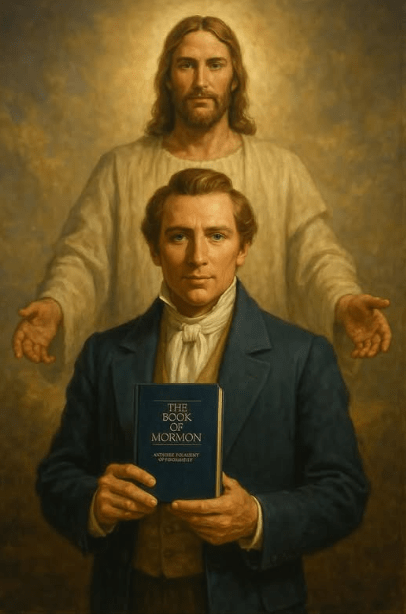
“How could an uneducated farm boy produce such a complex work of religious literature in 65 working days?” If you’ve ever met with LDS missionaries or have briefly engaged in some level of LDS apologetics, you’ve probably been asked this question before. On the surface, it sounds very compelling. But we need to remember the words of Jesus in Matthew chapter 7 when he warned us be aware of false prophets. Is the Book of Mormon proof in and of itself that Joseph Smith was a divine prophet of God? For the sake of truth and honoring God with our mind and heart, let’s dive into some of the main points that LDS commonly use in support of this argument.
Claim #1 – “Joseph Smith was uneducated.”
This statement is misleading and can give people the impression that Joseph Smith was basically either illiterate or unintelligent. When it comes to individuals with lack of formal education, there are a number of people who went on to do great things. Abraham Lincoln had the equivalent of one year of schooling and later became president. Mark Twain had less than 2 years of formal education and is recognized as one of the best writers in history. Here is what some friendly sources have stated about Joseph and his intelligence:
BH Roberts (former LDS historian and general authority): “That such power of imagination would have to be of a high order is conceded; that Joseph Smith possessed such a gift of mind there can be no question.”
Chauncy Webb (Joseph’s grammar teacher): “I taught him [Joseph Smith] the first rules of English grammar in Kirtland in 1834. He learned rapidly.”
Lucy Smith (Joseph’s mother): “for he was much less inclined to the perusals of books then any of the rest of our children, but far more given to meditation and deep study.”
We have a list of all the books from Joseph’s collection that were donated to the Navoo library and all of his books were related to religion, history, and geography. Even though he was largely uneducated in a formal sense, there’s no doubt that he was a brilliant and serious student.
Claim #2 – “There’s no way someone like Joseph could have invented the intricate narrative of the Book of Mormon in such a short amount of time.”
This statement is intentionally worded in a way to make the task sound more impressive than it actually is. The question that we should be asking is: how long did it take for him to create and prepare the Book of Mormon? Here’s what I mean:
16% of the Book of Mormon is literally copied straight from the King James Bible and an extra 2.5% consists of “and it came to pass.” Right here, we have roughly a fifth of the Book of Mormon that anyone could replicate.
Secondly, the overarching storyline in the Book of Mormon comes from other stories that were heavily circulating in the states of New York, Ohio, and Illinois. In these 3 states, there were a number of mysterious architectural mounds. A theory was introduced in the late 1700’s that a race of white religious people traveled to the Americas and built great structures and civilizations. These people then battled against a race of dark skinned Indians and the white people were eventually exterminated. Over the following centuries, dirt and debris covered these structures until they became hills or mounds. These stories were referred to as the Mound Builder Myths and made their way into a number of different newspapers in Palmyra, New York where Joseph lived. View of the Hebrews is a book with an identical overarching theme to the Book of Mormon and it was written 7 years beforehand. There were many other books and newspaper articles as well that expanded on this idea. In other words: the Book of Mormon narrative was a very common idea that was being greatly discussed and accepted in the time and place of Joseph prior to him producing the Book of Mormon.
Thirdly, when Joseph was 18 years old (5 years before dictating the Book of Mormon), his own mother stated: “In the course of our evening conversations, Joseph would give us some of the most amusing recitals which could be imagined. He would describe the ancient inhabitants of this continent, their dress, their manner of traveling, the animals which they rode, the cities that they built, and the structure of their buildings with every particular, their mode of warfare, and also their religious worship as specifically as though he had spent his life with them.” So for 5 years, Joseph would frequently tell these stories of ancient inhabitants in the Americas almost every night. This is no doubt the smoking gun of Joseph rehearsing what he eventually dictated into the Book of Mormon.
Claim #3 – “Joseph created the Book of Mormon in 65 working days, which means that he was dictating at an incredible pace of over 4,000 words per day.”
While dictating 4,000 words a day is impressive, it is still far from miraculous. Many other people can dictate just as fast, and some can even go at more than double Joseph’s pace.
- In 1982, Stephen King wrote a book called the Running Man which he wrote in a week and had about 70,000 words. That means that King was writing at a pace of roughly 10,000 words per day.
- Michael Critchton is another author in the late 1990’s who was known to write at a pace of up to 10,000 words a day as well.
- In the 1970’s, Barbara Cartland was known to dictate 7,000 words in a 2 to 3 hour session and also managed to write 23 novels over a span of one year.
The whole “65 day” argument, just is not as miraculous as Mormon apologists make it out to be.
Claim #4 – “How do you explain Joseph getting things right, like the location of Nahom?”
Yes, in Yemen, there is an alter with the inscriptions, “NHM.” If you remove the vowels from Nahom, you are left with NHM. Therefore, this must be the place of Nahom, right? However, here is what Mormon apologists often fail to mention: This is a temple that was dedicated to the Sabaean moon god, Almaqah. The Sabaeans were the powerhouse in Yemen for centuries, beginning in 800 BC. They would allow smaller tribes to participate in their religious rituals at their temple. At this time, religion and politics were intertwined. By submitting and worshipping someone else’s god, you are acknowledging their authority and submitting to their political rule. After these smaller tribes completed their ritual participation, the Sabaeans would inscribe their tribe name (or sometimes the name of the individual / family) into the alter. This acted as a communication device to the Sabaean gods, basically telling them who they are supposed to bless and protect. But the main point here is that the NHM inscription on alter is referring to a tribe of people or possibly a person or family. Virtually all scholars agree that the NHM inscription is referring to the Nihm tribe because we know that they lived in this region and interacted with the Sabaeans. This unfortunately means that the NHM is not referring to a city or region called, Nahom.
Claim #5 – “What about all of the Hebrew idioms and chasmic literary form in the Book of Mormon?”
When 14% of a book is copied from the Hebrew Bible (Old Testament), of course there will be Hebrew language and idioms. The most common Hebrew idiom in the Bible is “and it came to pass.” This phrase is found in the King James Bible over 700 times and in the Book of Mormon over 1,300 times. In regard to the chiasms, most LDS apologists turn to Alma 36 as the most impressive example of chiasm in the Book of Mormon. If you naturally read through this chapter, nothing about it stands out as special. It reads just like any other part of the Book of Mormon. When it comes to the criteria for what counts as a chiasm, you can make the criteria whatever you want it to be and say, “Hey, here’s a loosely metaphorical similarity that kind of, possibly sounds similar to this later verse down here…let’s make that a chiasm!” You literally have the freedom to take certain verses and create any kind of broad metaphorical theme you want, tie them together, and call it a chiasm. Again, there is no clear-cut consistency or standard. It can turn into a lot of subjective opinions and cherry-picked themes to make it sound more impressive than it actually is.
Claim #6 – “How did the Book of Mormon accurately predict over a dozen characteristics of a 20-mile stretch of coastline in the Dhofar region of Oman?”
Simply predicting that there is a narrow neck of land, many waters, mountains, fertile land and a lot of timber…these descriptions are very vague and not unique to Oman. There are a number of different coastlines around the world that also fit these vague descriptions, like the Hadhramaut coast of Yemen, the Konkan coast of India, or the coast of Sri Lanka. Each of these regions have narrow lands, rivers, fertile valleys, mountains and are abundant in timber. But even if this terrain match was unique, there is no independent evidence of Nephites or Lamanites ever existed in this same region of Oman. In the grand scheme, it still wouldn’t budge the needle.
There are a number of other things I could get into, but these are the most common defenses I’ve come across. But there is a reason why people like Thomas Fergason and Dee Green started out as zealous archeologists for the LDS Church who later lost their faith after discovering that there wasn’t any supporting evidence at all for it. (Link for more details on that: https://jllds.org/2023/12/22/geographic-evidence-the-bible-vs-the-book-of-mormon/)
It’s also worth mentioning that this is the exact same argument that Muslims use for their own prophet Muhammad. “He must be a prophet. How else could an uneducated man have possibly produced high-level literary, theological, and scientific content without divine inspiration?” To give you a better idea, here are a few arguments Muslims use when claiming that the Quran must have been supernaturally inspired:
- The word “day” is in the Quran 365 times and there just happens to be 365 days in a year. The word “month” is also in the Quran 12 times, and there are 12 months in a year.
- The words “man” and “woman” are separately mentioned in the Quran 23 times each and science tells us that both men and women happen to have 23 pairs of chromosomes.
- The word “sea” is mentioned 32 times and “land” is mentioned 13 times. With we divide 13/45 (32+13=45), we end up with 29% of land which is roughly how much land covers the earth.
“It’s so clear that the only way Muhammad could have possibly conjured this up was if God divinely inspired him to do so!” This is also a guy who denies the divinity, death, and resurrection of Jesus. He also married a 6 year old girl and then later slept with her when she was 9, while he was 54…but since he’s a prophet and God told him to do it, I guess that makes it ok for us to accept him as a prophet and just sweep that under the rug, right? (just kidding)
As a Bible based Christian, I can disregard any apparent miracles of the Quran and see that it’s not a divine product simply by appealing to the New Testament and acknowledging that it has historically been incredibly well preserved over time as even atheist scholars admit. And in this, we read that Jesus did claim to be the son of God, He did die on the cross, and He did rise from the dead. The Quran doesn’t prove that Muhammad was a prophet, nor does the Book of Mormon prove that Joseph Smith was a prophet. Many Gnostics and heretics also produced false writings in the early church eras and attributed them to the apostles. I strongly encourage you and anyone else to read the New Testament and make the teachings of Jesus and his apostles the foundational truth for your life.
Thanks for your time, God bless, and remember to never stop chasing after Jesus!
 JLLDS Ministries