1 Nephi 13:28 “Wherefore, thou seest that after the book hath gone forth through the hands of the great and abominable church, that there are many plain and precious things taken away from the book, which is the book of the Lamb of God.”
- According to the LDS Church, the Bible was trustworthy and accurate before the great apostasy. But during this time, the Bible was passed through the hands of many scribes who removed important truths of the gospel from it.
The 8th Article of Faith “We believe the Bible to be the word of God as far as it is translated correctly; we also believe the Book of Mormon to be the word of God.”
- We don’t have to worry about the Book of Mormon being translated incorrectly, but we do have to worry about the Bible being translated incorrectly. Therefore, if there is ever a conflict in the Bible with LDS doctrine, then that most likely is one of the parts that was translated incorrectly, right? I have asked many LDS members, “Can you show me one passage in the Bible that we know has been mistranslated or is missing?” And I have never received an answer to that question.
___________________________________________________
1 John 4:1 “Dear friends, do not believe every spirit, but test the spirits to see whether they are from God, because many false prophets have gone out into the world.”
We need to test these claims against the Bible and see where that takes us. What does the evidence say?
“Hasn’t Our Bible Today Been Translated Over & Over & Over?”
This is a common misunderstanding of our modern Bibles today. Many Latter-Day Saints hold the belief that Jesus spoke Aramaic, the gospel writers recorded it in Greek, then it was translated into Latin, and then a number of other different languages. Then 10 Bible translations later, it was finally translated into English, which is what we have in our Bibles today. It is basically like a kid’s game of “telephone.” By the time the message gets to the 10th kid, the ending message can be very different than what the original message was. Yes, the sequence above is how the Bible was “transmitted,” written down and preserved…but that is NOT how it was “translated.”
Transmission vs Translation
We have discovered over 26,000 New Testament manuscripts which I will go into more detail in a minute. Scholars have access to those manuscripts. Are we to believe that when translating our Bibles today, these scholars don’t care to utilize the earliest records we have? Don’t they just use the most recent translation of a translation of a translation of a translation? No! The truth is that the modern Bibles we hold today have utilized and been translated from the earliest Greek and Latin manuscripts that have been discovered.
Old Testament Reliability
The Great Isaiah Scroll – In 1947, the Dead Sea scrolls were discovered in the caves of Qumran, Israel. The most impactful discovery was the Great Isaiah scroll, which included all 66 chapters. Scholars have dated this scroll to have been written around 125 BC (Keep in mind that this dates to before the great apostasy). Before this discovery, the most ancient manuscript of Isaiah (Masoretic) we had was written around 800 AD. So the Great Isaiah scroll was written approximately 900 years earlier than the Masoretic text. Researchers examined both the Dead Sea Scroll of Isaiah and the Masoretic text to identify every difference between the two in order to see if it had been changed over time. After comparing all of the differences, both Christian and secular scholars have concluded that these two manuscripts are near identical. Not a single doctrine has been added or removed. This goes to show that the book of Isaiah has indeed been accurately preserved over time. If Isaiah has been accurately preserved, that would just be one reason to believe that other books of the Old Testament have been accurately preserved as well.
New Testament Reliability
As stated earlier, over 26,000 New Testament manuscripts have been discovered. This means that if an error, change or corruption ever did happen, we can retrace our steps backwards, compare a number of different manuscripts with each other. This gives us the ability to identify where the change occurred and then correct it moving forward. This basically gives us a way to reverse engineer our way back to what the original manuscripts said:
Example
John 3:16 “For Bob so loved the world that He gave his one and only son.” – INCORRECT TRANSLATION
John 3:16 “For God so loved the worm that He gave his one and only son.” – INCORRECT TRANSLATION
John 3:16 “For God so loved the world that He ate his one and only son.” – INCORRECT TRANSLATION
John 3:16 “For God so loved the world that He gave his one and only bun.” – INCORRECT TRANSLATION
Even though all of four of the above translations are wrong, we can figure out how to get back to what was originally written. This is what scholars have the ability to do today: reverse engineer our way back to what was originally written.
_______________________________________________________
Joseph Smith said, “I believe the Bible as it read when it came from the pen of the original writers. Ignorant translators, careless transcribers, or corrupt priests have committed many errors.”
- Smith claims that many people have committed errors in translating the Bible implying that we cannot fully trust everything that is in it. Is Smith’s claim true?
He also stated, “There are many things in the Bible which do not, as they now stand, accord with the revelations of the Holy Ghost to me.”
- Smith claims that the “Holy Ghost” was talking to him. This spirit was telling Smith certain things that did not line up with God’s Word/the Bible. Instead of trusting the truth of God’s Word, Smith chose to trust this spirit.
Is this how we should go about deciphering what is true and false? By trusting any spirit that speaks to us and makes us feel good? Or by trusting in God’s Word and what it says?
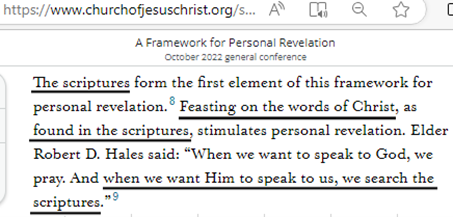
- Elder Renlund said at general conference that we should search the Scriptures for answers, not our feelings.

- Again, Elder Renlund restates that our feelings and experiences can deceive us and persuade us to belief something that is false.
John 17:17 “Sanctify them through thy truth: thy word is truth.”
We have the Bible, which is the Word of God and the Word of God is truth. If a spirit tells us something that confirms with God’s Word…great! But if a spirit tells us something that conflicts with God’s Word, we throw it out regardless of how good that spirit or experience feels. Because if it conflicts with God’s Word, we know that it is not of God.
______________________________________________________
Not only do we have the historical evidence that shows that the Bible has been accurately preserved and is trustworthy, Jesus himself declared in Mark 13:31 “Heaven and earth will pass away, but my words will never pass away.”
1 Peter 1:23-24 “For you have been born again, not of perishable seed, but of imperishable, through the living and enduring word of God. For, “All people are like grass, and all their glory is like the flowers of the field; the grass withers and the flowers fall, but the word of the Lord endures forever.”
Question: Is God strong enough to protect His Word/the Bible? YES or NO
______________________________________________________
For what it’s worth, the Book of Mormon Introduction page used to affirm that the Bible contains the fulness of the everlasting gospel.

But if you turn to this page in a current edition of the BOM (paperback, not on your phone), the LDS Church leaders decided to remove the words, “as does the Bible.” So the Bible apparently used to contain the fullness of the everlasting gospel, but it doesn’t anymore. Interesting how that works.
If we receive a revelation, the first thing we should do is test it against God’s Word, not our personal feelings and experiences. God loves us and he wants to protect us. That is why he has given us his precious Word for guidance. He is strong enough to protect His Word so that it always has and always will endure forever. For many Latter-Day Saints, this might be a difficult idea to accept since many plain and precious truths were lost from the Bible during the Great Apostasy. But was there really a Great Apostasy that was prophesied in Amos chapter 8 and 2 Thessalonians chapter 2? For more information on this, check out the article: “Was There Really A Great Apostasy?” (https://jllds.org/2024/02/16/was-there-really-a-great-apostasy-2/)
Any God who cannot protect his own Word from being corrupted is a small god and is also one who is not worthy of our worship.
What should we put our trust in?
The Word of God OR The words of Joseph Smith
Please let me know your thoughts, things you appreciated or things that you disagreed with in the comment section below. Thank you for reading and God bless!
 JLLDS Ministries
One thought on “Has The Bible Been Accurately Preserved Over Time?”