Part 1 – https://docs.google.com/document/d/16p2G1zlqRz7i_Bf0Syv4kiFZ2caNTslkN3dFO_T7fdo/edit?usp=sharing
Part 2 – https://docs.google.com/document/d/13DXGPAPIN_6F3F-Q-Yz_jZjF1942byzMMxB8bjvY87k/edit?tab=t.0
Jesus Loves Latter Day Saints


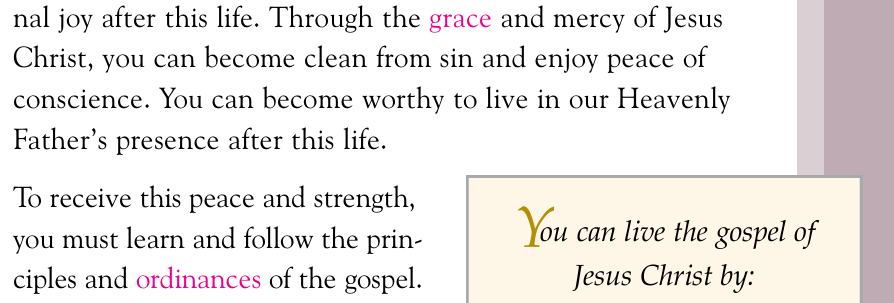
On page 3, it says, “Through the grace and mercy of Jesus Christ, you can become clean from sin and enjoy peace of conscience. You can become worthy to live in Heavenly Father’s presence after this life.”
A few points to hit on here:
“But to him that worketh not, but believeth on him that justifieth the ungodly, his faith is counted for righteousness. Even as David also describeth the blessedness of the man, unto whom God imputeth righteousness without works,”
Next, the pamphlet starts to break down what the worthy or covenant path looks like. The 4 fundament principals are:
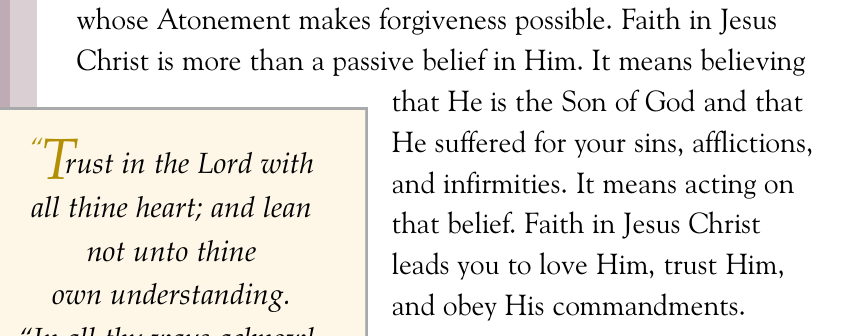
At the top of page 4 it says, “Faith in Jesus Christ is more than a passive belief in Him….It means acting on that belief. Faith in Jesus Christ leads you to love Him, trust Him, and obey His commandments.”
This is so close to being Biblically correct.
These verses help us understand that faith is not a work…but genuine faith will always lead to works.
The next fundamental principle is Repentance. In the middle of page 4, it says, “Through repentance, you change those thoughts, desires, habits, and actions that are not in harmony with God’s teachings. He promises that when you repent, He will forgive your sins.”

In a previous video, I covered this topic focusing on repenting of serious sins. Part of repenting of serious sins includes confession to your bishop. In those situations, you will not receive God’s forgiveness if you don’t confess take that step in confessing to your bishop. Confessing your serious sins to God is not good enough.
It says that “When you repent, you will stop doing what is wrong and strive never to do it again.”
You can imagine how man LDS members felt unworthy as a result of this impossible standard, to the point that they would throw in the towel, leave the church and say, “What’s the point of even trying?” Then the church adjusted this principal and made it less strict in order to retain membership.
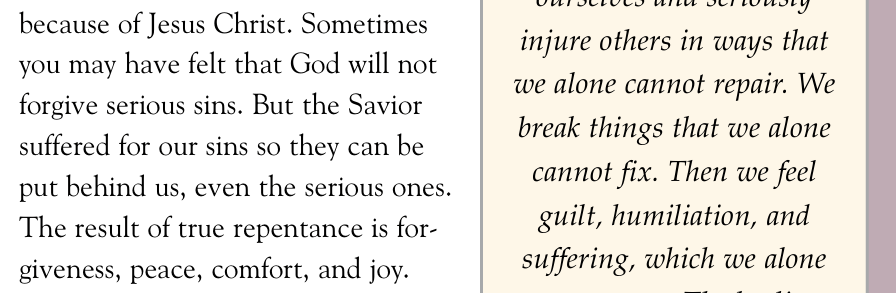
The last point here of Acknowledging the Savior, it says, “Sometimes you may have felt that God will not forgive serious sins. But the Savior suffered for our sins so they can be put behind us, even the serious ones. The result of true repentance is forgiveness, peace, comfort, and joy.”
This sounds great and I agree with it. I want to read a Psalm that David wrote after he committed the sins of adultery and murder.
Psalm 51 “Have mercy on me, O God, according to your unfailing love; according to your great compassion blot out my transgressions. Wash away all my iniquity and cleanse me from my sin. For I know my transgressions, and my sin is always before me…Cleanse me with hyssop, and I will be clean; wash me, and I will be whiter than snow…Hide your face from my sins and blot out all my iniquity. Create in me a pure heart, O God, and renew a steadfast spirit within me. Do not cast me from your presence or take your Holy Spirit from me. Restore to me the joy of your salvation and grant me a willing spirit, to sustain me.”
David truly repented and cried out to God for forgiveness. And we actually read in 2 Samuel 12:13 that God did forgive King David of his sins…but the LDS Church teaches that David was not forgiven even though he repented. Even though he begged God for forgiveness, God in all of his grace, love and mercy looked at David and said, “Nope…I’m not going to forgive your sins. You crossed this line and you’ve gone too far.”
When this pamphlet says, ‘the Savior suffered our sins so they can be put behind us, even the serious one.” That is not completely accurate and should be reworded.
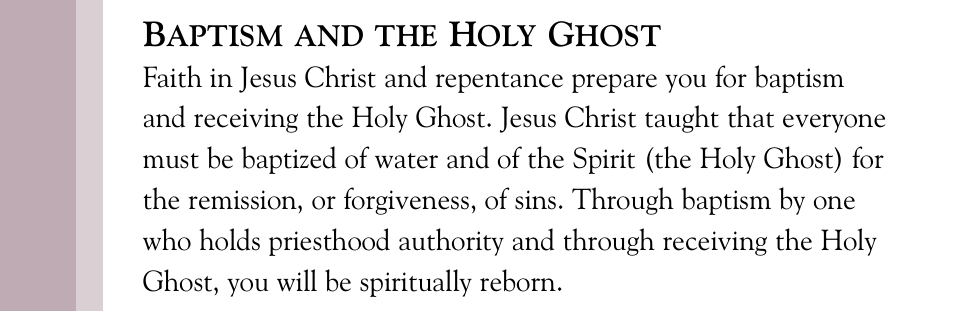
Moving onto baptism and the Holy Ghost. At the top of page 8, it says, “Jesus Christ taught that everyone must be baptized of water and of the Spirit (the Holy Ghost) for the remission, or forgiveness, of sins. Through baptism by one who holds priesthood authority and through receiving the Holy Ghost, you will be spiritually reborn.”
And the text they go to is John 3:5 “Jesus answered, Verily, verily, I say unto thee, Except a man be born of water and of the Spirit, he cannot enter into the kingdom of God.”
The missionaries will tell you that “born of water” is a reference to getting baptized. But notice 2 things here:
Starting at verse 3, Jesus is talking to Nicodemus and says, “Very truly I tell you, no one can see the kingdom of God unless they are born again.”
Then notice what Nicodemus says, “How can someone be born when they are old? Surely they cannot enter a second time into their mother’s womb to be born!”
John 3:6 “Flesh gives birth to flesh, but the Spirit gives birth to spirit.”
The first birth is birth of the flesh, a physical birth. But the second birth is a spiritual birth. Being born of water and of spirit = being born of the flesh and of the spirit
Being born of water is not talking about baptism. It is contextually referring to the physical birth that every person goes through, but not every person becomes spiritually reborn. This also makes sense biologically because what happens right before a baby is physically born? The mom’s water breaks!
Now in regard to the point where it talks about “baptism by one who holds priesthood authority.” Imagine if someone loves God with all their heart and wants to follow his commandment to get baptized. So they find a non-LDS Church and get baptized. Does the LDS Church view this as a proper baptism?

This is a picture of a friend of mine who got baptized this last year (beginning of 2024). She was so excited that she sent me this picture. She currently lives in a poverty stricken area in Pakistan. Notice what she is sitting in: a kiddie pool. Her church doesn’t have a baptismal font and there isn’t a clean river nearby either. Additionally, there are hostile Muslims who have terrorized Christian communities close to her city. When I look at this picture, I find it so humbling that she is willing to follow Christ in that kind of environment.
Even though my friend loves Jesus with all her heart, she is spending time as a Sunday school teacher, and wants nothing more than to obey God…according to the LDS Church, this baptism is not legitimate for two reasons:
Because of these factors, Latter Day Saints will look at this beautiful and humbling picture and say, “That’s great that she wants to grow closer to Jesus…but if she wants to get baptized for real…it needs to be through the LDS Church.”
We know that Christ cares most about the heart. And it’s the condition of the heart that makes an ordinance legit or not. Because my friend’s heart was in the right place, she did exactly what Christ wanted her to do and there is nothing wrong or illegitimate about her baptism.
The pamphlet goes on to say, “When you are baptized, you receive a remission of your sins.” Then gives Acts 2:38 as a prooftext, which says, “Repent and be baptized, every one of you, in the name of Jesus Christ for the forgiveness of your sins. And you will receive the gift of the Holy Spirit.”
You know the drill, let’s read the surrounding verses to get a better understanding of the context. Verses 36-37 “Therefore let all Israel be assured of this: God has made this Jesus, whom you crucified, both Lord and Messiah.” When the people heard this, they were cut to the heart and said to Peter and the other apostles, “Brothers, what shall we do?”
These are people who may have been alive when Christ was crucified. Some of them were probably in the crowd chanting “crucify Him!” Peter tells them about Jesus whom THEY crucified and it gripped their heart. They felt terrible and wanted to make things right, so they ask Peter, “What should we do?”
So the question being asked in Acts 2, is from a different angle and that’s why the apostles responded with a different answer. Now, imagine that you have a headache, and you go to the doctor. The doctor gives you a prescription to help with the headache and on the instructions, it says, “Take 2 pills for a headache.”
This does not mean, “Take two pills in order to receive a headache.” It’s saying, “Take two pills because you have a headache.” And this is the same way, Acts 2:38 is saying, “get baptized because you have been forgiven.” Not in order to become forgiven. Forgiveness is a gift of grace through faith in Christ, and not by any kind of ordinance or work.
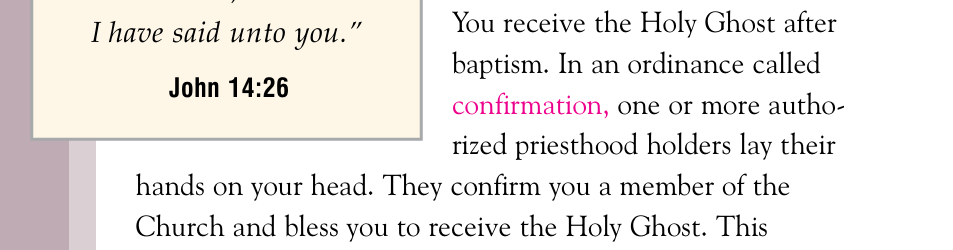
Towards the bottom of page 10, it says, “You receive the Holy Ghost after Baptism. In an ordinance called confirmation, one or more authorized priesthood holders lay their hands on your head. They confirm you a member of the Church and bless you to receive the Holy Ghost.”
In one of my previous videos, I highlight Acts 10:44-48 where there is a group of Christians who approach Peter and they have not yet been baptized. Then Peter says, “These guys have received the gift of the Holy Ghost just as we have…now let’s get them baptized.” That clearly conflictions with the LDS doctrine that you can only receive the gift of the Holy Ghost after baptism.
But then the second requirement is that you must be confirmed as a member into the LDS Church in order to receive the gift of the Holy Ghost. So if you are not a member of the LDS Church, you cannot receive the gift of the Holy Ghost…but we know better. We know that this is only received through faith alone in Christ alone and not through any kind of religious organization.
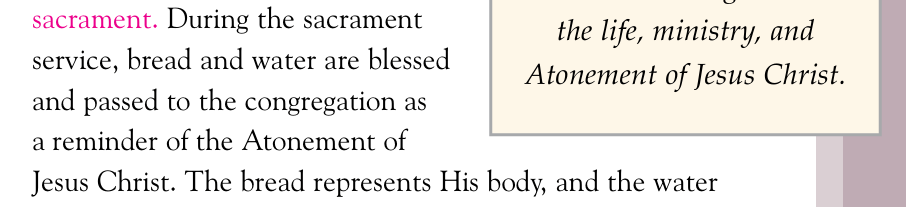
On page 13, it talks about the sacrament and says, “During the sacrament service, bread and water are blessed and passed to the congregation as a reminder of the Atonement of Jesus Christ… The sacrament helps you remember with gratitude the life, ministry, and Atonement of Jesus Christ.”
While sacrament and communion have a lot in common, there is one thing that I have a problem with regarding the sacrament. When LDS members commit some kind of sin and they confess that sin to their bishop. Their bishop might instruct them NOT to take the sacrament for one week or a number of weeks. The bishop will determine when that person is worthy enough to start taking the sacrament again.
The sacrament is something that everyone in the service takes. Now imagine that you committed a sexual sin and your bishop tells you to pass the sacrament for 2 weeks. The next Sunday you are sitting in church and its sacrament. It gets passed down your row and every single person takes it…then it gets to you and you pass it without taking it. People notice that. And when they notice it, they are going to think, “I wonder what kind of sin Paul did. It must of have been something pretty bad if he can’t take the sacrament.” Whether intentional or not, this is a form of public shaming and humiliation.
But more importantly, if the person he repented in their heart, turned away from their sin and wants to surrender that sin to God…why are you preventing them from taking part in an ordinance that is supposed to help them?
We know that communion is between you and God. Regardless of any kind of serious sin that you recently committed, if you were to decide right before the communion plate gets passed around that you are giving that sin to the Lord and repenting of it in your heart with no intent to do it again, Christ wants you to take the bread. You don’t have become worthy and get your life all in order before coming to the Lord and taking communion. If your heart is right with God at any given point, He wants you to partake of communion.
The very last thing this pamphlet covers is once again, “How can I know if these things are true?” On page 17, it says, “Pray to heavenly and then the Holy Ghost will confirm truth through feelings, thoughts and impressions.”
But we know that our feelings can deceived us. That’s why it says in Jeremiah 17:9 says that the heart is deceitful above all things and corrupt.” Our feelings come from our heart. If feelings come from our heart, and if our heart is deceitful…why would we trust it?
It also says, “Express the feelings of your heart (gratitude, questions, requests to confirm the truth of the Book of Mormon and the teachings of the missionaries)”
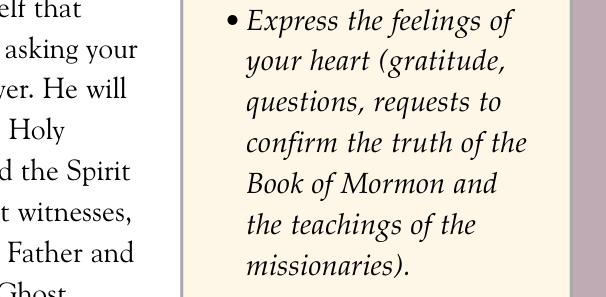
Notice that this is not telling you to test if these things are true. It’s telling you to confirm and assume that these things are true. Then if you get a good feeling, that confirms that these things are true. But 1 John 1:4 says to test all things…not to confirm all things.
It also lists the fruits of the spirit as a prooftext which I want to dig into before we wrap this up. Galatians 5:22-23 “But the fruit of the Spirit is love, joy, peace, forbearance, kindness, goodness, faithfulness, gentleness and self-control. Against such things there is no law.”
They believe that this verse is saying, “if you pray about something and receive feelings of love, joy, peace, and so on…then that is the Holy Ghost telling you that whatever your praying about is true. In short, good feelings are from God, bad feelings are from the devil. But once again, lets read the surrounding verses to verify the context.
Galatians 5:19-21 “The acts of the flesh are obvious: sexual immorality, impurity and debauchery; idolatry and witchcraft; hatred, discord, jealousy, fits of rage, selfish ambition, dissensions, factions and envy; drunkenness, orgies, and the like. I warn you, as I did before, that those who live like this will not inherit the kingdom of God.”
Notice that these are all external actions and lifestyles, not internal feelings. This shows that contextually, verses 22 & 23 are also talking about external actions. It is saying that if you are following Christ, then you will consistently show love, joy, peace, patience, etc. It has nothing to do with internal feelings.
Congratulations on completing my 3-part course on Ministering to LDS Missionaries and here is what you can do next: Go onto the LDS Church website, scroll down and submit your contact information to set up a meeting with missionaries in your area.
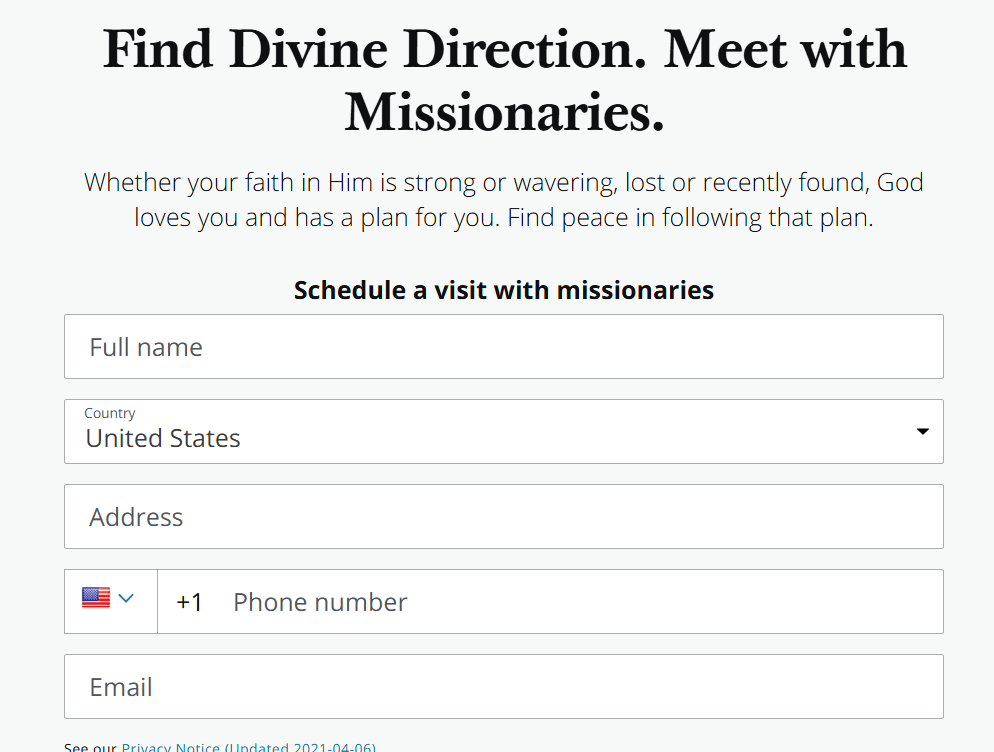
After submitting your information, they will reach out to you either by email or by phone to introduce themselves and set up a meeting. When they come over, you can have notes, Bible verses and questions on hand. Make preparations beforehand. You could even print out one of my Ministering to LDS Missionary lessons right here. I always give them lunch, dinner, or a snack when they come over. Ask them questions like:
Thanks for reading, God bless, and remember to never stop chasing after Jesus!

Starting on page 2, it says:
“As you learn about the plan of salvation, you will find answers to these questions: “Where did I come from?” “What is my purpose in life?” “Where will I go after this life?”
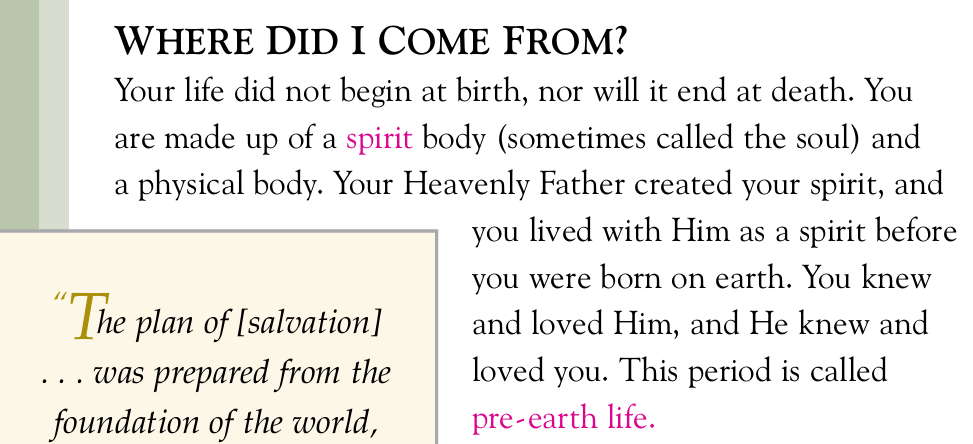
“Can you show me where heavenly mother is mentioned in this pamphlet, in the Bible or in the Book of Mormon?”
The pamphlet goes on to say:
“You were taught about the plan of salvation…you learned that through Him you would be able to overcome the effects of your wrong choices…You would not remember living in Heavenly Father’s presence, but He would give you the ability to know right from wrong.”

For any of these points, a good question to always ask is: “Can you show me in the Bible where it clearly and contextually says that?”
Next up is the Creation and the Fall. It talks about Adam and Eve and how God commanded them not to eat from the tree of knowledge of good and evil. In the middle of page 6, it says:
“Obeying this commandment meant they could remain in the garden, but they could not progress by learning from experiences and challenges.”

On page 7, it lists 2 Nephi 2:22-25
“If Adam had not transgressed he would not have fallen, but he would have remained in the garden of Eden…. “And [Adam and Eve] would have had no children; wherefore they would have remained in a state of innocence, having no joy, for they knew no misery; doing no good, for they knew no sin.”
I was having a conversation on this topic an LDS missionary who has since returned home from his mission and we still keep in touch. He invited me to their church for some volleyball which was a lot of fun and we also enjoyed talking about basketball. I truly do have a lot of respect for this young man. But anyways, after he explained this concept to me needing to sin before being able to make the right choice and knowing right from wrong:
Me: “Did Jesus ever sin?”
Him: “No. Jesus is perfect and sinless.”
Me: “Did Jesus know right from wrong?”
Him (as he glances up towards the ceiling): “……………………..huh……..”
The next part talks about life on earth and how its best for us to obey God’s commands. At the bottom of page 9, it says:
“When you make wrong choices and commit sin, you separate yourself to some degree from God…You cannot overcome sin and its effects by yourself.”
Next, it talks about the atonement of Jesus. It references John 3:16 and then in the middle of page 10, it says:
“God will not make you clean against your will. To receive His help and strength, you need to exercise faith in Him, repent, be baptized, receive the Holy Ghost, and choose to follow His teachings for the rest of your life.”


What must we do to endure til the end? You need to go through the endowment ceremony, you need to receive the priesthoods and other temple ordinances, you need to fast…one word that can summarize these things: works. And in the next section, it clearly explains how our own personal works determine where we are going to end up in the afterlife, and that is what makes this a works-based gospel.
Here is an article from the LDS website titled, “What things do I need to see my bishop about to be forgiven?” The first sentence in this article says, “The short answer is that you need to confess “serious transgressions” to your bishop. These includes (but are not limited to) serious violations of the law of chastity.”

In another article from the LDS Church website, it says, “Why and What do I need to confess to my bishop?” It states that “Some mistakes, especially those requiring immorality require confession to the bishop before you can receive the Lord’s forgiveness.”

When it comes to the area of serious sins, like breaking the law of chastity, there is a man who stands between you and God. Meaning, that there is a specific man on this earth whom you must go through first and confess your sins directly to that specific man before you can receive God’s forgiveness. Confessing your serious sins to God is not good enough.
In one of these articles, the general authority tells a story about a woman. He starts off by saying, “Sometimes a person will stop doing wrong but never confess, when it is needed, to his or her bishop.”

He talks about a middle aged woman who came in for a temple recommend interview. Here is what he said,

Then he ends the talk by stating, “You can be forgiven insofar as you repent… I testify in the name of Jesus Christ that through repentance, including confession to your bishop when necessary, you will become clean.”

Again, repentance in the Bible is confessing your sins directly to God for forgiveness 100% of the time (1 John 1:9). But in the LDS Church, you need to confess your serious sins to the bishop before you can be made clean. There is a man in between you and God whom you must go through if you want to receive forgiveness of your serious sins. Another word for someone who stands between you the reconciliation and forgiveness of God is a “mediator.” 1 Timothy 2:5 makes it clear that there is only one mediator between God and man, and it’s Jesus…not any other man on earth.
The next point is: “You must be baptized.” This is also connected with the 4th point of receiving the Holy Ghost.
This is considered the first saving ordinance that you must receive if you want to live in the presence of God and receive eternal life. After that happens, you will then receive another required ordinance of being confirmed as a member of the LDS Church. At that point, you will receive the laying on of hands and someone with priesthood authority will bless you with the gift of the Holy Ghost…and it must be done in that order. If you aren’t baptized and confirmed into the LDS Church, you cannot receive the gift of the Holy Ghost. The reason why this is problematic is because we actually read about a group of Christians in the New Testament who received the gift of the Holy Ghost prior to being baptized.
In Acts 10:45-48 “The circumcised believers who had come with Peter were astonished that the gift of the Holy Spirit had been poured out even on Gentiles. For they heard them speaking in tongues and praising God. Then Peter said, “Surely no one can stand in the way of their being baptized with water. They have received the Holy Spirit just as we have.”So he ordered that they be baptized in the name of Jesus Christ.”
The LDS Church teaches that there is a progressional order in which things need to be done. The gift of the Holy Ghost can only be received after one has been baptized into the LDS Church. But here in Acts 10, we see that there was a group of Christians who already had the gift of the Holy Ghost, then Peter says, “Let’s get them in the water.”
Scripture is clear that you do not need to be baptized first before receiving the gift of the Holy Ghost. The LDS Church contradicts what we clearly see in the New Testament.
At the bottom of page 10, the pamphlet asks the important question: “Where Will I Go after I Die?” It talks about the spirit world and how you will go here after you physically die here on earth. In the spirit world, there are two places: spirit paradise and spirit prison. If you ask the missionaries for a Bible verse that supports this doctrine, they will take you to 1 Peter 3:18-20
“For Christ also suffered once for sins, the righteous for the unrighteous, to bring you to God. He was put to death in the body but made alive in the Spirit. After being made alive, he went and made proclamation to the imprisoned spirits—to those who were disobedient long ago when God waited patiently in the days of Noah while the ark was being built.”
They believe that Peter is talking about the spirit world. But here is the thing that we want to point out to our LDS friends. This specific passage is talking about a specific group of spirits: those who were disobedient in the days of Noah. We can agree and that there is a place where spirits who were disobedient in Noah’s day are being held…but there is nothing in passages implying that everyone goes to this going to either go to that same dimensional spirit prison or spirit paradise.
I talked about this passage with an LDS friend of mine and after discussing the concept of eisegesis, where you start with your presupposed belief and then find a Bible verse that sounds like it supports your belief without looking at the surrounding context. I explained it to him just like that and said, “this passage is talking about disobedient spirits in Noah’s day. Nothing in here contextually suggests that anyone else today is going to go to that same spiritual prison.” Then he looked down and read the passage one more time. I can’t remember precisely what he said, but it was something along the lines of, “I can see how this verse is would appear ambiguous and wouldn’t support the doctrine of spirit prison without the Doctrine & Covenants.”
And I truly applaud the integrity of my dear friend for realizing this. The passage my friend was referring to is D&C 138. To give a little bit of background:
“Some of the revelations as they now appear in the Book of Doctrine and Covenants have been changed and added to. Some of the changes being of the greatest importance as the meaning is entirely changed on some very important matters; The revelations were printed in the Book of Commandments correctly! But in the winter of 1834, they saw that some of the revelations in the Book of Commandments had to be changed, because the heads of the church had gone too far. So the book of ‘Doctrine and Covenants’ was printed in 1835, and some of the revelations changed and added to.” (David Whitmer – An Address to All Believers in Christ)
I’m not going to go further into that topic right now, but if you want me to make a video and go deeper on this topic and explain what Scriptures Smith changed, added and removed, let me know in the comment section below.
But the Book of Commandments eventually evolved into The Doctrine and Covenants and in this Scripture, chapters were continuously being added to it.
And that is a very quick snapshot of the four LDS standard works: The Bible, Book of Mormon, Doctrine & Covenants and Pearl of Great Price. But of the 4 of these, the very last chapter of Scripture was written in 1918, and that would be Doctrine & Covenants chapter 138.
In this chapter, Prophet Joseph Fielding Smith claims to have received a revelation and it is specifically on the doctrine of the spirit world. He quotes 1 Peter chapter 3 and gives us more “knowledge and revelation” as to what exactly Peter was talking about.
Two things we can bring up here:
Romans 3:23-24 “For everyone has sinned; we all fall short of God’s glorious standard. Yet God, in his grace, freely makes us right in his sight. He did this through Christ Jesus when he freed us from the penalty for our sins.”
“The dead who repent will be redeemed, through obedience to the ordinances of the house of God, And after they have paid the penalty of their transgressions, and are washed clean, shall receive a reward according to their works, for they are heirs of salvation.”
The first thing that stands out to me is how similar this is to the Catholic doctrine of purgatory. But the other thing is that this verse is linked to Alma 5:21 which says:
“…there can no man be saved except his garments are washed white; yea, his garments must be purified until they are cleansed from all stain, through the blood of him of whom it has been spoken by our fathers…”
First point is when it says that we are cleansed from our sins THROUGH the blood of Christ. Yet in D&C 138:59, we are cleansed by paying the penalty for our transgressions. Here is an important difference that I noticed:
But the most important thing is how this clearly conflicts with God’s Word which says that Christ suffered for our sins once and for all. If you believe in Christ, then you aren’t going to be judged for our sins and you are free from the penalty of your sin…but here, Prophet Joseph Fielding Smith writes, “Nope…everyone who rejects the restored gospel is going to suffer and pay the penalty for their sins in the spirit world. And only after suffering for their sins will they be washed clean.”
In other words: the blood of Jesus is NOT enough to wash your sins away. You need to contribute suffering of your own on top of the suffering of Christ, because his sacrifice isn’t enough. This is a slap in the face to the savior of the world.
At general conference in 2008, General Authority Jeffery Holland gave a talk called, The Atonement of Jesus Christ. In this talk, he made a statement regarding mankind:
“They are NOT freely and universally given a reprieve OF THEIR OWN SINS UNLESS they pledge faith in Christ, repent of those sins, are baptized in his name, receive the gift of the Holy Ghost and CONFIRMATION INTO CHRIST’S CHURCH, and press forward in faithful endurance the remainder of life’s journey.”
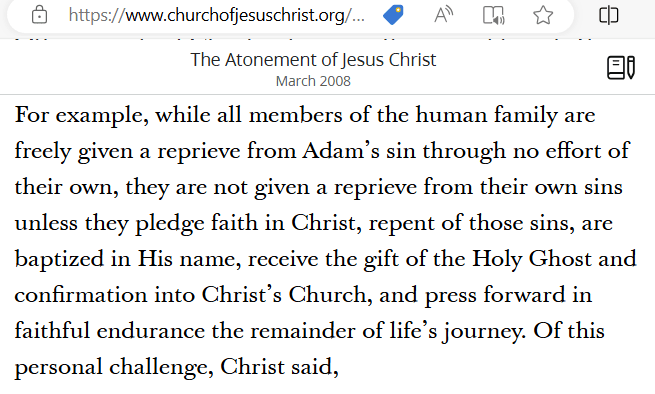
Again, the sacrifice and blood that Jesus spilt for you is not enough to blot out your transgressions. Even if you repent of your sins, obey his commands, and love him for your all the days of your life…as Jeffery Holland clearly stated, you will not be reprieved or forgiven of your sins unless you are confirmed into the LDS Church and follow their teachings. Full forgiveness of sins is not possible apart from their organization.
So after you die, you go to the spirit world, then at some point later, the resurrection will occur. According to LDS doctrine this is when the judgement happens. Continuing to the bottom of page 12 in the pamphlet, it says:
“After you are resurrected, you will go before God to be judged according to your works and the desires of your heart.”
At this point, the main scripture they’re likely to quote here is Revelation 20:12-13
“And I saw the dead, small and great, standing before God, and books were opened. And another book was opened, which is the Book of Life. And the dead were judged according to their works, by the things which were written in the books. The sea gave up the dead who were in it, and Death and Hades delivered up the dead who were in them. And they were judged, each one according to his works.”
What does this contextually mean and how do we reconcile it with other passages that clearly say that we are saved by grace through faith and not by works? That we are declared righteous by faith apart works? When we read Revelation chapter 20 in context, we understand that it deals with 3 types of people:
The end of verse 4 and verse 5 say, Revelation 20:4-5 “…They (believers) came to life and reigned with Christ a thousand years.”
Those who are alive in Christ will be resurrected when Christ returns get to reign with him in the millennial kingdom, but the dead will not be resurrected until the 1,000 years has ended. Verse 12 is talking about the judgement of the dead / non-believers. So when we are looking at a timeline, we understand that there are different judgements that are going to take place at different points in time.
Jesus said in Matthew 25:32-33 “All the nations will be gathered before him, and he will separate the people one from another as a shepherd separates the sheep from the goats. He will put the sheep on his right and the goats on his left.”
This is the first judgement. When Jesus returns, he is going to separate people into two groups: On one side, you have those who have eternal life, will be resurrected upon his return, and get to live with Him in his millennial kingdom. Then on the other side, you have those who do have eternal life, will not yet be resurrected upon Christ’s return and will not get to live with him. It’s important to note that at this judgement, these are the only two categories. Either you have eternal life with Christ or you don’t.
Going back to Revelation 20, it describes these two groups as those who are alive in Christ and those who are dead. First, he is going to judge the living when he returns, then after the 1,000 years, he is going to resurrect and judge the dead. But still, what exactly does this mean? Are we saved by works or not?
Jesus gives us a little more clarity in Matthew 16:27 when he said, “For the Son of Man is going to come in his Father’s glory with his angels, and then he will reward each person according to what they have done.”
The important word to notice here is “reward.” Jesus is going to reward each person according to what they have done when he returns. But as we just covered, believers are going to be the first group of people who will be resurrected and judged upon his return…and they will be rewarded according to their works. And that is the difference right there. Romans 6:23 says that eternal life is a free gift.
John 3:18 “Whoever believes in him is not condemned, but whoever does not believe stands condemned already because they have not believed in the name of God’s one and only Son.”
John 5:24 says that “whoever hears my word and believes him who sent me has eternal life and will not be judged…”
Here is how all of this fits together:
On page 14 in the pamphlet, it talks about degrees of glory. The LDS Church teaches that at the resurrection, everyone will be judged and placed in a heavenly kingdom based on their works here on earth. There are 3 kingdoms of heaven also described as degrees of glory. To quickly summarize:
The lowest kingdom is the telestial kingdom where evil people will most likely go. People like Hitler, Stahlin, rapists, murders will go here. Interesting sidenote, the LDS Church also teaches that king David is lumped in with these groups of people and is destined to spend eternity in the telestial kingdom with all of these other people that I mentioned. If you want me to make a video on why God banished king David to the telestial kingdom, let me know in the comments.
The middle kingdom is the Terrestrial kingdom. People who try to live a good life and care about others will go here. I have been told by a number of Latter Day Saints that this is where I am going to end up which I take as a compliment. Although, I did recently run into a young LDS member who was preparing for his mission and he told me that I was going to end up in the telestial kingdom with Hitler and all the other evil people.
Then the highest kingdom is called the celestial kingdom. And only the faithful LDS members who have received all of the required ordinances and faithfully kept their temple covenants will qualify to enter into this kingdom. There actually is another eternal place called outer darkness where Satan, his demons, and apostates will end up.
They might describe these different degrees of glory as heavenly rewards. But again, in Matthew 25, Jesus didn’t separate people into 3 groups. He only separated them into 2 groups: those who will eternally live with him, and those who will live eternally apart from him. When attempting to support the doctrine of there being 3 kingdoms of heaven, there are 2 Bible verses they’ll go to:
2 Corinthians 12:2 “I know a man in Christ who fourteen years ago was caught up to the third heaven. Whether it was in the body or out of the body I do not know—God knows.”
They will say, “See? If Paul went up to the 3rd heaven, obvious means that there must 3 levels or kingdoms of heaven.” However, all throughout the Bible, the word “heaven” or “heavens” is used in a couple different ways and here is what I mean:
Jeremiah 4:25 “I beheld, and, lo, there was no man, and all the birds of the heavens were fled.”
Psalm 104:12 “By them shall the fowls of the heaven have their habitation, which sing among the branches.”
In these passages, we understand that the word “heaven” is referring the atmosphere or sky where the birds fly. What else might the word “heaven” be referring to?
Genesis 26:4 “And I will make thy seed to multiply as the stars of heaven,”
1 Chronicles 27:23 “the Lord had said he would increase Israel like to the stars of the heavens.”
Here we see that heaven is in reference to the atmosphere where the sun, stars and moon reside. If the first level of heaven is the sky, and the 2nd level of heaven is outer space, we can logically conclude that the 3rd level of heaven that Paul is talking about in 2 Corinthians 12 is in reference to God’s heavenly kingdom. There is only 1 level of the spiritual realm of heaven, not 3.
The other passage they will go to is 1 Corinthians 15:40 “There are also celestial bodies, and bodies terrestrial: but the glory of the celestial is one, and the glory of the terrestrial is another.”
In this passage, it seems like they have a solid case because, it specifically mentions the words “terrestrial” and “celestial.” It doesn’t mention “telestial,” but hey, 2 out of 3 ain’t bad, right?
This is a great opportunity for you to walk them through this passage and study it together with them, teaching them how to properly and contextually study God’s Word. You will want to start back at verse 35 which says, “But someone will say, “How are the dead raised? And with what kind of body do they come?”
That is the question that Paul is addressing. When Jesus returns and the resurrection takes place, what kind of bodies are people going to have? See, there were people at this time who believed that this life was all there was and that there was no afterlife. And they knew what happens to bodies when they have been dead for a long time…they decay and eventually turn back into dust. So these people are asking basically asking Paul, “When people die, are they going to come back looking like zombies? Or what happens to be people who have been dead for a long time have literally decayed into dust? What kind of body are they going to have?”
This the question that Paul is about to answer and he starts off by giving us a couple examples of what different bodies look like right now.
1 Corinthians 15:39 “All flesh is not the same flesh, but there is one flesh of mankind, another flesh of animals, another flesh of birds, and another of fish.”
Then in verse 41, he gives us some more examples of different kinds of bodies:
“There is one glory of the sun, another glory of the moon, and another glory of the stars; for star differs from star in glory.”
First Paul gives us examples of bodies that dwell on earth, now he is giving us some example of bodies that dwell in the heavens or outer space. Then Paul summarizes this point and hits it home in the next couple verses:
“So also is the resurrection of the dead. It is sown a perishable body, it is raised an imperishable body; it is sown in dishonor, it is raised in glory; it is sown in weakness, it is raised in power; it is sown a natural body, it is raised a spiritual body. If there is a natural body, there is also a spiritual body.”
That last sentence summarizes Paul’s entire point here. He is not saying that there are different kinds of resurrected bodies that will be placed in a certain level of heaven. The only point that Paul is making is that at the resurrection, people won’t have a physical body like you have now…they are going to have a supernatural kind of spiritual body.
Yes, the King James Bible uses the words, Terrestrial bodies and Celestial bodies, but in modern Bibles today, the more modern terms that are used are “earthly bodies” and “heavenly bodies.” This passage does not in any way contextually support the doctrine that there are 3 kingdoms of heaven called Telestial, Terrestrial and Celestial.
Feel free to leave a comment below of what you agreed or disagreed with. Thank you for reading, God bless, and remember to never stop chasing after Jesus!

Aside from choosing to follow Christ, the biggest decision one can possibly make in this life is who to marry. This is a life-long covenant we are talking about and “what God has brought together, let man not separate.” So we’d better be very wise and discerning not only in our own life but in the lives of our children as well (for those who have kids). How can we guide them with wisdom without overwhelming them?
Brant Hansen is a radio host and author. A number of years ago, he wrote a fantastic piece on this called, “5 Things I Want My Daughter to Look For In A Man.” Below are his points with some of my personal additions. Keep in mind that it is a given that we want our daughters to marry a man who is a follower of Christ. The list gives some practical ways of what it should look like if a man truly is a follower of Christ:
He doesn’t make excuses. He doesn’t run away from his own mistakes. He doesn’t see himself as a victim. To me, this is the essence of masculinity. There’s a word for a man who is not willing to admit his mistakes and take responsibility: A child.
This can be shown in many ways: He can successfully work a job that he doesn’t like. He shows discipline with his money. He listens to people even when they’re not talking about something he enjoys. Pay attention to what things he is willing to sacrifice.
Some men think acting in anger is a mark of manliness. I’ve found that quite the opposite is true. After all, even a toddler can throw a tantrum. Self-control, perspective, mercy and forgiveness are marks of true strength.
Does he get easily frustrated and upset whenever an unexpected or inconvenient situation occurs? Or does he display a flexible and calm demeanor?
How does he treat people who can do nothing for him? How does he treat and talk about people who have special needs or are not outwardly attractive? If he tends to ignore or mock them, you’re very possibly dealing with a narcissist. Run away…now.
He doesn’t try to manipulate you to get what he wants. When he encounters the vulnerable, he doesn’t make fun of them. He defends and befriends them, even when no one’s looking. Even if a man seems “church impressive”, check for this stuff. Being on stage, leading worship, talking a great “Christian game,” being admired in public, and leading a ministry is great and all, but it has nothing to do with being a great husband.
6. He doesn’t change into different “modes”
Anyone can put on a front when he knows that others are watching him. Is he the same person when the two of you are alone? Does he have a “spiritual switch” that he can easily turn on and off? Does he have integrity? Is he striving to make the right choice even when no one else will know?
I would love to hear your thoughts. What do you think is something that daughters should look for in a spouse?
Thanks for reading. God bless. And remember to never stop chasing after Jesus!

In one of the missionary pamphlets that they pass out to people (The Restoration of The Gospel of Jesus Christ), the first thing it says is “God is your father in heaven.”
When it says this, it means that God the father is literally the father of your spirit. Meaning that heavenly father and heavenly mother together procreated your spirit, and you are literally their spirit offspring. The primary Bible verse that LDS members will most often go to is Acts 17:29 which says:
“Therefore since we are God’s offspring, we should not think that the divine being is like gold or silver or stone—an image made by human design and skill.”
Whenever we are reading God’s Word, we should always strive to be faithful interpreters of God’s Word. One of the ways we can do that is by verifying the context of a single verse by reading the verses before and the verses after to make sure we have a proper understanding of what the paragraph and this verse are actually saying. If we take this approach and jump back just one verse to Acts 17:28, it says:
“As some of your own poets have said, ‘We are his offspring.’”
The first thing we notice is that Paul is quoting pagan Greek poetry. And poetry very often uses metaphors that should not be taken in a literal sense. Paul is quoting a pagan source in order to make a theological point to the people of Greece. Quoting a source that the people are familiar with would enable them to understand Paul’s message more easily. Other passages in the New Testament clarify that we are not literally God’s offspring.
Romans 8:14-15 “For those who are led by the Spirit of God are the children of God…the Spirit you received brought about your adoption to sonship.”
Galatians 4:4-5 says: “God sent his son…to redeem those under the law, that we might receive adoption to sonship.”
Two points:
1st – Not everyone is a child of God. Only those who are led by the Spirit are His children.
2nd – We become children of God when we are spiritually adopted into his family which occurs when we become born again by putting our faith in Christ.
A good question to ask our LDS friends and missionaries on this topic would be:
I see that we can become spiritually adopted into God’s family, but can you show me a verse that clearly states that we are the literal offspring of heavenly father and heavenly mother?
This concept of being adopted into God’s family is so beautiful. Truth be told, we are born sinners. There is a reason why two of the most common words in a toddler’s vocabulary are “no” and “mine.”
At dinner time: “No, mom and dad…I will not eat my broccoli!”
A sibling has a toy that the toddler wants: “Mine!” as they walk up to the sibling and snatch the toy out of their hands.
There is a reason why we have to teach our kids how to share and be unselfish. Why is our default nature selfishness? I never taught my kids how to lie, cheat, steal or hit…they picked that up all on their own because they are born with a sin nature. As a result of Adam and Eve’s sin at the fall, you and I enter into this world as natural enemies of God.
Yet in his mercy, God sees us in our mud pit of sin and reaches down, offering us his hand with this amazing gospel of grace and forgiveness. For more information on this topic, check out my other article, “Which Gospel Are You Under” (https://jllds.org/2024/01/12/which-gospel-are-you-under/)
John 1:12 “Yet to all who did receive him, to those who believed in his name, he gave the right to become children of God.”
To anyone who chooses to believe and receive this free gift of eternal life, those will become spiritually adopted into God’s family. And once you are adopted into God’s family, He will never kick you out. For his unconditional love endures forever.
Romans 8:38-39 “And I am convinced that nothing can ever separate us from God’s love. Neither death nor life, neither angels nor demons, neither our fears for today nor our worries about tomorrow—not even the powers of hell can separate us from God’s love. No power in the sky above or in the earth below—indeed, nothing in all creation will ever be able to separate us from the love of God that is revealed in Christ Jesus our Lord.”
2 Corinthians 9:15 “Thanks be to God for his indescribable gift!”
It’s important to remember what our motives should be whenever we do engage with anyone of a different faith. Those motives should be:
Keeping that in mind, let’s get to it the first lesson that LDS missionaries are trained to teach you. Below is a link to the online pamphlet if you want to follow along and see exactly where it says something as you read through my following notes:
https://www.churchofjesuschrist.org/bc/content/ldsorg/content/english/manual/missionary/pdf/36920_the-restoration-eng.pdf?lang=eng&icid=osd
_____________________________________________________________
On Page #3 in the pamphlet, the very first thing it says is: “God is your father in heaven.” When it says this, it means that he is literally the father of your spirit. Meaning that heavenly father and heavenly mother procreated you and you are literally their spirit offspring.
When interacting with Latter Day Saints, you’ll find that there are many rabbit trails and differences to discuss. My first tip is to pick and choose your battles. I normally don’t choose to dig into this topic because I would rather try to steer the discussion in a more essential direction, such as who is Jesus or what is the gospel?
But I still want to equip you just in case the missionaries want to dig into this point. The primary Scripture they are trained to go to is Acts 17:29 which says:
“Therefore since we are God’s offspring, we should not think that the divine being is like gold or silver or stone—an image made by human design and skill.”
In my last video, I mentioned how we should strive to faithful interpreters of God’s Word and one the ways we can do that is by reading the verses before and the verses after to verify the surrounding context.
If we jump back just one verse to Acts 17:28, it says:
“As some of your own poets have said, ‘We are his offspring.’”
The first thing we need to realize is that Paul is quoting pagan Greek poetry. And poetry very often uses metaphors and illustrations that should not be taken in a literal sense. Yet that is what Latter Day Saints do to this passage.
Other passages like Romans 8:14-15 and Galatians 3:4-5 clarify that we are not literally God’s offspring. Romans 8 says: “For those who are led by the Spirit of God are the children of God…the Spirit you received brought about your adoption to sonship.”
Then in Galatians 4:4-5 says: “God sent his son…to redeem those under the law, that we might receive adoption to sonship.”
Two points:
1st – Not everyone is a child of God…only those who are led by the Spirit are His children.
2nd point – We are not God’s literal offspring, but we become spiritually adopted into his family when we put our faith in Christ and are born again.
A good question to ask on this topic would be: Is there a Scripture that clearly states that we are the literal offspring of heavenly father and heavenly mother?
On the top of Page 5, it says, “He taught them (the 12 apostles) and gave them priesthood authority to teach in his name.”
A good starting question for this topic would be: “How would someone like me receive priesthood authority?”
To which they will answer, “Someone who already has the priesthood needs to lay their hands on you and then pass the priesthood onto you through what is called, the “laying on of hands.”
The follow up question needs to be: “Since Jesus is our example, can you please show me a clear Scripture where Jesus laid his hands on the apostles and passed on the priesthood?
The best thing they can give you is an ambiguous passage that talks about Jesus giving the apostles authority, but again, you really want to hammer the point home that we never see Jesus laying his hands on anyone to pass on the priesthood, nor do we see any prophet or apostle laying their hands on anyone to pass on the priesthood. This super important saving ordinance is completely absent from God’s Word.
Another point that you could make: “The term “priesthood authority” is found nowhere in Scripture. If it really was that important, why isn’t there any clear references to it?”
They might bring up 1 Nephi 13:28 which states that many plain and precious truths have been removed from the book of the lamb/the Bible.
On page 8, it says that the “apostles were killed and the priesthood authority was taken from earth.” They always seem to forget about the apostle John. As far as we know, he was the only apostle that was not killed and died a natural death. John actually had 2 disciples of his own, named Ignatius and Polycarp. They had a disciple named Iraneaus. Then Iraneaus has a disciple name Hippolytus.
Question to ask: “Are you really telling me that the apostle John dropped the ball and forgot to pass on the saving ordinance of the priesthood?”
Again, if it really was that important, surely John would have passed it on and instructed his disciples to continue passing it on as well. We also have letters from John’s disciples. Yet, in the writings of John and his apostles, we see no mention at all of Jesus or anyone else passing on the priesthood by the laying on of hands. All the evidence points to no one in the Bible ever doing this.
They might explain that the apostles did pass on the priesthood by laying on of hands, but after a few centuries, that priesthood authority was lost. Let’s stop for a minute and critically think how this would play out:

2. In Acts 2:41, we read “Those who accepted his message were baptized, and about three thousand were added to their number that day.”
– Thousands of people were joining the church!

3. But for some reason, not everyone was receiving the priesthood authority.

4. Over time, few and few people received the priesthood authority until there was no one left who had it. This is when the church that Jesus built was officially and completely destroyed.

5. One way to summarize this is that the number of converts to Christianity dramatically increased while the number of people with priesthood authority significantly decreased.
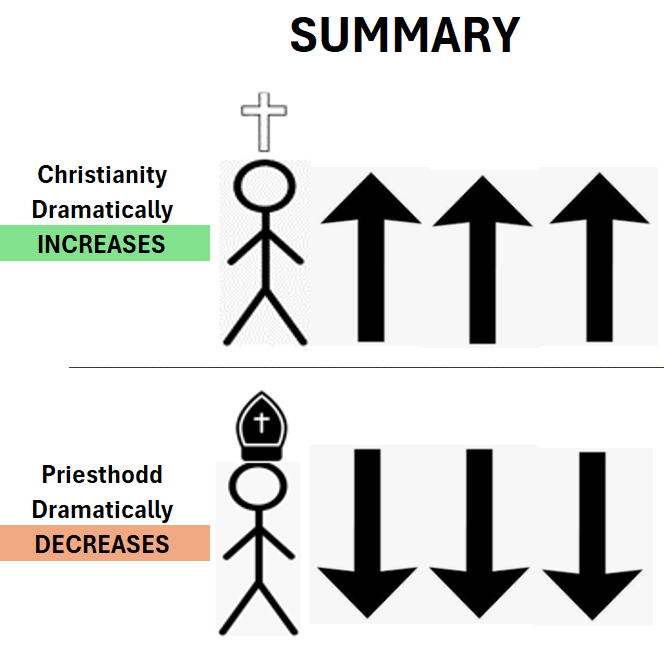
I hope you can see how inconsistent this sounds.
In the middle of page 8, it talks about the Great Apostasy. It doesn’t come right out and say that the Church that Christ built was destroyed. It just says that the priesthood was lost and errors crept into the church.
But on the LDS Church website, here is what it says:
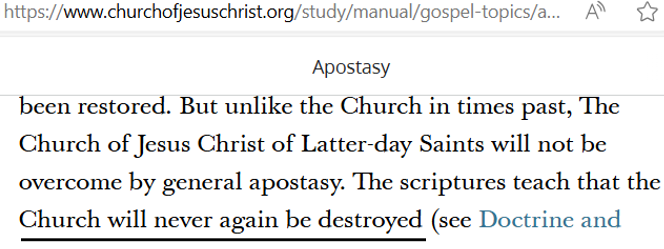
Here is a super important question you can ask them, but start by clarifying what this article is saying. Start by saying, “So if I understand this correctly, Jesus built his church…but it got destroyed. Then 1800 years later, Joseph Smith built the Church of Jesus Christ of Latter Day Saints, and it’s not going to be destroyed. Is that accurate?”
They most likely will say, “Yup, that’s exactly right.” To which you can rephrase the question by saying:
“Jesus is the God of creation, Jehovah of the Old Testament, the alpha and the Omega. You are telling me that the church that the almighty God, Jesus built was destroyed, but the church that a man built will last forever…can you guys understand why that doesn’t make a lot of sense to me?”
After saying this, they might appeal to the Bible and attempt to use some verses that support this idea of the destruction of Christ’s church which is better known as, The Great Apostasy. They are trained to go to two Bible passages. The first one being Amos 8:11-12 where God says:
“The days are coming, when I will send a famine through the land— not a famine of food or a thirst for water, but a famine of hearing the words of the Lord. People will stagger from sea to sea and wander from north to east, searching for the word of the Lord, but they will not find it.”
They will say that this is a prophecy about the Great Apostasy that was to come. But again, we need to read this verse in context and be faithful interpreters of God’s Word. If we read the opening of the chapter, verse 2 says:
“Then the Lord said to me, “The time is ripe for my people Israel; I will spare them no longer.”
This prophecy is about Israel and how God is going to judge them. The verses immediately after verse 12 give us context that God is going to judge the Israelite nation of Samaria for the idol worship. And we actually see the fulfillment of this prophecy take place in 2 Kings 17:5
“Then the king of Assyria came up throughout all the land, and went up to Samaria, and besieged it three years.”
This is a specific reference about a specific group of people for a specific sin they were committing. Contextually, it is not in any way referring to the Great Apostasy that allegedly took place after the time of Christ.
The other passage they like going to is 2 Thessalonians 2:3
“Don’t let anyone deceive you in any way, for that day will not come until the rebellion occurs”
They will try to say that the “rebellion” is talking about the great apostasy. Once again, just read the verses before and the verses after, and we can quickly come to the conclusion that this is not the case. Latter Day Saints are so focused on the word “rebellion” that many of them don’t even pay attention to the last half of this verse, which says, “and the man of lawlessness is revealed, the man doomed to destruction.”
So there is going to be a rebellion that occurs…but when will it occur? After the man of lawlessness is revealed! This man of lawlessness is also known as the anti-Christ. Since the anti-Christ has not yet been revealed, we know that this prophesied rebellion has not happened yet. Therefore, it can’t be referring to the LDS Great apostasy.
Verses to point them to:
Matthew 16:18 “And I also say to you that you are Peter, and upon this rock I will build My church; and the gates of Hades will not overpower it.”
Jude 1:3 “Dear friends, although I was very eager to write to you about the salvation we share, I felt compelled to write and urge you to contend for the faith that was once for all entrusted to God’s holy people.”
Which Version Is Right?
Below is a Greek Bible that has the literal English wording above each Greek word.

The Greek word is “hapax.” We can see here that the literal translation is “once for all.” The King James Bible is fantastic for its time, but modern Bibles today are easier to understand. Some of the more scholarly Latter-Day Saints might push back and say that the Greek word, “hapax” should be translated as “once.” And they aren’t wrong.
Yes, “Hapax” can mean “once.” But it can also mean, “once for all” depending on the context. Below is a screenshot of the Strong’s concordance which breaks down each usage of “Hapax” in the Bible and splits them into two groups: passages where it contextually means, “once” and passages where it contextually means, “once for all.”
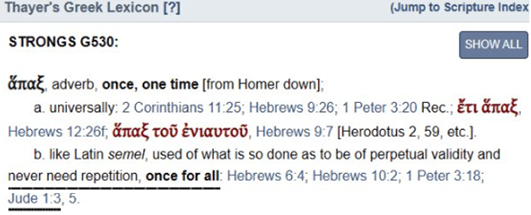
As we can see in the bottom left corner of the screenshot above, the correct usage of “Hapax” in Jude 1:3 is “once for all.”
Question #1: “According to God’s Word, how many times will the gospel be delivered to the saints?“
Question #2: “I believe that God is strong enough and wise enough to figure out a way to protect his church from ever being destroyed. Do you?”
Page 11 in the pamphlet talks about Joseph Smith and the first vision. Let me know in the comment section if any of you want me to make a video of the different and conflicting accounts of Joseph Smith’s first vision.
On page 12, it talks about how John the Baptist, Peter, James and John all appeared to Joseph Smith, they laid their hands on him and passed on the priesthood authority. A big oversight here is that in Hebrews 7:23-24 it says:
“Now there have been many of those priests, since death prevented them from continuing in office; but because Jesus lives forever, he has a permanent priesthood.”
When priests died, they lost their priesthood status. John the Baptist, Peter, James and John all died. This means that they don’t have any kind of priesthood status, yet here they are passing on the priesthood to Joseph Smith. That would be a conflict along with the fact that Jesus alone is the rightful holder of the Melchezidek priesthood because he lives forever. No one else can rightfully claim to have it. It belongs to him alone.
On page 15, it starts talking about the Book of Mormon and how we got it. It briefly states that “Joseph Smith translated this book from an ancient record written on gold plates.”
I remember having two missionaries over for dinner and I asked them, “How exactly did Joseph Smith translated the Book of Mormon?” Before answering, one of them asked me, “What do you know about it?”
I told him that I was aware of how Joseph Smith took a seer stone, put it into a hat and held the hat up to his face, and didn’t even look at the gold plates for most of the translation process. After informing him of what I knew, the missionary honestly answered and confirmed that these things were true. But if I wasn’t aware of these things, would this missionary have honestly told me the transparent truth? I have a hard time believing that he would voluntarily expose the fact that Joseph Smith used a seer stone to translate the gold plates.
Anyways, the reason why this one makes me upset is because of how it intentionally paints a picture in the mind of the naïve investigator that Smith was diligently examining and translating the gold plates. There is an article on the LDS Church website called, “Joseph Smith Translates the Gold Plates.” The first picture at the very top of this article shows Joseph Smith sitting at a desk and studying the gold plates with a scribe on the other side of the curtain. Here is the picture:

The seer stones aren’t even mentioned in this article nor are they mentioned in the pamphlet. So many Latter Day Saints today believe that the above picture is what happened, when the truth is that it never happened…yet there it is on the LDS Church website. The fact remains that if investigators were aware how Smith truly translated the gold plates, it would significantly decrease the number of converts to the LDS Church.
Here is something else that might be interesting to touch on and ask the missionaries about:
In the middle of page 15, it lists a quote from the Book of Mormon introduction page which says, “The Book of Mormon is a record of God’s dealings with the ancient inhabitants of the Americas and contains, as does the Bible, the fulness of the everlasting gospel.”
Apparently both the Book of Mormon and the Bible contain the fulness of the everlasting gospel. But in 2013, the LDS Church edited the introduction page and removed those four words, “as does the Bible.”
Question to ask: “In 2012, the Bible contained the fulness of the everlasting gospel, but in 2013, it apparently no longer contained the fullness of the gospel. Why did the LDS Church remove those 4 words from the introduction page in 2013?”
Then lastly on page 16, it tells us how we can know if these things are true. In the middle of the page, it says that “the holy ghost confirms the truth through feelings, throughs and impressions.” Then it goes on to say, “These feels from the Holy Ghost are personal revelation to you that the gospel of Jesus Christ as restored through Jospeh Smith are true.”
Where do feelings come from? Our heart…and what does God’s Word have to say about feelings from the heart?
Jeremiah 17:9 “The heart is deceitful above all things, and desperately wicked: who can know it?”
Proverbs 28:26 “He that trusts in his own heart is a fool:”
Can the Holy Spirit speak to us through feelings? Sure. But is that the primary way that we are to go about deciphering what is true from what is false? Absolutely not. Anytime we have an experience or a feeling, we need to test that against God’s Word. If it conflicts with God’s Word, we through it out no matter how strong or amazing the experience was. God’s Word specifically tells us not to trust our feelings because they can deceive us.
Thanks for reading, God bless and remember to never stop chasing after Jesus.

I was shocked when my father told me I had the potential to become a god. He explained that since we were God’s children, it was only natural to become like Him. My 14-year-old mind protested. However, I couldn’t argue with his logic. If I was a literal child of God as LDS doctrine taught, then why shouldn’t I eventually become a god like him? As I grew in my understanding of Mormonism, I learned that I needed to be married before I could ascend to godhood.
After obtaining godhood, my spouse and I would have spirit children and send them to an earth of our creation. It was a continuation of the pattern of eternal progression. As Latter-day Saints we were treading the same path Heavenly Father once walked. I was 16 when I first heard about Heavenly Mother from my Bishop in Priest’s Quorum. He explained that God Himself was married. Again, I was surprised, but couldn’t argue the logic. One of my peers asked the Bishop why we never talked about her, and why her existence wasn’t revealed anywhere in Scripture.
“She’s very sacred,” the Bishop said solemnly. “If people knew of her existence, they would malign her and use her name in vain. I’m sure that would hurt our Father deeply, and that’s why He doesn’t reveal it.”
That piece of emotional rhetoric was enough to satisfy me at the time. When I went on my mission, I was exposed to deeper doctrines. The other missionaries informed me that I could have multiple Celestial wives. For me, even if Celestial polygamy was available, I wasn’t interested in it. One of the missionaries shot me a smug grin. “Why would you want to slow your progression? With more wives you could have more children and attain greater glory.”
When I came home from my mission I continued to study the gospel. I was unable to find any scriptural evidence that God the Father was ever created or walked a mortal path like us.
Former LDS prophet, Harold B. Lee stated, “If it is not in the standard works, we may well assume that it is speculation, man’s own personal opinion; and if it contradicts what is in the scriptures, it is not true.” (January 1969 Improvement Era, Harold B. Lee, p.13)
This implied that it doesn’t matter if a hymnal made reference to a divine mother or even if General Authorities made occasional mention of her. The Standard Works were devoid of any direct reference to her existence. Therefore, she was nothing but speculation.
A lot changed over the next decade and I left Mormonism for the Biblical gospel. I still have LDS friends, and occasionally their zeal for a Heavenly Mother shines through. Now that I’ve had time to think about it, and since I’m no longer committed to the doctrine of eternal progression, the reasons for my uneasiness have come into focus.
Let’s start with the assumption that there’s polygamy in the Celestial Kingdom. After all, Apostles Orson Pratt, Orson Hyde and Prophet Brigham Young all taught that both Jesus and God the Father have multiple wives. While not every Latter Day Saint believes this, it’s worth mentioning briefly. Polygamous marriage in heaven necessarily makes the husband and wife unequal. While the exalted man is having many children with many wives and gaining glory thereby (see Moses 1:39), the exalted woman can only have a fraction of the posterity.
Then there’s the fact that having plural wives implies that the man is not satisfied with any of them. No polygamous wife is ever enough for her husband. It goes back to one of the main issues Evangelicals have with Latter-day Saints: they practice a polygamous atonement and trust many saviors. Even if Jesus is the main one, He has to share with baptism, repentance, temple ordinances, and overall obedience. Plainly stated, in Mormonism Jesus is not enough.
Even if polygamy doesn’t occur in heaven, the existence of Heavenly Mother doesn’t bode well for Mormonism because it puts the Father in a very bad light. Let’s look back at my bishop’s sentiment that God didn’t reveal His wife because people might malign her. Does a Celestial being really need that kind of protection? Shouldn’t she be able to withstand the mockery of measly mortals? She is a goddess for goodness sake!
The idea of any god having such a fragile ego is not only laughable, it immediately renders that God unworthy of worship. What’s the point of worshiping a God that’s no better than us?
There really aren’t many reasons to hide a mother’s existence from her own children. According to LDS doctrine, it’s forbidden to pray to anyone besides the Father. The Mother is completely shut out, thus reducing her to a demigod whose only role is that of an incubator. I can’t imagine LDS women being thrilled about a future like that and not being able to have any kind of relationship with your children for their entire mortal existence.
One could argue that mortality is short, and our future relationship with Heavenly Mother will compensate for lost time, but I disagree. Our relationship with God will be built on what He did for us during mortality.
On the other hand, we’re reunited with a Mother who was completely absent when we needed her most, when our mortal situation was a matter of spiritual life and death. When it comes to parenting, staying out of the limelight isn’t classy…it’s negligent. A relationship like that could never rival what we’ll have with members of the Godhead.
To top it off, some statements by God come off as incredibly callous when you assume Heavenly Mother exists. Keeping in mind that a goddess is literally a female God, let’s look at Isaiah 45:5-6 (KJV):
“I am the Lord, and there is none else, there is no God beside me: I girded thee, though thou has not known me: That they may know from the rising of the sun, and from the west, that there is none beside me. I am the Lord, and there is none else.”
Then there’s Isaiah 44:8 (KJV):
“Fear ye not, neither be afraid: have not I told thee from that time, and have declared it? Ye are even my witnesses. Is there a God beside me? Yea, there is no God; I know not any.”
My friends, this isn’t just God hiding the existence of Heavenly Mother, but lying to do so. This is an action, according to The Book of Mormon, that will have violators thrust into the fires of hell (2 Nephi 9:34).
God continues His denial of Heavenly Mother in Isaiah 46:9 (KJV) when He says:
“Remember the former things of old: for I am God, and there is none else; I am God, and there is none like me.”
Let’s examine the options:
Seriously though, if Heavenly Mother exists, why isn’t she part of our lives? Did she fall from her exaltation? Did she divorce Heavenly Father and lose the custody battle?
Taking all of this into consideration, the option that makes the most sense is that Heavenly Mother is a myth. God wasn’t lying when He said there wasn’t any other God beside Him. He isn’t a control freak who shuts our Mother out and intimately engages with polygamous demi-goddesses.
To those invested in the Heavenly Mother myth, I offer this plea: repent from your animosity and your rebellion against God, even if it is unintentional. This theology only serves one purpose: to siphon away God’s glory.
Would you partake of a beverage that had a tiny bit of alcohol or coffee in it? No, because that little amount contaminates the whole drink. You would fling it far from away from you. In the same way, I implore you to fling these poisonous doctrines as far away as you can.
Abandon all hope but Christ, for His grace is sufficient to save and grant us to the highest exaltation in heaven with Him.

Whether the experience was good or bad, the first time going through the endowment ceremony is an experience that a Latter Day Saint will always remember. In an Ex-Mormon Christian Facebook group, I asked 3 questions regarding the first time they went through the temple endowment ceremony. Some people responded with details. Others answered with just a “yes” or “no.”
For each question, I’ll begin by listing the detailed answers and then end with the statistics of how many people answered “yes” and “no.” Let’s get to the first question:
__________________________________________________________________________________________________
Question #1 – Did anyone try to mentally prepare you for your endowment ceremony by telling you something like, “Hey, it might feel strange…but that’s normal and expected.”
12 people indicated that, “Yes, to some degree, I did receive preparation before going through the endowment ceremony for the first time.” While 11 people indicated that, “No, I did not receive any kind of preparation.”
_________________________________________________________________________________
Question #2 – At some point during the endowment ceremony, did you feel that it was strange and looked around to see if anyone else might be feeling the same way?
15 people indicated that, “Yes, it felt strange and I looked around to see if other people were feeling the same way.” While 5 people indicated that, “No, I did not look around at other people.”
____________________________________________________________________________________
Question #3 – After you went through your endowment for the first time, did anyone tell you, “It’s ok if you don’t understand it all right now…just keeping going through the ceremony and you will start to understand it a little better each time.”
20 people indicated that, “Yes, I was told that I would need to just keep going through the endowment ceremony and I will understand it a little more each time.” While only 1 person said, “No,” and that was simply because none of her friends and family were allowed to talk about it.
_________________________________________________________________________
Other comments that were made
________________________________________________________________________
The purpose of the two pictures below is not to embarrass or disrespect LDS members. But rather to inform those who are not aware of these specific details, people who might be considering joining the LDS Church and anyone else who is interested. Everyone should have a right to this information that is allegedly a very important part of the gospel of Jesus and also a requirement to receive eternal life and enter into God’s presence according to LDS doctrine. If these things are true, it should not be kept a secret from anyone.

For each ordinance, members used to be required to recite the following oaths to secrecy:
1st token of the Aaronic Priesthood: “We, and each of us, covenant and promise that we will not reveal any of the secrets of this, the first token of the Aaronic priesthood, with its accompanying name, sign or penalty. Should we do so; we agree that our throats be cut from ear to ear and our tongues torn out by their roots.“
2nd token of the Aaronic priesthood: “…Should we do so, we agree to have our breasts cut open and our hearts and vitals torn from our bodies and given to the birds of the air and the beasts of the field.“
1st token of the Melchizedek priesthood: “…Should we do so, we agree that our bodies be cut asunder in the midst and all our bowels gush out.”
New Name that you are given at your endowment ceremony: “I, ______, think of the New Name, covenant that I will never reveal the First Token of the Aaronic Priesthood, with its accompanying name, sign and penalty. Rather than do so, I would suffer my life to be taken.”
Around the 1990, the LDS Church sent out a survey of things their members liked and didn’t like. They also wanted to know why former members left Mormonism. These vile oaths were a common complaint. After examining the surveys, the LDS Church leaders allegedly received a “revelation” from God to remove the vile section of these oaths. Today, they are no longer part of the temple endowment ceremony. Interesting how the god of Mormonism changes and seemingly must give in to peer pressure in order to retain members of his one true church.

____________________________________________________________________________
As some of the former LDS members stated, members who go through the endowment ceremony are required to take an oath of secrecy regarding the ordinances and things that they do in the temple. But what did Jesus teach?
Matthew 18:20 “I have spoken openly to the world,” Jesus replied. “I always taught in synagogues or at the temple, where all the Jews come together. I said nothing in secret.”
If the temple endowment ceremony truly was part of the restored gospel, why did Jesus never teach anything in secret while the LDS Church has always said and taught things in secret inside of the temple? If Jesus truly is our example, shouldn’t we do as he did and teach nothing in secret? This indicates that the LDS Church should make the endowment ceremony and ordinances public knowledge for all to know about. But the fact is that if everyone was aware of these things, it would significantly decrease the number of converts to the LDS Church…and the LDS leaders obviously don’t want that to happen.
God never ceases to amaze me when He takes something evil and uses it for His good and perfect purpose. That He can use something like the endowment ceremony to wake people up, guide them out of a false religion and into his true gospel of grace. For more information about temples, check out the article, “Do We Still Need A Temple Today?” (Do We Still Need A Temple Today? – JLLDS Ministries)
If you have a friend who might benefit from this article, please pass it along and ask them what they think. Feel free to let me know your thoughts, things you appreciated or things that you disagreed with in the comment section below. Thank you for reading and God bless!

Proverbs 7:21-23 “With persuasive words she led him astray; she seduced him with her smooth talk. All at once he followed her like an ox going to the slaughter, like a deer stepping into a noose till an arrow pierces his liver, like a bird darting into a snare, little knowing it will cost him his life.”
When a fish sees that worm on a hook, it often gets tempted to bite it. Little does the fish know that biting that hook might very well lead it to its’ death. After a fish takes the bait and swallows the hook, it gets caught in the fish’s throat and can be very, very difficult to remove. Sin can be very similar to this. It can negatively take us farther to do and say things that we never imagined that we would ever do, and it can feel discouragingly impossible to break old habits.
I’ve have experienced the “hook” of pornography in my own life. Beginning in middle school and going through the first years of my marriage, it was a constant battle…but no one else really knew about it. I kept it to myself, hoping that I would be able to privately overcome this sin and avoid any kind of shame and embarrassment. I wanted to protect my self-image.
When I was in high school and college, I remember thinking, “Once I get married, I will be sexually satisfied with my wife and then I won’t struggle with this sin of lust anymore.” That is a lie straight from the devil. When it comes to sin, it always wants more. Regardless of however much you have or how frequently you get something, your flesh will never be satisfied and always tempt you to get more and more and more.
Not only does pornography damage the active person, but it also severely affects the significant other. The significant other might ask, “Why are they looking at these other people? Am I not attractive enough? Why can’t I satisfy you? There must be something wrong with me.” The sinful act of one spouse can lead to the incredible insecurity of the other. My wife was aware that pornography and lustful thoughts were something that men battle with. So she would lovingly ask me on occasion, “Have you ever struggled with this stuff at all? How are you doing in this area right now?” Not wanting to hurt her and most importantly, not wanting to damage my self-image, I would answer, “I used to struggle with that stuff, but I am over it now.” She was satisfied with this answer. After all, who would think that her “Prince Charming” who apparently looked holy and put together on the outside would have such a shameful problem on the inside? This kind scenario is far too common.
One summer day in 2014, my wife found out my secret as she somehow stumbled across one of the inappropriate websites I had previously viewed. She was devastated due to my lust addiction and my lies. My heart broke at seeing how terrible I made her feel. “How could I hurt my best friend so badly?” I asked myself. I damaged her trust, but she was willing to process things, pray for me, and in time, her heart would heal. I confessed my sin to her only because she found me out, but I still wasn’t willing to confess my sin to anyone else on earth. Even though this was one of the darkest, shameful, hopeless day in my life…I can now see that it was a tender mercy from God. Even while I was wallowing in my sin, God was at work in my life that day and this was the painful start of him breaking me free from my prison of lust.
After the first couple months, I was doing great. I didn’t have any setbacks, but then the guilt started to fade away. I learned that at this time, it was the feeling of terrible guilt that was preventing me from stumbling back into my lust. But that feeling only lasts for so long and after it slowly disappeared, it was back to the same situation as before. I didn’t understand. I would pray every time after I sinned, “Jesus, please forgive me and help me to never do this again.” Why wasn’t he answering my prayers? Why was He allowing me to continue in my sin that hurts both me and my wife?
Later my wife would check in with me and ask me how I was doing. Once again, I would lie and tell her that I am doing good. For more than the previous decade, I remember sitting in my seat on communion Sundays. This was always a time of confession and guilt for me as I would pray, “God, I’m done with that. I’m living for you and I’m not going back.” There might have been stretches of doing a better job of resisting the sexual temptation, but those consistent victories just never seemed to happen. I was still losing more battles than I was winning. Eventually, I became convinced that I was doomed to live with these heavy chains of sin and guilt for the rest of my life. But I was determined not to hurt my wife anymore. So chose that I would lie to her and take this sin with me to my grave. I believed the voices that were whispering in my ear, “You will never overcome this. You might as well accept it without hurting anyone else.” Another lie from the devil.
One night, I knew that God was telling me to confess my sin to my wife. Not only to her, but to other people as well. Preparing to make this confession, I walked around my neighborhood that night in prayer, then returned to my house, walked up the stairs and told her once again that I had been lying to her and I had been looking at things that are dishonorable to both her and God. Her heart broke once again. I praise God that she was willing to forgive me and work through this together. An example of God’s grace shined through her during this time.
The thing that changed this time around was that I was willing to bring forth my sin to her instead of her finding me out. Also, I was finally willing to confess my sin to other people: six of my closest godly friends. I was finally willing to humble myself and sacrifice my self-image by telling them, “I am broken right now and I need support, prayer and accountability. Will you please help me?” This was by far the biggest turning point in this journey. I finally died to this sin in my life and laid down my self-image, and Jesus began to give me more and more consistent victories in this area of my life.
One of the friends who I reached out to for help and accountability responded to me by saying, “Please wait…I need to do something.” I wasn’t sure what to make of this. The next day, he responded and said, “Your confession to me inspired me to confess my sins to my own wife. I have been guilty of indulging in pornography also. We can now pray for each other.” Have I stopped looking at pornography since that time? Yes! Have I been cured from my temptation to lust? No! To this day, it is still a battle and a choice every day. I still need to keep my spiritual guard up, but Jesus has faithfully never left my side and I now have the prayers, support and encouragement of brothers in Christ.
Recently, God brough Joseph and Potipher in Genesis chapter 39. Potipher trusted Joseph with his entire kingdom. When Potipher’s wife attempted to seduce Joseph, he faithfully fled. It was such an important responsibility to take care of everything that his master (Potipher) entrusted to him. The connection that God made to me that was this: “Paul, I have given you this woman to sacrificially love, to gently hold and to always cherish. I have entrusted her to you…and you’d better take good care of her. That is your responsibility.”
To the married men who are reading this: Regardless of how patient you are with your wife, how many things you have bought her, how great of a provider you are or how loving of a father you have been…if you are indulging your lust with pornography, you are not taking care of your wife.
If you are struggling with pornography today, tell someone who you trust. Confession, accountability and a willingness to change are always the first steps in conquering a long-term addiction. After doing this, you must come up with a gameplan and inform others who can support you in this sanctification process. The only way I was able to overcome this sin was because of the foundation of having Jesus as my best friend. To learn more about this, check out this article: Who Is Your Personal Mediator? Who Is Your Personal Mediator? – JLLDS Ministries
I hope this was of some encouragement. If God set me free from the “hook” of lust and pornography, I know that He can set you free as well. Thank you for reading and God bless!

 JLLDS Ministries