
On page 3, it says, “Through the grace and mercy of Jesus Christ, you can become clean from sin and enjoy peace of conscience. You can become worthy to live in Heavenly Father’s presence after this life.”
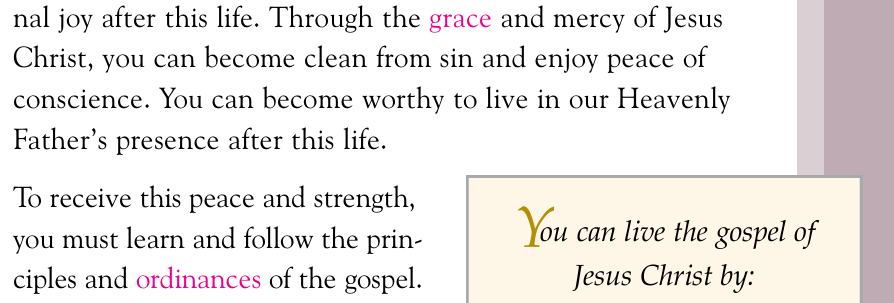
- Becoming individually worthy is a very big part of the LDS gospel. In October, 2003, General Authority Dallin Oaks gave a general conference talk called, “Repentance and Change.” And in this talk, he stated: “The gospel plan is based on individual responsibility…The plan of the father and the savior is based on individual choice and individual effort.”
- In another article on the Church website titled, “On Being Worthy,” the general authority explained, “As we turn to Church leaders to help us learn how to become worthy members of The Church of Jesus Christ of Latter-day Saints, we learn that we can reach the status of worthiness for each goal along life’s path. Yet we must strive for worthiness.”
- This article also states, “During such interviews it may be determined how worthiness can be achieved if there is need for improvement…It is a great responsibility for a bishop or stake president to conduct a worthiness interview.”
A few points to hit on here:
- It is your responsibility to do the required works in order to reach the status of worthiness. Becoming worthy and becoming righteous is the same thing. What does God’s Word say about us trying to build up our own righteousness?
- Romans 10:2-3 “For I can testify about them that they are zealous for God, but their zeal is not based on knowledge. Since they did not know the righteousness of God and sought to establish their own, they did not submit to God’s righteousness.”
– A question we can ask the missionaries is, “Are you telling me that we need to strive to establish our own personal righteousness? Because at the beginning of Romans 10, it denounces a group of people for doing this.”
- The apostles of Christ proclaimed that Jesus alone is our righteousness. That’s why it says in 2 Corinthians 5:21 “For he hath made him to be sin for us, who knew no sin; that we might be made the righteousness of God in him.”
This is something that Bible based Christians refer to as “the great exchange.” When you sincerely put your faith in Christ, He takes your sin from your slate, and then writes your name on his perfectly sinless slate and gives it to you. We see concept being clearly taught in Romans 4:5-6
- Romans 10:2-3 “For I can testify about them that they are zealous for God, but their zeal is not based on knowledge. Since they did not know the righteousness of God and sought to establish their own, they did not submit to God’s righteousness.”
“But to him that worketh not, but believeth on him that justifieth the ungodly, his faith is counted for righteousness. Even as David also describeth the blessedness of the man, unto whom God imputeth righteousness without works,”
- Imputeth means to credit or give on account of. And it is by genuine, life changing faith in Christ that one is counted as righteous apart from works. Perfection is the ticket in order to enter into God’s perfect kingdom. And unfortunately for all of us, that ship as long sailed because all of us have sinned.
- That’s why Jesus came down to earth. He alone is perfectly righteous, and to anyone who puts their faith in Christ, he will cover them with his own righteousness, apart from works.
And here is an illustration that might be helpful for Latter Day Saint viewers. when you guys go to the temple and perform baptisms for the dead, the LDS Church teaches that in the spirit world, the dead will be able to accept the temple work you did on their behalf. Guess what? That is exactly what Jesus did for us. He lived the perfect life, fulfilled all of the ordinances and kept every command on your behalf. And if you trust in this work that Christ did and ask for His forgiveness, he will then cover all of your sins with his own righteousness and that is what determines whether or not we will get to live in his presence. It’s all about the righteousness of Christ and nothing of our own.”
Next, the pamphlet starts to break down what the worthy or covenant path looks like. The 4 fundament principals are:
- Faith
- Repentance
- Baptism
- And Enduring til the end
At the top of page 4 it says, “Faith in Jesus Christ is more than a passive belief in Him….It means acting on that belief. Faith in Jesus Christ leads you to love Him, trust Him, and obey His commandments.”
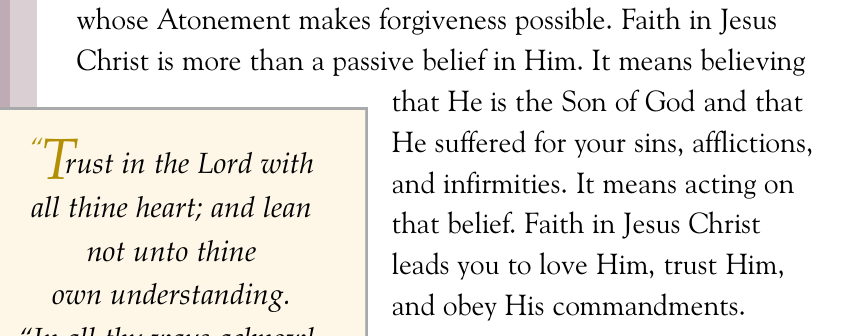
This is so close to being Biblically correct.
- “Faith in Jesus Christ is more than a passive belief in Him.” Absolutely. This is what James 2 is all about. There are 2 kinds of faith: a dead faith and a living faith. Someone who merely professes to be a follower of Christ yet doesn’t care about obeying His commands is an example of someone with a dead faith. And that is the same kind of faith that the demons have. They believe that Jesus is real. They believe that Jesus died on the cross and rose from the dead…but this acknowledgement does not affect their life nor does it lead to any kind of change. It is a dead and useless faith.
- I love that last sentence that says, “Faith in Jesus Christ leads you to love Him, trust Him, and obey His commandments.” Completely agree with both of those points, but it’s the middle part where it conflates faith with works, when it says, “It means acting on that belief.” This is not what faith is (Hebrews 11:1).
- Acting on that belief is an action. And actions are works. Genuine saving faith is an internal belief that leads to external actions. It is faith alone that saves, but faith that saves will always be accompanied by good works. But faith itself is not a work. We see the separation between these two in passages like
- Ephesians 2:8 where it says, “We are saved by grace through faith and NOT by works…”
- Romans 4:6 “blessed is the one who is given righteousness through faith APART from works.”
These verses help us understand that faith is not a work…but genuine faith will always lead to works.
The next fundamental principle is Repentance. In the middle of page 4, it says, “Through repentance, you change those thoughts, desires, habits, and actions that are not in harmony with God’s teachings. He promises that when you repent, He will forgive your sins.”

In a previous video, I covered this topic focusing on repenting of serious sins. Part of repenting of serious sins includes confession to your bishop. In those situations, you will not receive God’s forgiveness if you don’t confess take that step in confessing to your bishop. Confessing your serious sins to God is not good enough.
It says that “When you repent, you will stop doing what is wrong and strive never to do it again.”
- The LDS Church has eased up on this in recent years. In 1969, 12th president Spencer Kimball wrote a book called “The Miracle of Forgiveness.” In this book, there is a chapter titled, “Trying Is Not Sufficient,”
- And in this chapter, it stated “When one “merely tries” to abandon sin, then they haven’t completely repented. Trying is OK for children, but adults must DO. To ‘try’ is weak. To ‘do the best I can’ is not strong.”
You can imagine how man LDS members felt unworthy as a result of this impossible standard, to the point that they would throw in the towel, leave the church and say, “What’s the point of even trying?” Then the church adjusted this principal and made it less strict in order to retain membership.
The last point here of Acknowledging the Savior, it says, “Sometimes you may have felt that God will not forgive serious sins. But the Savior suffered for our sins so they can be put behind us, even the serious ones. The result of true repentance is forgiveness, peace, comfort, and joy.”
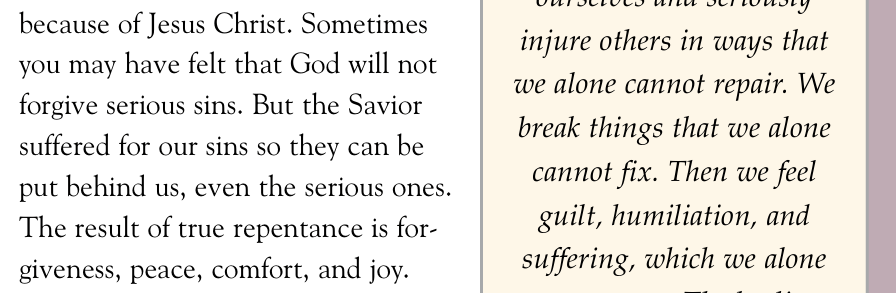
This sounds great and I agree with it. I want to read a Psalm that David wrote after he committed the sins of adultery and murder.
Psalm 51 “Have mercy on me, O God, according to your unfailing love; according to your great compassion blot out my transgressions. Wash away all my iniquity and cleanse me from my sin. For I know my transgressions, and my sin is always before me…Cleanse me with hyssop, and I will be clean; wash me, and I will be whiter than snow…Hide your face from my sins and blot out all my iniquity. Create in me a pure heart, O God, and renew a steadfast spirit within me. Do not cast me from your presence or take your Holy Spirit from me. Restore to me the joy of your salvation and grant me a willing spirit, to sustain me.”
David truly repented and cried out to God for forgiveness. And we actually read in 2 Samuel 12:13 that God did forgive King David of his sins…but the LDS Church teaches that David was not forgiven even though he repented. Even though he begged God for forgiveness, God in all of his grace, love and mercy looked at David and said, “Nope…I’m not going to forgive your sins. You crossed this line and you’ve gone too far.”
When this pamphlet says, ‘the Savior suffered our sins so they can be put behind us, even the serious one.” That is not completely accurate and should be reworded.
Moving onto baptism and the Holy Ghost. At the top of page 8, it says, “Jesus Christ taught that everyone must be baptized of water and of the Spirit (the Holy Ghost) for the remission, or forgiveness, of sins. Through baptism by one who holds priesthood authority and through receiving the Holy Ghost, you will be spiritually reborn.”
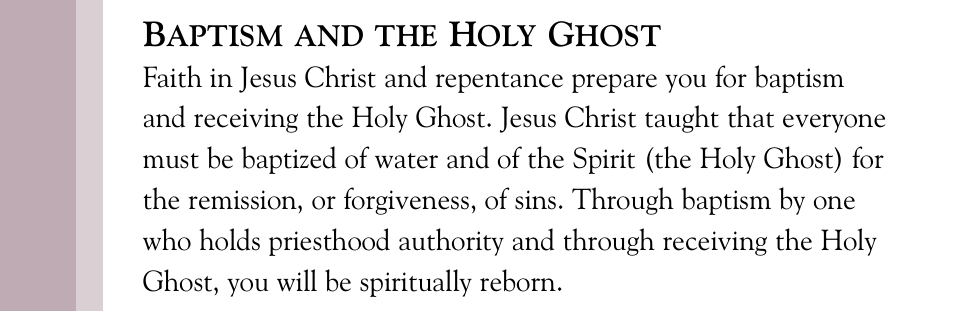
And the text they go to is John 3:5 “Jesus answered, Verily, verily, I say unto thee, Except a man be born of water and of the Spirit, he cannot enter into the kingdom of God.”
The missionaries will tell you that “born of water” is a reference to getting baptized. But notice 2 things here:
- The first thing: Jesus doesn’t say anything about baptism or the remission of sins.
- Second thing, just like always, lets read the verses before and the verses after to verify whether or not this contextually talking about water baptism.
Starting at verse 3, Jesus is talking to Nicodemus and says, “Very truly I tell you, no one can see the kingdom of God unless they are born again.”
Then notice what Nicodemus says, “How can someone be born when they are old? Surely they cannot enter a second time into their mother’s womb to be born!”
- Nicodemus thinks that Jesus is talking about being physically born once, then being physically born a second time.
- Then Jesus tells Nicodemus, “You gotta be born of water and of spirit.” And the very next verse clarifies what “being born of water” is.
John 3:6 “Flesh gives birth to flesh, but the Spirit gives birth to spirit.”
The first birth is birth of the flesh, a physical birth. But the second birth is a spiritual birth. Being born of water and of spirit = being born of the flesh and of the spirit
Being born of water is not talking about baptism. It is contextually referring to the physical birth that every person goes through, but not every person becomes spiritually reborn. This also makes sense biologically because what happens right before a baby is physically born? The mom’s water breaks!
Now in regard to the point where it talks about “baptism by one who holds priesthood authority.” Imagine if someone loves God with all their heart and wants to follow his commandment to get baptized. So they find a non-LDS Church and get baptized. Does the LDS Church view this as a proper baptism?

This is a picture of a friend of mine who got baptized this last year (beginning of 2024). She was so excited that she sent me this picture. She currently lives in a poverty stricken area in Pakistan. Notice what she is sitting in: a kiddie pool. Her church doesn’t have a baptismal font and there isn’t a clean river nearby either. Additionally, there are hostile Muslims who have terrorized Christian communities close to her city. When I look at this picture, I find it so humbling that she is willing to follow Christ in that kind of environment.
Even though my friend loves Jesus with all her heart, she is spending time as a Sunday school teacher, and wants nothing more than to obey God…according to the LDS Church, this baptism is not legitimate for two reasons:
- The first one being that your whole body must be entirely submerged underwater. Because she is being baptized in kiddie pool, this did not happen.
- Secondly, the person baptizing her was not a member of the LDS Church and didn’t have priesthood authority.
Because of these factors, Latter Day Saints will look at this beautiful and humbling picture and say, “That’s great that she wants to grow closer to Jesus…but if she wants to get baptized for real…it needs to be through the LDS Church.”
We know that Christ cares most about the heart. And it’s the condition of the heart that makes an ordinance legit or not. Because my friend’s heart was in the right place, she did exactly what Christ wanted her to do and there is nothing wrong or illegitimate about her baptism.
The pamphlet goes on to say, “When you are baptized, you receive a remission of your sins.” Then gives Acts 2:38 as a prooftext, which says, “Repent and be baptized, every one of you, in the name of Jesus Christ for the forgiveness of your sins. And you will receive the gift of the Holy Spirit.”
You know the drill, let’s read the surrounding verses to get a better understanding of the context. Verses 36-37 “Therefore let all Israel be assured of this: God has made this Jesus, whom you crucified, both Lord and Messiah.” When the people heard this, they were cut to the heart and said to Peter and the other apostles, “Brothers, what shall we do?”
These are people who may have been alive when Christ was crucified. Some of them were probably in the crowd chanting “crucify Him!” Peter tells them about Jesus whom THEY crucified and it gripped their heart. They felt terrible and wanted to make things right, so they ask Peter, “What should we do?”
- Important note: they are NOT asking, “What should we do in order to be saved.” We actually see this question being asked in Acts 16:30-31 which says, “What must we do in order to be saved?” And the disciples respond by saying, “Believe on the Lord Jesus Christ and you will be saved.”
So the question being asked in Acts 2, is from a different angle and that’s why the apostles responded with a different answer. Now, imagine that you have a headache, and you go to the doctor. The doctor gives you a prescription to help with the headache and on the instructions, it says, “Take 2 pills for a headache.”
This does not mean, “Take two pills in order to receive a headache.” It’s saying, “Take two pills because you have a headache.” And this is the same way, Acts 2:38 is saying, “get baptized because you have been forgiven.” Not in order to become forgiven. Forgiveness is a gift of grace through faith in Christ, and not by any kind of ordinance or work.
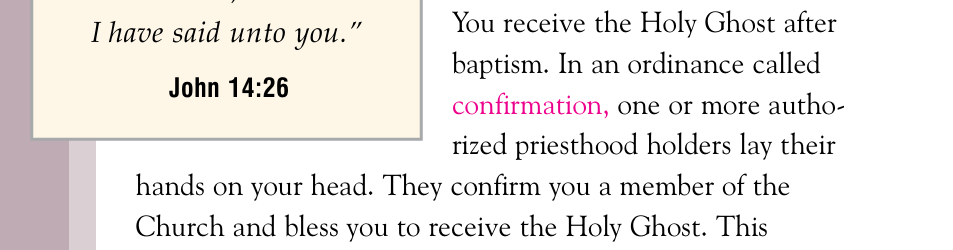
Towards the bottom of page 10, it says, “You receive the Holy Ghost after Baptism. In an ordinance called confirmation, one or more authorized priesthood holders lay their hands on your head. They confirm you a member of the Church and bless you to receive the Holy Ghost.”
In one of my previous videos, I highlight Acts 10:44-48 where there is a group of Christians who approach Peter and they have not yet been baptized. Then Peter says, “These guys have received the gift of the Holy Ghost just as we have…now let’s get them baptized.” That clearly conflictions with the LDS doctrine that you can only receive the gift of the Holy Ghost after baptism.
But then the second requirement is that you must be confirmed as a member into the LDS Church in order to receive the gift of the Holy Ghost. So if you are not a member of the LDS Church, you cannot receive the gift of the Holy Ghost…but we know better. We know that this is only received through faith alone in Christ alone and not through any kind of religious organization.
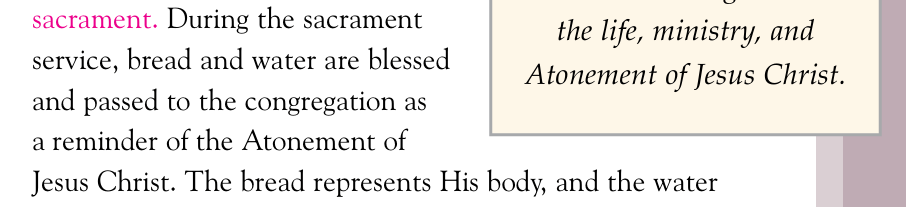
On page 13, it talks about the sacrament and says, “During the sacrament service, bread and water are blessed and passed to the congregation as a reminder of the Atonement of Jesus Christ… The sacrament helps you remember with gratitude the life, ministry, and Atonement of Jesus Christ.”
While sacrament and communion have a lot in common, there is one thing that I have a problem with regarding the sacrament. When LDS members commit some kind of sin and they confess that sin to their bishop. Their bishop might instruct them NOT to take the sacrament for one week or a number of weeks. The bishop will determine when that person is worthy enough to start taking the sacrament again.
The sacrament is something that everyone in the service takes. Now imagine that you committed a sexual sin and your bishop tells you to pass the sacrament for 2 weeks. The next Sunday you are sitting in church and its sacrament. It gets passed down your row and every single person takes it…then it gets to you and you pass it without taking it. People notice that. And when they notice it, they are going to think, “I wonder what kind of sin Paul did. It must of have been something pretty bad if he can’t take the sacrament.” Whether intentional or not, this is a form of public shaming and humiliation.
But more importantly, if the person he repented in their heart, turned away from their sin and wants to surrender that sin to God…why are you preventing them from taking part in an ordinance that is supposed to help them?
We know that communion is between you and God. Regardless of any kind of serious sin that you recently committed, if you were to decide right before the communion plate gets passed around that you are giving that sin to the Lord and repenting of it in your heart with no intent to do it again, Christ wants you to take the bread. You don’t have become worthy and get your life all in order before coming to the Lord and taking communion. If your heart is right with God at any given point, He wants you to partake of communion.
The very last thing this pamphlet covers is once again, “How can I know if these things are true?” On page 17, it says, “Pray to heavenly and then the Holy Ghost will confirm truth through feelings, thoughts and impressions.”
But we know that our feelings can deceived us. That’s why it says in Jeremiah 17:9 says that the heart is deceitful above all things and corrupt.” Our feelings come from our heart. If feelings come from our heart, and if our heart is deceitful…why would we trust it?
It also says, “Express the feelings of your heart (gratitude, questions, requests to confirm the truth of the Book of Mormon and the teachings of the missionaries)”
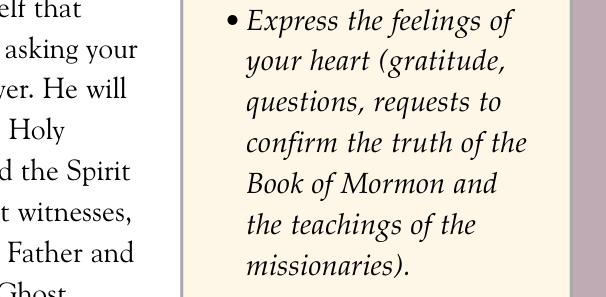
Notice that this is not telling you to test if these things are true. It’s telling you to confirm and assume that these things are true. Then if you get a good feeling, that confirms that these things are true. But 1 John 1:4 says to test all things…not to confirm all things.
It also lists the fruits of the spirit as a prooftext which I want to dig into before we wrap this up. Galatians 5:22-23 “But the fruit of the Spirit is love, joy, peace, forbearance, kindness, goodness, faithfulness, gentleness and self-control. Against such things there is no law.”
They believe that this verse is saying, “if you pray about something and receive feelings of love, joy, peace, and so on…then that is the Holy Ghost telling you that whatever your praying about is true. In short, good feelings are from God, bad feelings are from the devil. But once again, lets read the surrounding verses to verify the context.
Galatians 5:19-21 “The acts of the flesh are obvious: sexual immorality, impurity and debauchery; idolatry and witchcraft; hatred, discord, jealousy, fits of rage, selfish ambition, dissensions, factions and envy; drunkenness, orgies, and the like. I warn you, as I did before, that those who live like this will not inherit the kingdom of God.”
Notice that these are all external actions and lifestyles, not internal feelings. This shows that contextually, verses 22 & 23 are also talking about external actions. It is saying that if you are following Christ, then you will consistently show love, joy, peace, patience, etc. It has nothing to do with internal feelings.
Congratulations on completing my 3-part course on Ministering to LDS Missionaries and here is what you can do next: Go onto the LDS Church website, scroll down and submit your contact information to set up a meeting with missionaries in your area.
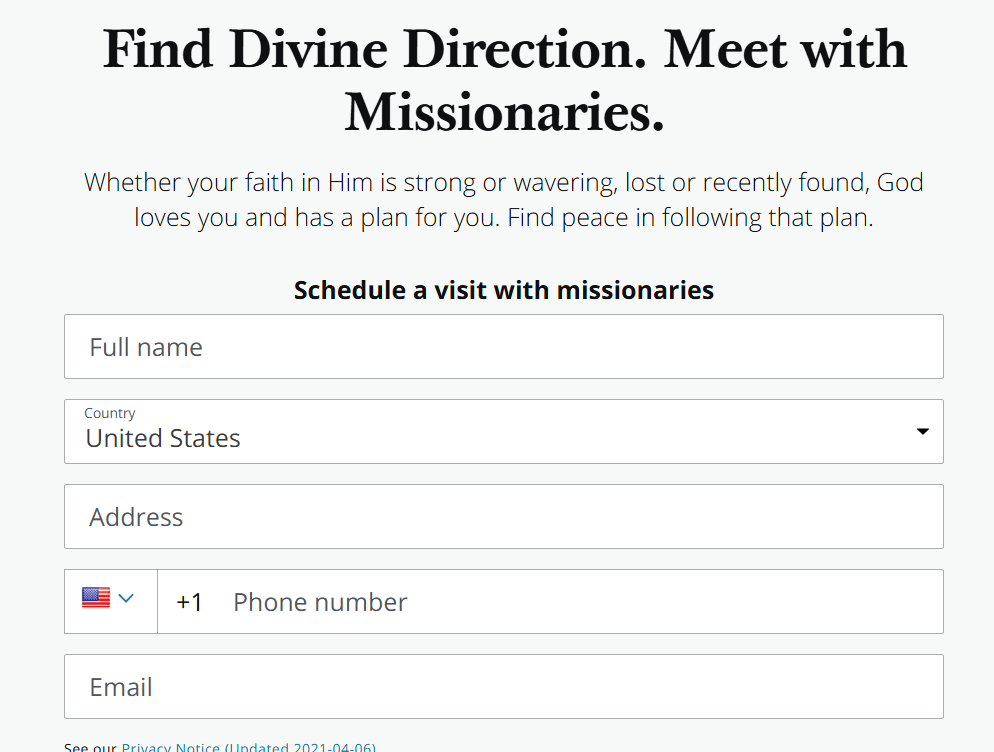
After submitting your information, they will reach out to you either by email or by phone to introduce themselves and set up a meeting. When they come over, you can have notes, Bible verses and questions on hand. Make preparations beforehand. You could even print out one of my Ministering to LDS Missionary lessons right here. I always give them lunch, dinner, or a snack when they come over. Ask them questions like:
- Where are you from?
- How long have you been on your mission for?
- What is one high point and one low point that you’ve experienced on your mission so far?
Thanks for reading, God bless, and remember to never stop chasing after Jesus!
 JLLDS Ministries