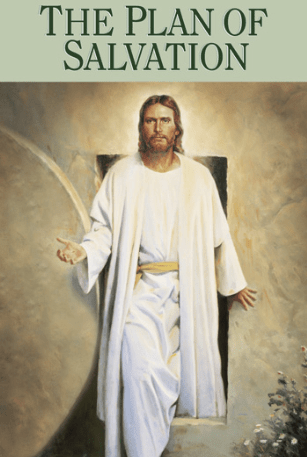
Starting on page 2, it says:
“As you learn about the plan of salvation, you will find answers to these questions: “Where did I come from?” “What is my purpose in life?” “Where will I go after this life?”
- These three questions are very foundational and important to Latter Day Saints. And if we want to engage with them in fruitful conversation, it’s important to these parts of their theology. Below is what the pamphlet goes on to say:
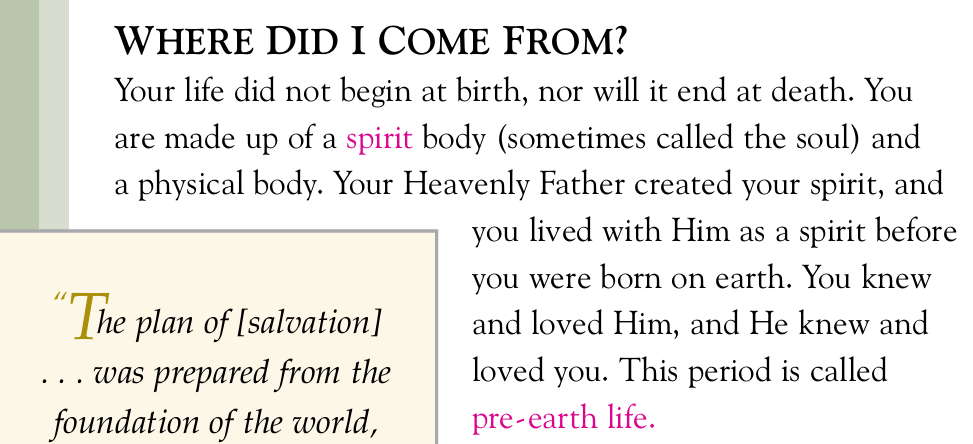
“Your life did not begin at birth, nor will it end at death…Your Heavenly Father created your spirit, and you lived with Him as a spirit before you were born on earth. You knew and loved Him, and He knew and loved you. This period is called pre-earth life.”
- Heavenly mother was just as involved in creating our spirits as heavenly father was. Without either one of them, our spirits wouldn’t exist and we wouldn’t be here on this earth today. A question to ask the missionaries could be:
“Can you show me where heavenly mother is mentioned in this pamphlet, in the Bible or in the Book of Mormon?”
The pamphlet goes on to say:
“You were taught about the plan of salvation…you learned that through Him you would be able to overcome the effects of your wrong choices…You would not remember living in Heavenly Father’s presence, but He would give you the ability to know right from wrong.”

- So we lived with heavenly father and loved him and he loves us, but we just can’t remember anything about it. It then talks about how Satan and Jesus each had their own plan of salvation. Satan wanted to force everyone to obey but the plan of Christ gave us free will. God the Father goes with Jesus’ plan, Satan doesn’t like that and he rebelled. Lots of our spirit brothers and sisters followed Satan in his rebellion and as a consequence, they were not given the chance to be born on earth and receive a physical body. And that’s important because you can’t attain godhood without a physical body.
For any of these points, a good question to always ask is: “Can you show me in the Bible where it clearly and contextually says that?”
Next up is the Creation and the Fall. It talks about Adam and Eve and how God commanded them not to eat from the tree of knowledge of good and evil. In the middle of page 6, it says:
“Obeying this commandment meant they could remain in the garden, but they could not progress by learning from experiences and challenges.”

- When it says that “they could not progress,” it means progressing towards godhood. If Adam and Eve never sinned, they wouldn’t have gained the ability of progressing and becoming Gods.
On page 7, it lists 2 Nephi 2:22-25
“If Adam had not transgressed he would not have fallen, but he would have remained in the garden of Eden…. “And [Adam and Eve] would have had no children; wherefore they would have remained in a state of innocence, having no joy, for they knew no misery; doing no good, for they knew no sin.”
- Adam and Eve were created without sin and had no joy. Because you need to experience misery in order to know what joy is. Then you have experience and knowledge to know one from the other. Likewise, you can’t chose to make a right choices until you made a wrong choice. Only after making a wrong choice and experiencing sin can you then know right from wrong and good from evil.
I was having a conversation on this topic an LDS missionary who has since returned home from his mission and we still keep in touch. He invited me to their church for some volleyball which was a lot of fun and we also enjoyed talking about basketball. I truly do have a lot of respect for this young man. But anyways, after he explained this concept to me needing to sin before being able to make the right choice and knowing right from wrong:
Me: “Did Jesus ever sin?”
Him: “No. Jesus is perfect and sinless.”
Me: “Did Jesus know right from wrong?”
Him (as he glances up towards the ceiling): “……………………..huh……..”
The next part talks about life on earth and how its best for us to obey God’s commands. At the bottom of page 9, it says:
“When you make wrong choices and commit sin, you separate yourself to some degree from God…You cannot overcome sin and its effects by yourself.”
- I love that and 100% agree with it.
Next, it talks about the atonement of Jesus. It references John 3:16 and then in the middle of page 10, it says:
“God will not make you clean against your will. To receive His help and strength, you need to exercise faith in Him, repent, be baptized, receive the Holy Ghost, and choose to follow His teachings for the rest of your life.”

- This sounds pretty good, right? Each of these 5 points are heavily supported in the New Testament. But let’s break down what each one means.
- Exercising faith is the first one and very closely connected the last one, which is to follow God’s teachings for the rest of your life.
- Another name for this is “Enduring til the end.” But what exactly does this entail? In the missionary handbook, it is laid out very clearly for us:

What must we do to endure til the end? You need to go through the endowment ceremony, you need to receive the priesthoods and other temple ordinances, you need to fast…one word that can summarize these things: works. And in the next section, it clearly explains how our own personal works determine where we are going to end up in the afterlife, and that is what makes this a works-based gospel.
- Repent: There are different degrees of repentance, but the one I am going to focus on is the repentance of serious sins that people commit. If commit a serious sin and look at pornography, what does the LDS Church say that I am required to do in order to properly repent?
Here is an article from the LDS website titled, “What things do I need to see my bishop about to be forgiven?” The first sentence in this article says, “The short answer is that you need to confess “serious transgressions” to your bishop. These includes (but are not limited to) serious violations of the law of chastity.”

In another article from the LDS Church website, it says, “Why and What do I need to confess to my bishop?” It states that “Some mistakes, especially those requiring immorality require confession to the bishop before you can receive the Lord’s forgiveness.”

When it comes to the area of serious sins, like breaking the law of chastity, there is a man who stands between you and God. Meaning, that there is a specific man on this earth whom you must go through first and confess your sins directly to that specific man before you can receive God’s forgiveness. Confessing your serious sins to God is not good enough.
In one of these articles, the general authority tells a story about a woman. He starts off by saying, “Sometimes a person will stop doing wrong but never confess, when it is needed, to his or her bishop.”

- This part is important because the most common response I get is, “Well, the bishop wants to help people overcome their sin.” Ok, I get that, but this general authority completely negates that point with this statement, because the person has already repented and stopped sinning…yet they still need to confess that sin that they stopped doing to their bishop if they want to be forgiven. Going directly to Jesus in prayer will not remove the guilt or mark of the serious transgression.
He talks about a middle aged woman who came in for a temple recommend interview. Here is what he said,

Then he ends the talk by stating, “You can be forgiven insofar as you repent… I testify in the name of Jesus Christ that through repentance, including confession to your bishop when necessary, you will become clean.”

Again, repentance in the Bible is confessing your sins directly to God for forgiveness 100% of the time (1 John 1:9). But in the LDS Church, you need to confess your serious sins to the bishop before you can be made clean. There is a man in between you and God whom you must go through if you want to receive forgiveness of your serious sins. Another word for someone who stands between you the reconciliation and forgiveness of God is a “mediator.” 1 Timothy 2:5 makes it clear that there is only one mediator between God and man, and it’s Jesus…not any other man on earth.
The next point is: “You must be baptized.” This is also connected with the 4th point of receiving the Holy Ghost.
This is considered the first saving ordinance that you must receive if you want to live in the presence of God and receive eternal life. After that happens, you will then receive another required ordinance of being confirmed as a member of the LDS Church. At that point, you will receive the laying on of hands and someone with priesthood authority will bless you with the gift of the Holy Ghost…and it must be done in that order. If you aren’t baptized and confirmed into the LDS Church, you cannot receive the gift of the Holy Ghost. The reason why this is problematic is because we actually read about a group of Christians in the New Testament who received the gift of the Holy Ghost prior to being baptized.
In Acts 10:45-48 “The circumcised believers who had come with Peter were astonished that the gift of the Holy Spirit had been poured out even on Gentiles. For they heard them speaking in tongues and praising God. Then Peter said, “Surely no one can stand in the way of their being baptized with water. They have received the Holy Spirit just as we have.”So he ordered that they be baptized in the name of Jesus Christ.”
The LDS Church teaches that there is a progressional order in which things need to be done. The gift of the Holy Ghost can only be received after one has been baptized into the LDS Church. But here in Acts 10, we see that there was a group of Christians who already had the gift of the Holy Ghost, then Peter says, “Let’s get them in the water.”
Scripture is clear that you do not need to be baptized first before receiving the gift of the Holy Ghost. The LDS Church contradicts what we clearly see in the New Testament.
At the bottom of page 10, the pamphlet asks the important question: “Where Will I Go after I Die?” It talks about the spirit world and how you will go here after you physically die here on earth. In the spirit world, there are two places: spirit paradise and spirit prison. If you ask the missionaries for a Bible verse that supports this doctrine, they will take you to 1 Peter 3:18-20
“For Christ also suffered once for sins, the righteous for the unrighteous, to bring you to God. He was put to death in the body but made alive in the Spirit. After being made alive, he went and made proclamation to the imprisoned spirits—to those who were disobedient long ago when God waited patiently in the days of Noah while the ark was being built.”
They believe that Peter is talking about the spirit world. But here is the thing that we want to point out to our LDS friends. This specific passage is talking about a specific group of spirits: those who were disobedient in the days of Noah. We can agree and that there is a place where spirits who were disobedient in Noah’s day are being held…but there is nothing in passages implying that everyone goes to this going to either go to that same dimensional spirit prison or spirit paradise.
I talked about this passage with an LDS friend of mine and after discussing the concept of eisegesis, where you start with your presupposed belief and then find a Bible verse that sounds like it supports your belief without looking at the surrounding context. I explained it to him just like that and said, “this passage is talking about disobedient spirits in Noah’s day. Nothing in here contextually suggests that anyone else today is going to go to that same spiritual prison.” Then he looked down and read the passage one more time. I can’t remember precisely what he said, but it was something along the lines of, “I can see how this verse is would appear ambiguous and wouldn’t support the doctrine of spirit prison without the Doctrine & Covenants.”
And I truly applaud the integrity of my dear friend for realizing this. The passage my friend was referring to is D&C 138. To give a little bit of background:
- The Book of Mormon was published in 1830.
- The next LDS Scripture that Joseph Smith published in 1833 was called, the Book of Commandments. Then in 1835, Smith published a 2nd version of this Scripture, which he made many different changes to. Smith added a number of things to it and he removed a number of things from it. This is one of many reasons why many of the eyewitnesses of the gold plates began to view Smith as a fallen prophet. David Whitmer worked very closely with Smith and wrote a letter with regard to this matter:
“Some of the revelations as they now appear in the Book of Doctrine and Covenants have been changed and added to. Some of the changes being of the greatest importance as the meaning is entirely changed on some very important matters; The revelations were printed in the Book of Commandments correctly! But in the winter of 1834, they saw that some of the revelations in the Book of Commandments had to be changed, because the heads of the church had gone too far. So the book of ‘Doctrine and Covenants’ was printed in 1835, and some of the revelations changed and added to.” (David Whitmer – An Address to All Believers in Christ)
I’m not going to go further into that topic right now, but if you want me to make a video and go deeper on this topic and explain what Scriptures Smith changed, added and removed, let me know in the comment section below.
But the Book of Commandments eventually evolved into The Doctrine and Covenants and in this Scripture, chapters were continuously being added to it.
- The Pearl of Great Price was finalized and accepted as Scripture in 1880.
- Before all of this, of course we had the Bible.
And that is a very quick snapshot of the four LDS standard works: The Bible, Book of Mormon, Doctrine & Covenants and Pearl of Great Price. But of the 4 of these, the very last chapter of Scripture was written in 1918, and that would be Doctrine & Covenants chapter 138.
In this chapter, Prophet Joseph Fielding Smith claims to have received a revelation and it is specifically on the doctrine of the spirit world. He quotes 1 Peter chapter 3 and gives us more “knowledge and revelation” as to what exactly Peter was talking about.
Two things we can bring up here:
- Hebrews 9:27 “Just as people are destined to die once, and after that to face judgment,”
- After you die, there is no second chance to repent in the afterlife. You physically live. You physically die. Then you are spiritually judged.
- 1 Peter 3:18 “Christ suffered and died for sins once for all. He never sinned and yet He died for us who have sinned. He died so He might bring us to God. His body died but His spirit was made alive.”
Romans 3:23-24 “For everyone has sinned; we all fall short of God’s glorious standard. Yet God, in his grace, freely makes us right in his sight. He did this through Christ Jesus when he freed us from the penalty for our sins.”
- These passages help us understand that Christ suffered the penalty of our sins in our place. Those who have genuinely put their trust in Christ and have accepted his grace are free from the penalty of their sins. I repeat, those who are in Christ are free from the penalty of their sins. Let’s now read what it says in D&C 138:58-59
“The dead who repent will be redeemed, through obedience to the ordinances of the house of God, And after they have paid the penalty of their transgressions, and are washed clean, shall receive a reward according to their works, for they are heirs of salvation.”
The first thing that stands out to me is how similar this is to the Catholic doctrine of purgatory. But the other thing is that this verse is linked to Alma 5:21 which says:
“…there can no man be saved except his garments are washed white; yea, his garments must be purified until they are cleansed from all stain, through the blood of him of whom it has been spoken by our fathers…”
First point is when it says that we are cleansed from our sins THROUGH the blood of Christ. Yet in D&C 138:59, we are cleansed by paying the penalty for our transgressions. Here is an important difference that I noticed:
- These LDS Scriptures say that we are washed clean THROUGH the blood of Christ…but we are not washed clean BY the blood of Christ. For me, if I were to die in my current state of rejecting the restored gospel of the LDS Church, it would be through the blood of Christ that my sins may be cleansed BY me suffering the penalty for my sins.
But the most important thing is how this clearly conflicts with God’s Word which says that Christ suffered for our sins once and for all. If you believe in Christ, then you aren’t going to be judged for our sins and you are free from the penalty of your sin…but here, Prophet Joseph Fielding Smith writes, “Nope…everyone who rejects the restored gospel is going to suffer and pay the penalty for their sins in the spirit world. And only after suffering for their sins will they be washed clean.”
In other words: the blood of Jesus is NOT enough to wash your sins away. You need to contribute suffering of your own on top of the suffering of Christ, because his sacrifice isn’t enough. This is a slap in the face to the savior of the world.
At general conference in 2008, General Authority Jeffery Holland gave a talk called, The Atonement of Jesus Christ. In this talk, he made a statement regarding mankind:
“They are NOT freely and universally given a reprieve OF THEIR OWN SINS UNLESS they pledge faith in Christ, repent of those sins, are baptized in his name, receive the gift of the Holy Ghost and CONFIRMATION INTO CHRIST’S CHURCH, and press forward in faithful endurance the remainder of life’s journey.”
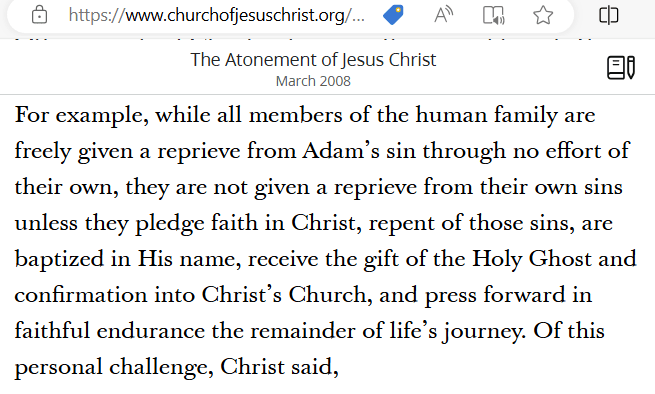
Again, the sacrifice and blood that Jesus spilt for you is not enough to blot out your transgressions. Even if you repent of your sins, obey his commands, and love him for your all the days of your life…as Jeffery Holland clearly stated, you will not be reprieved or forgiven of your sins unless you are confirmed into the LDS Church and follow their teachings. Full forgiveness of sins is not possible apart from their organization.
So after you die, you go to the spirit world, then at some point later, the resurrection will occur. According to LDS doctrine this is when the judgement happens. Continuing to the bottom of page 12 in the pamphlet, it says:
“After you are resurrected, you will go before God to be judged according to your works and the desires of your heart.”
At this point, the main scripture they’re likely to quote here is Revelation 20:12-13
“And I saw the dead, small and great, standing before God, and books were opened. And another book was opened, which is the Book of Life. And the dead were judged according to their works, by the things which were written in the books. The sea gave up the dead who were in it, and Death and Hades delivered up the dead who were in them. And they were judged, each one according to his works.”
What does this contextually mean and how do we reconcile it with other passages that clearly say that we are saved by grace through faith and not by works? That we are declared righteous by faith apart works? When we read Revelation chapter 20 in context, we understand that it deals with 3 types of people:
- The 1st type is believers in Christ – the righteous who will receive eternal life and live with Christ in the Millennial kingdom on earth.
- The 2nd type is actually just 1 person – that would be Satan who will be thrown into the lake of fire.
- And the 3rd type is non-believers, who are described as “the dead.”
The end of verse 4 and verse 5 say, Revelation 20:4-5 “…They (believers) came to life and reigned with Christ a thousand years.”
Those who are alive in Christ will be resurrected when Christ returns get to reign with him in the millennial kingdom, but the dead will not be resurrected until the 1,000 years has ended. Verse 12 is talking about the judgement of the dead / non-believers. So when we are looking at a timeline, we understand that there are different judgements that are going to take place at different points in time.
Jesus said in Matthew 25:32-33 “All the nations will be gathered before him, and he will separate the people one from another as a shepherd separates the sheep from the goats. He will put the sheep on his right and the goats on his left.”
This is the first judgement. When Jesus returns, he is going to separate people into two groups: On one side, you have those who have eternal life, will be resurrected upon his return, and get to live with Him in his millennial kingdom. Then on the other side, you have those who do have eternal life, will not yet be resurrected upon Christ’s return and will not get to live with him. It’s important to note that at this judgement, these are the only two categories. Either you have eternal life with Christ or you don’t.
Going back to Revelation 20, it describes these two groups as those who are alive in Christ and those who are dead. First, he is going to judge the living when he returns, then after the 1,000 years, he is going to resurrect and judge the dead. But still, what exactly does this mean? Are we saved by works or not?
Jesus gives us a little more clarity in Matthew 16:27 when he said, “For the Son of Man is going to come in his Father’s glory with his angels, and then he will reward each person according to what they have done.”
The important word to notice here is “reward.” Jesus is going to reward each person according to what they have done when he returns. But as we just covered, believers are going to be the first group of people who will be resurrected and judged upon his return…and they will be rewarded according to their works. And that is the difference right there. Romans 6:23 says that eternal life is a free gift.
John 3:18 “Whoever believes in him is not condemned, but whoever does not believe stands condemned already because they have not believed in the name of God’s one and only Son.”
John 5:24 says that “whoever hears my word and believes him who sent me has eternal life and will not be judged…”
Here is how all of this fits together:
- Eternal life and living in the presence of God is a free gift of grace. Anyone who puts their full trust in the work of Christ will get to live in his presence completely based on their genuine faith in Christ.
- But there are differently types of heavenly rewards that every believer will receive. We don’t know what those heavenly rewards are, but the types of rewards in God’s kingdom will be based on our works here on earth. Its important to distinguish the free gift of eternal life from rewards that believers will receive in heaven.
- Both believers and non-believers will be judged, but it’s the concept of a reward vs the concept of a punishment. Believers will be judged by receiving their reward based on their works…while non-believers will receive their punishment based on their works.
On page 14 in the pamphlet, it talks about degrees of glory. The LDS Church teaches that at the resurrection, everyone will be judged and placed in a heavenly kingdom based on their works here on earth. There are 3 kingdoms of heaven also described as degrees of glory. To quickly summarize:
The lowest kingdom is the telestial kingdom where evil people will most likely go. People like Hitler, Stahlin, rapists, murders will go here. Interesting sidenote, the LDS Church also teaches that king David is lumped in with these groups of people and is destined to spend eternity in the telestial kingdom with all of these other people that I mentioned. If you want me to make a video on why God banished king David to the telestial kingdom, let me know in the comments.
The middle kingdom is the Terrestrial kingdom. People who try to live a good life and care about others will go here. I have been told by a number of Latter Day Saints that this is where I am going to end up which I take as a compliment. Although, I did recently run into a young LDS member who was preparing for his mission and he told me that I was going to end up in the telestial kingdom with Hitler and all the other evil people.
Then the highest kingdom is called the celestial kingdom. And only the faithful LDS members who have received all of the required ordinances and faithfully kept their temple covenants will qualify to enter into this kingdom. There actually is another eternal place called outer darkness where Satan, his demons, and apostates will end up.
They might describe these different degrees of glory as heavenly rewards. But again, in Matthew 25, Jesus didn’t separate people into 3 groups. He only separated them into 2 groups: those who will eternally live with him, and those who will live eternally apart from him. When attempting to support the doctrine of there being 3 kingdoms of heaven, there are 2 Bible verses they’ll go to:
2 Corinthians 12:2 “I know a man in Christ who fourteen years ago was caught up to the third heaven. Whether it was in the body or out of the body I do not know—God knows.”
They will say, “See? If Paul went up to the 3rd heaven, obvious means that there must 3 levels or kingdoms of heaven.” However, all throughout the Bible, the word “heaven” or “heavens” is used in a couple different ways and here is what I mean:
Jeremiah 4:25 “I beheld, and, lo, there was no man, and all the birds of the heavens were fled.”
Psalm 104:12 “By them shall the fowls of the heaven have their habitation, which sing among the branches.”
In these passages, we understand that the word “heaven” is referring the atmosphere or sky where the birds fly. What else might the word “heaven” be referring to?
Genesis 26:4 “And I will make thy seed to multiply as the stars of heaven,”
1 Chronicles 27:23 “the Lord had said he would increase Israel like to the stars of the heavens.”
Here we see that heaven is in reference to the atmosphere where the sun, stars and moon reside. If the first level of heaven is the sky, and the 2nd level of heaven is outer space, we can logically conclude that the 3rd level of heaven that Paul is talking about in 2 Corinthians 12 is in reference to God’s heavenly kingdom. There is only 1 level of the spiritual realm of heaven, not 3.
The other passage they will go to is 1 Corinthians 15:40 “There are also celestial bodies, and bodies terrestrial: but the glory of the celestial is one, and the glory of the terrestrial is another.”
In this passage, it seems like they have a solid case because, it specifically mentions the words “terrestrial” and “celestial.” It doesn’t mention “telestial,” but hey, 2 out of 3 ain’t bad, right?
This is a great opportunity for you to walk them through this passage and study it together with them, teaching them how to properly and contextually study God’s Word. You will want to start back at verse 35 which says, “But someone will say, “How are the dead raised? And with what kind of body do they come?”
That is the question that Paul is addressing. When Jesus returns and the resurrection takes place, what kind of bodies are people going to have? See, there were people at this time who believed that this life was all there was and that there was no afterlife. And they knew what happens to bodies when they have been dead for a long time…they decay and eventually turn back into dust. So these people are asking basically asking Paul, “When people die, are they going to come back looking like zombies? Or what happens to be people who have been dead for a long time have literally decayed into dust? What kind of body are they going to have?”
This the question that Paul is about to answer and he starts off by giving us a couple examples of what different bodies look like right now.
1 Corinthians 15:39 “All flesh is not the same flesh, but there is one flesh of mankind, another flesh of animals, another flesh of birds, and another of fish.”
Then in verse 41, he gives us some more examples of different kinds of bodies:
“There is one glory of the sun, another glory of the moon, and another glory of the stars; for star differs from star in glory.”
First Paul gives us examples of bodies that dwell on earth, now he is giving us some example of bodies that dwell in the heavens or outer space. Then Paul summarizes this point and hits it home in the next couple verses:
“So also is the resurrection of the dead. It is sown a perishable body, it is raised an imperishable body; it is sown in dishonor, it is raised in glory; it is sown in weakness, it is raised in power; it is sown a natural body, it is raised a spiritual body. If there is a natural body, there is also a spiritual body.”
That last sentence summarizes Paul’s entire point here. He is not saying that there are different kinds of resurrected bodies that will be placed in a certain level of heaven. The only point that Paul is making is that at the resurrection, people won’t have a physical body like you have now…they are going to have a supernatural kind of spiritual body.
Yes, the King James Bible uses the words, Terrestrial bodies and Celestial bodies, but in modern Bibles today, the more modern terms that are used are “earthly bodies” and “heavenly bodies.” This passage does not in any way contextually support the doctrine that there are 3 kingdoms of heaven called Telestial, Terrestrial and Celestial.
Feel free to leave a comment below of what you agreed or disagreed with. Thank you for reading, God bless, and remember to never stop chasing after Jesus!
 JLLDS Ministries