It’s important to remember what our motives should be whenever we do engage with anyone of a different faith. Those motives should be:
- Love for God
- Love for others
- Love for the truth
Keeping that in mind, let’s get to it the first lesson that LDS missionaries are trained to teach you. Below is a link to the online pamphlet if you want to follow along and see exactly where it says something as you read through my following notes:
https://www.churchofjesuschrist.org/bc/content/ldsorg/content/english/manual/missionary/pdf/36920_the-restoration-eng.pdf?lang=eng&icid=osd
_____________________________________________________________
On Page #3 in the pamphlet, the very first thing it says is: “God is your father in heaven.” When it says this, it means that he is literally the father of your spirit. Meaning that heavenly father and heavenly mother procreated you and you are literally their spirit offspring.
When interacting with Latter Day Saints, you’ll find that there are many rabbit trails and differences to discuss. My first tip is to pick and choose your battles. I normally don’t choose to dig into this topic because I would rather try to steer the discussion in a more essential direction, such as who is Jesus or what is the gospel?
But I still want to equip you just in case the missionaries want to dig into this point. The primary Scripture they are trained to go to is Acts 17:29 which says:
“Therefore since we are God’s offspring, we should not think that the divine being is like gold or silver or stone—an image made by human design and skill.”
In my last video, I mentioned how we should strive to faithful interpreters of God’s Word and one the ways we can do that is by reading the verses before and the verses after to verify the surrounding context.
If we jump back just one verse to Acts 17:28, it says:
“As some of your own poets have said, ‘We are his offspring.’”
The first thing we need to realize is that Paul is quoting pagan Greek poetry. And poetry very often uses metaphors and illustrations that should not be taken in a literal sense. Yet that is what Latter Day Saints do to this passage.
Other passages like Romans 8:14-15 and Galatians 3:4-5 clarify that we are not literally God’s offspring. Romans 8 says: “For those who are led by the Spirit of God are the children of God…the Spirit you received brought about your adoption to sonship.”
Then in Galatians 4:4-5 says: “God sent his son…to redeem those under the law, that we might receive adoption to sonship.”
Two points:
1st – Not everyone is a child of God…only those who are led by the Spirit are His children.
2nd point – We are not God’s literal offspring, but we become spiritually adopted into his family when we put our faith in Christ and are born again.
A good question to ask on this topic would be: Is there a Scripture that clearly states that we are the literal offspring of heavenly father and heavenly mother?
On the top of Page 5, it says, “He taught them (the 12 apostles) and gave them priesthood authority to teach in his name.”
A good starting question for this topic would be: “How would someone like me receive priesthood authority?”
To which they will answer, “Someone who already has the priesthood needs to lay their hands on you and then pass the priesthood onto you through what is called, the “laying on of hands.”
The follow up question needs to be: “Since Jesus is our example, can you please show me a clear Scripture where Jesus laid his hands on the apostles and passed on the priesthood?
The best thing they can give you is an ambiguous passage that talks about Jesus giving the apostles authority, but again, you really want to hammer the point home that we never see Jesus laying his hands on anyone to pass on the priesthood, nor do we see any prophet or apostle laying their hands on anyone to pass on the priesthood. This super important saving ordinance is completely absent from God’s Word.
Another point that you could make: “The term “priesthood authority” is found nowhere in Scripture. If it really was that important, why isn’t there any clear references to it?”
They might bring up 1 Nephi 13:28 which states that many plain and precious truths have been removed from the book of the lamb/the Bible.
On page 8, it says that the “apostles were killed and the priesthood authority was taken from earth.” They always seem to forget about the apostle John. As far as we know, he was the only apostle that was not killed and died a natural death. John actually had 2 disciples of his own, named Ignatius and Polycarp. They had a disciple named Iraneaus. Then Iraneaus has a disciple name Hippolytus.
Question to ask: “Are you really telling me that the apostle John dropped the ball and forgot to pass on the saving ordinance of the priesthood?”
Again, if it really was that important, surely John would have passed it on and instructed his disciples to continue passing it on as well. We also have letters from John’s disciples. Yet, in the writings of John and his apostles, we see no mention at all of Jesus or anyone else passing on the priesthood by the laying on of hands. All the evidence points to no one in the Bible ever doing this.
They might explain that the apostles did pass on the priesthood by laying on of hands, but after a few centuries, that priesthood authority was lost. Let’s stop for a minute and critically think how this would play out:
- John would have passed this extremely important ordinance onto his own disciples and they would have passed it onto others as well. And let’s not forget about the other apostles doing this same thing:
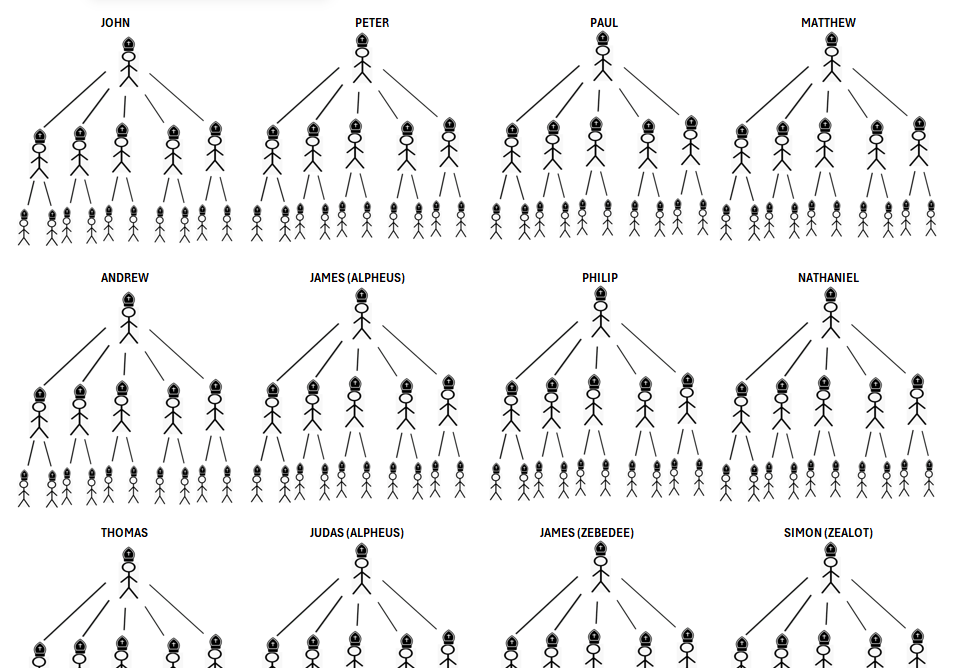
2. In Acts 2:41, we read “Those who accepted his message were baptized, and about three thousand were added to their number that day.”
– Thousands of people were joining the church!

3. But for some reason, not everyone was receiving the priesthood authority.

4. Over time, few and few people received the priesthood authority until there was no one left who had it. This is when the church that Jesus built was officially and completely destroyed.

5. One way to summarize this is that the number of converts to Christianity dramatically increased while the number of people with priesthood authority significantly decreased.
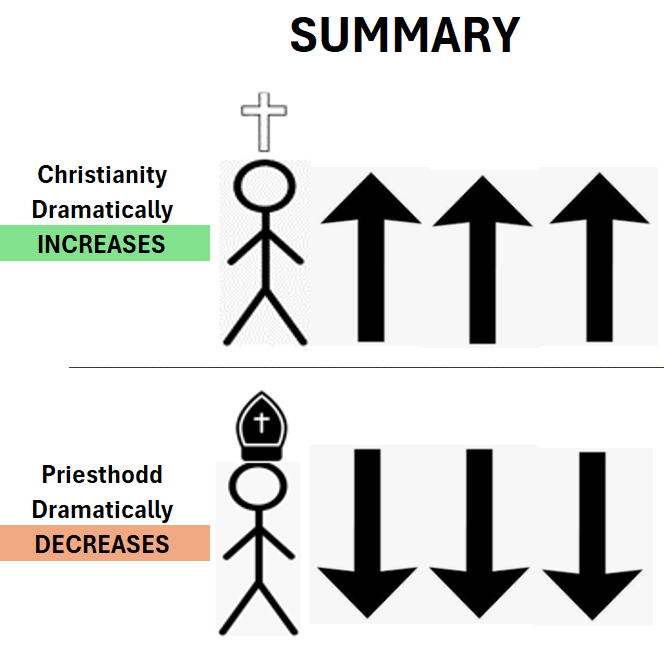
I hope you can see how inconsistent this sounds.
In the middle of page 8, it talks about the Great Apostasy. It doesn’t come right out and say that the Church that Christ built was destroyed. It just says that the priesthood was lost and errors crept into the church.
But on the LDS Church website, here is what it says:
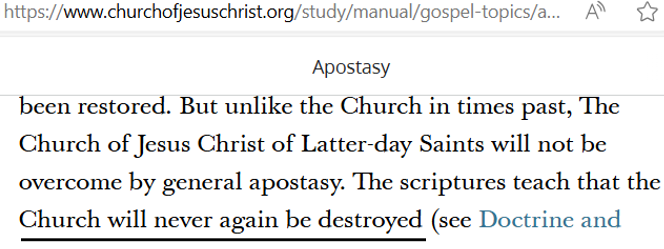
Here is a super important question you can ask them, but start by clarifying what this article is saying. Start by saying, “So if I understand this correctly, Jesus built his church…but it got destroyed. Then 1800 years later, Joseph Smith built the Church of Jesus Christ of Latter Day Saints, and it’s not going to be destroyed. Is that accurate?”
They most likely will say, “Yup, that’s exactly right.” To which you can rephrase the question by saying:
“Jesus is the God of creation, Jehovah of the Old Testament, the alpha and the Omega. You are telling me that the church that the almighty God, Jesus built was destroyed, but the church that a man built will last forever…can you guys understand why that doesn’t make a lot of sense to me?”
After saying this, they might appeal to the Bible and attempt to use some verses that support this idea of the destruction of Christ’s church which is better known as, The Great Apostasy. They are trained to go to two Bible passages. The first one being Amos 8:11-12 where God says:
“The days are coming, when I will send a famine through the land— not a famine of food or a thirst for water, but a famine of hearing the words of the Lord. People will stagger from sea to sea and wander from north to east, searching for the word of the Lord, but they will not find it.”
They will say that this is a prophecy about the Great Apostasy that was to come. But again, we need to read this verse in context and be faithful interpreters of God’s Word. If we read the opening of the chapter, verse 2 says:
“Then the Lord said to me, “The time is ripe for my people Israel; I will spare them no longer.”
This prophecy is about Israel and how God is going to judge them. The verses immediately after verse 12 give us context that God is going to judge the Israelite nation of Samaria for the idol worship. And we actually see the fulfillment of this prophecy take place in 2 Kings 17:5
“Then the king of Assyria came up throughout all the land, and went up to Samaria, and besieged it three years.”
This is a specific reference about a specific group of people for a specific sin they were committing. Contextually, it is not in any way referring to the Great Apostasy that allegedly took place after the time of Christ.
The other passage they like going to is 2 Thessalonians 2:3
“Don’t let anyone deceive you in any way, for that day will not come until the rebellion occurs”
They will try to say that the “rebellion” is talking about the great apostasy. Once again, just read the verses before and the verses after, and we can quickly come to the conclusion that this is not the case. Latter Day Saints are so focused on the word “rebellion” that many of them don’t even pay attention to the last half of this verse, which says, “and the man of lawlessness is revealed, the man doomed to destruction.”
So there is going to be a rebellion that occurs…but when will it occur? After the man of lawlessness is revealed! This man of lawlessness is also known as the anti-Christ. Since the anti-Christ has not yet been revealed, we know that this prophesied rebellion has not happened yet. Therefore, it can’t be referring to the LDS Great apostasy.
Verses to point them to:
Matthew 16:18 “And I also say to you that you are Peter, and upon this rock I will build My church; and the gates of Hades will not overpower it.”
- A common response they will give for this verse is that the “rock” is referring to revelation from prophets and apostles. The point of this verse to help them focus on is the last half where Jesus states that nothing (not even the gates of hell) will overcome and destroy His church and that the fullness of the gospel was lost.
Question to ask: “Jesus said that church that he establishes will never be destroyed, but 1,800 years later, Joseph Smith came along and taught that the church that Jesus established was destroyed. Who do you think we should trust more: Jesus or Joseph Smith?”
Jude 1:3 “Dear friends, although I was very eager to write to you about the salvation we share, I felt compelled to write and urge you to contend for the faith that was once for all entrusted to God’s holy people.”
- This verse clearly states that the faith and gospel message would only be delivered to the saints one time. If the gospel was truly delivered once and for all, then that eliminates the possibility of the gospel being delivered a second time. In other words, there will never be a restored gospel because the full gospel of Jesus will always endure.
- Many LDS would prefer the King James Version for this passage in Jude which says that “the faith which was once delivered unto the saints.” They will typically respond by saying, “My Bible doesn’t say ‘once for all.’ It only says, ‘once.’ So I think this means that Jesus delivered the gospel once, and then after the great apostacy, Joseph Smith delivered it once again.”
Which Version Is Right?
Below is a Greek Bible that has the literal English wording above each Greek word.

The Greek word is “hapax.” We can see here that the literal translation is “once for all.” The King James Bible is fantastic for its time, but modern Bibles today are easier to understand. Some of the more scholarly Latter-Day Saints might push back and say that the Greek word, “hapax” should be translated as “once.” And they aren’t wrong.
Yes, “Hapax” can mean “once.” But it can also mean, “once for all” depending on the context. Below is a screenshot of the Strong’s concordance which breaks down each usage of “Hapax” in the Bible and splits them into two groups: passages where it contextually means, “once” and passages where it contextually means, “once for all.”
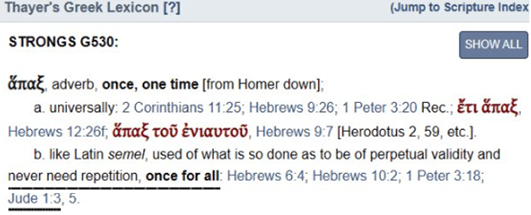
As we can see in the bottom left corner of the screenshot above, the correct usage of “Hapax” in Jude 1:3 is “once for all.”
Question #1: “According to God’s Word, how many times will the gospel be delivered to the saints?“
Question #2: “I believe that God is strong enough and wise enough to figure out a way to protect his church from ever being destroyed. Do you?”
Page 11 in the pamphlet talks about Joseph Smith and the first vision. Let me know in the comment section if any of you want me to make a video of the different and conflicting accounts of Joseph Smith’s first vision.
On page 12, it talks about how John the Baptist, Peter, James and John all appeared to Joseph Smith, they laid their hands on him and passed on the priesthood authority. A big oversight here is that in Hebrews 7:23-24 it says:
“Now there have been many of those priests, since death prevented them from continuing in office; but because Jesus lives forever, he has a permanent priesthood.”
When priests died, they lost their priesthood status. John the Baptist, Peter, James and John all died. This means that they don’t have any kind of priesthood status, yet here they are passing on the priesthood to Joseph Smith. That would be a conflict along with the fact that Jesus alone is the rightful holder of the Melchezidek priesthood because he lives forever. No one else can rightfully claim to have it. It belongs to him alone.
On page 15, it starts talking about the Book of Mormon and how we got it. It briefly states that “Joseph Smith translated this book from an ancient record written on gold plates.”
I remember having two missionaries over for dinner and I asked them, “How exactly did Joseph Smith translated the Book of Mormon?” Before answering, one of them asked me, “What do you know about it?”
I told him that I was aware of how Joseph Smith took a seer stone, put it into a hat and held the hat up to his face, and didn’t even look at the gold plates for most of the translation process. After informing him of what I knew, the missionary honestly answered and confirmed that these things were true. But if I wasn’t aware of these things, would this missionary have honestly told me the transparent truth? I have a hard time believing that he would voluntarily expose the fact that Joseph Smith used a seer stone to translate the gold plates.
Anyways, the reason why this one makes me upset is because of how it intentionally paints a picture in the mind of the naïve investigator that Smith was diligently examining and translating the gold plates. There is an article on the LDS Church website called, “Joseph Smith Translates the Gold Plates.” The first picture at the very top of this article shows Joseph Smith sitting at a desk and studying the gold plates with a scribe on the other side of the curtain. Here is the picture:

The seer stones aren’t even mentioned in this article nor are they mentioned in the pamphlet. So many Latter Day Saints today believe that the above picture is what happened, when the truth is that it never happened…yet there it is on the LDS Church website. The fact remains that if investigators were aware how Smith truly translated the gold plates, it would significantly decrease the number of converts to the LDS Church.
Here is something else that might be interesting to touch on and ask the missionaries about:
In the middle of page 15, it lists a quote from the Book of Mormon introduction page which says, “The Book of Mormon is a record of God’s dealings with the ancient inhabitants of the Americas and contains, as does the Bible, the fulness of the everlasting gospel.”
Apparently both the Book of Mormon and the Bible contain the fulness of the everlasting gospel. But in 2013, the LDS Church edited the introduction page and removed those four words, “as does the Bible.”
Question to ask: “In 2012, the Bible contained the fulness of the everlasting gospel, but in 2013, it apparently no longer contained the fullness of the gospel. Why did the LDS Church remove those 4 words from the introduction page in 2013?”
Then lastly on page 16, it tells us how we can know if these things are true. In the middle of the page, it says that “the holy ghost confirms the truth through feelings, throughs and impressions.” Then it goes on to say, “These feels from the Holy Ghost are personal revelation to you that the gospel of Jesus Christ as restored through Jospeh Smith are true.”
Where do feelings come from? Our heart…and what does God’s Word have to say about feelings from the heart?
Jeremiah 17:9 “The heart is deceitful above all things, and desperately wicked: who can know it?”
Proverbs 28:26 “He that trusts in his own heart is a fool:”
Can the Holy Spirit speak to us through feelings? Sure. But is that the primary way that we are to go about deciphering what is true from what is false? Absolutely not. Anytime we have an experience or a feeling, we need to test that against God’s Word. If it conflicts with God’s Word, we through it out no matter how strong or amazing the experience was. God’s Word specifically tells us not to trust our feelings because they can deceive us.
Thanks for reading, God bless and remember to never stop chasing after Jesus.
 JLLDS Ministries