
After Joseph Smith published the Book of Mormon in March 1830, he began the new task of retranslating the Bible just three months later in June. The Book of Mormon implies that this was a much-needed task as it says in 1 Nephi 13:26:

Then two verses later in 1 Nephi 13:28, we read:
“Wherefore, thou seest that AFTER the book hath gone forth through the hands of the great and abominable church, that there are many plain and precious things taken away from the book, which is the book of the Lamb of God.”
To clarify: the Book of the Lamb is the Bible. This verse sets up the stage very nicely for Joseph to save the day and restore to the Bible all the “plain and precious things” that were removed from it during the Great Apostasy, which the LDS Church claims to have happened after the time of Christ.
Here is the good news: we have Biblical manuscripts that were written BEFORE the great apostasy allegedly occurred! In 1947, there was the monumental discovery of the Dead Sea scrolls. They are a collection of Jewish writings that primarily consist of Old Testament fragments. Included on these scrolls are chapters from Genesis, Psalms, Deuteronomy, Leviticus, Job and many other books. The most impactful discovery was the Great Isaiah scroll. This scroll is important and unique because it contains all 66 chapters of Isaiah. Scholars have dated this scroll to have been written around 125 BC.
Prior to this discovery, the most ancient manuscript of Isaiah we had was written around 800 AD, which is referred to as the Masoretic text. If we do the math, we can conclude that the Great Isaiah scroll was written approximately 900 years earlier than the Masoretic text. Surely, the scribes would have changed, added and removed important doctrines during that gap in time. Researchers examined both the Dead Sea Scroll of Isaiah with the Masoretic text to identify every difference between the two in order to see what all had been changed over time. After comparing them, both Christian and secular scholars alike have concluded that the messages and doctrines contained in these two documents are identical. While there might be minor differences in spelling and grammar, not a single doctrine was been added or removed.
“Even though the two copies of Isaiah discovered in Qumran Cave 1 near the Dead Sea in 1947 were a thousand years earlier than the oldest dated manuscript previously known (A.D. 980), they proved to be word for word identical with our standard Hebrew Bible in more than 95 percent of the text. The five percent of variation consisted chiefly of obvious slips of the pen and variations in spelling.” -Gleason Archer (Biblical scholar, theologian, professor and author)
At the very least, both Bible Based Christians and Latter-Day Saints can agree on the fact that the Book of Isaiah in our Bibles today has been accurately preserved over time. It’s important remember the fact that the Great Isaish scroll was written BEFORE the Book of the Lamb went through the great and abominable church as the Book of Mormon claims. Keeping this in mind, there is no reason to believe that Book of Isaiah had “many plain and precious truths” removed from it before the Great Apostasy. We have every reason to confidently belief that the messages and doctrines found in the book of Isaiah are the exact same as when it was first penned.
_____________________________________________________________________________________
“Paul…what does the Book of Isaiah have to do with Joseph Smith?”
I’m glad you asked! Let’s start with some of the changes that Joseph Smith made to the Bible, starting with the book of Isaiah. A while ago, I came across a very useful study tool related to this topic. It is a JST (Joseph Smith Translation) and KJV (King James Version) Parallel Bible. It only lists Bible passages that Joseph Smith changed. On each page, there is the JST on one half of the page and the KJV on the other side. This way, you can see for yourself exactly what Joseph Smith changed, added and removed.
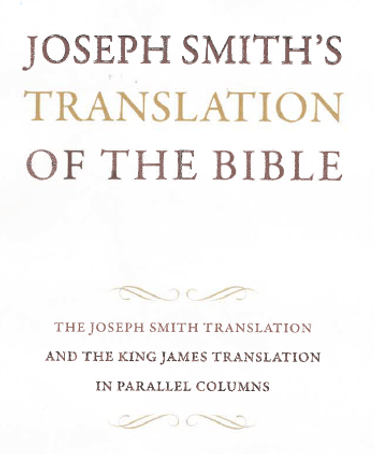

Below is the first change that we will discuss which occurs in Isaiah chapter 29, starting at verse 11. My personal handwritten notes are included in the screenshots (please excuse the sloppiness of my handwriting):
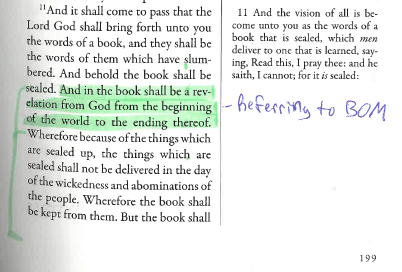
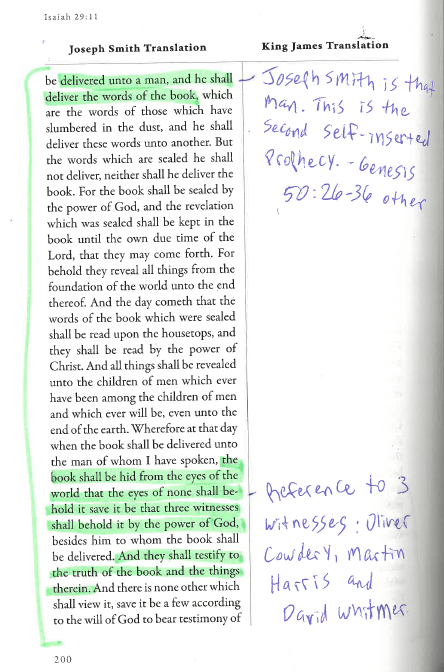

There are two primary observations we can make regarding these changes and additions:
- As previously established, the evidence shows that the messages and doctrines in the book of Isaiah have not changed over time. Why then did Joseph add these LDS doctrines into Isaiah 29? And notice that it’s not just minor changes or a few added verses here and there. He is literally adding paragraphs into this chapter. Despite the evidence that we have already established, are we really supposed to believe that Isaiah 29 really had all of these passages removed from it?
- Notice the green highlighted parts in the JST above. Do you see how they are prophecies specifically related to himself, the book of Mormon and the 3 witnesses to the book of Mormon? It would seem as if Joseph Smith is attempting to smuggle prophecies about his own religion into the Bible.
________________________________________________________________________________________________________
These aren’t the only prophecies Joseph added into the Bible. There is also a particular passage is found in Genesis 50:33. Note that every single Bible that has ever existed has 50 chapters in Genesis. Likewise, every single Bible in Genesis 50 only has 26 verses…except for one. Yes, Genesis 50 in the JST has 38 verses as Smith felt justified in adding an extra 12 verses to this chapter. What do these verses consist of and why did Joseph feel the need to add them to God’s Word?

This added verse is telling us that God is going to bring forth a seer at some point in the future. His name will be Joseph and his dad’s name will also be Joseph. He is also going bring salvation to people. We saw this same tactic in Isaiah 29, and we are seeing it again now as Joseph Smith is adding another prophecy about himself into the Bible without any justification.
There were some Bible verses that were in opposition to Smith’s theological beliefs. Instead of changing his beliefs to match up with God’s Word, he decides to change God’s Word to make it match up with his beliefs. He accomplishes this by simply adding the word “not” into 2 Samuel 12:13 & Romans 4:5:


Smith was motivated to change other passages in order to protect himself. Exodus 22:18 condemned those who practice witchcraft and sorcery to death. However, Smith was one who practiced witchcraft and sorcery. How does he solve this problem? By simply changing the word “witch” to “murderer.”
KJV: “Thou shalt not suffer a witch to live.”
JST: “Thou shalt not suffer a murderer to live.”
Genesis 14 is another important passage to cover:

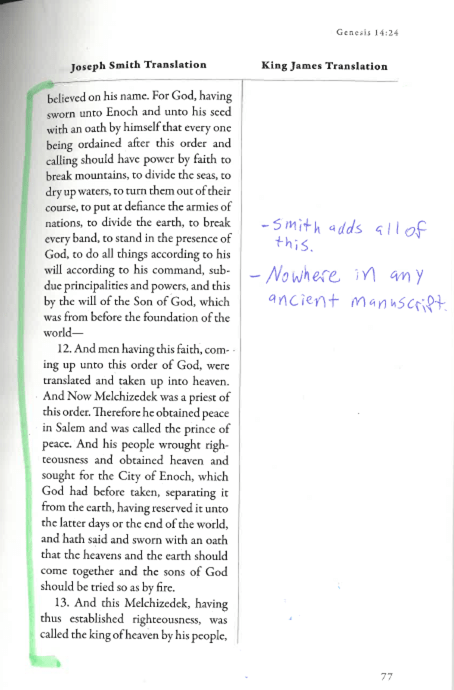
The right side of the page is blank because none of what Smith added is in the KJV nor is it in any manuscript that has ever been discovered. This is another example of Joseph Smith added paragraphs into God’s Word. We also see that the things he chooses to insert are foundational LDS doctrines such as the structure of priesthood authority being passed on through ordinances. The paragraphs that Smith inserts are specifically regarding this doctrine. He knows that these things are contextually absent from the Bible. Therefore, he feels the need to add them into the Bible. He does this same tactic with 1 Corinthians 15:40 by adding the word “telestial” into the verse:
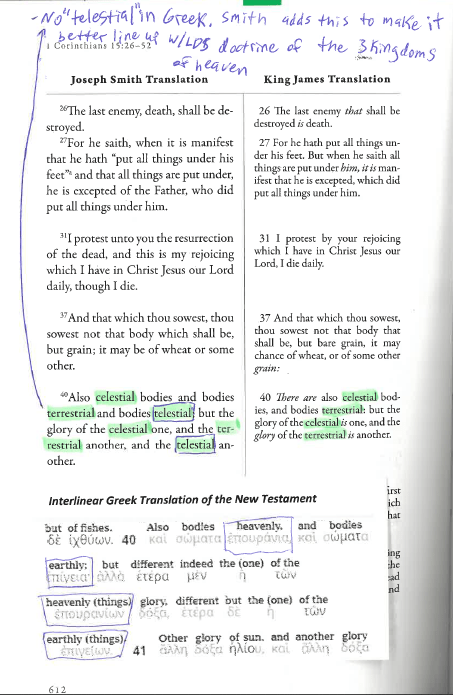
Joseph Smith wants it to be abundantly clear that this verse is talking about the 3 kingdoms of heaven as taught by the LDS Church. I’ve also included a clip from the Interlinear Greek for further clarification as to what the correct words in this passage are. There is no Greek word for “telestial.” It was never written in Paul’s letter to the Corinthians. Smith simply dictated to add this word into the verse.
This next one is intriguing. We know that there are a number of passages from the KJV that are also in the BOM. An example of this is Matthew 7:23. In the KJV, this verse reads, “I never knew you.” In the BOM in 3 Nephi 14:23, it says the same thing, “I never knew you.” Yet in the JST, Smith changed this verse and to make it say, “You never knew me.”
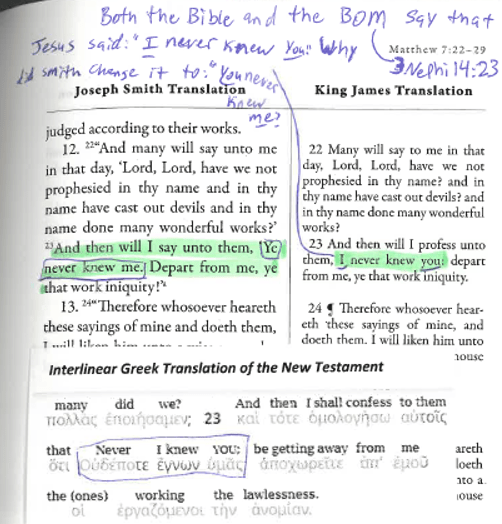
This creates the dilemma of: which one is right? Joseph Smith’s translation of the Bible or Joseph Smith’s translation of the Book of Mormon? They were both translated by the same person about Jesus giving the same message, yet they both say different things!
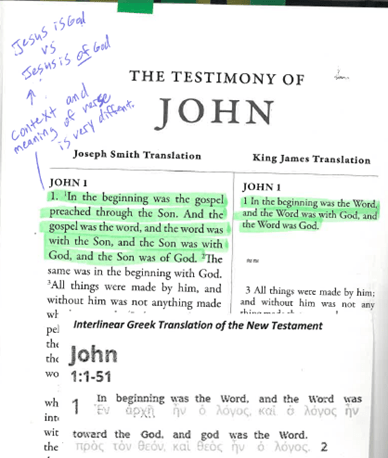
I believe that John 1:1 is also worth noting as Joseph completely changes the meaning the verse as well as the person of Jesus in his translation:
________________________________________________________________________________________________________
Examining these differences is important so that we can see for ourselves what exactly Joseph Smith changed in his translation of the Bible. It has always struck me as odd that the majority of LDS Church members carry a KJV much more often than a JST. If they truly believe that Smith divinely translated the Bible, why don’t they all use the JST? My personal opinion is that the JST is far too different than any standard Bible that has ever been written. When compared to any other Bible, the JST sticks out like a sore thumb because of how clearly intentional Joseph Smith was about inserting prophecies of the BOM, prophecies about himself, and doctrines of the LDS Church into God’s Word.
If someone is trying to insert something into God’s Word that was never there to begin with, that leaves us with the conclusion that they are actively and knowingly attempting to corrupt the very Word of God to make it match up with their personal believers. We see the Jehovah’s Witnesses do this exact same thing with their New World Translation. At the end of the day, we must honestly ask ourselves the question:
Would a true prophet of God intentionally corrupt His Word?
Thank you for reading and God bless!
 JLLDS Ministries